There's not much to report, but I thought I'd write a post anyway since it's been a few days. The title is, I suppose, pretty self-explanatory - I turn 23 today! It's my brother's birthday, too, which is why I chose that particular quote. (We're not twins, although it feels like it on our birthday!) Happy birthday, TJ! I wish you were here!
This is my second birthday spent in Moscow, and hopefully this evening's "Babylonian" restaurant (supposedly a fusion of Turkish, Israeli, Syrian, Lebanese, and Iraqi food) will be as tasty as last year's Indian restaurant was! Currently I'm delighting in the wireless internet at Moscow's version of Starbucks, Kofe Haus. A girl could get used to this, but I probably shouldn't, because who knows what there'll be in Taganrog. (Not Kofe Haus, I think.)
My history of having strange things happen at Novodevichy Convent (you know, the nun story) continued yesterday - Amara and I tried to go to the cemetery there, where many famous Russians are buried, but it had closed half an hour before we got there. However, the guards were willing to let us in if we bribed them 50 rubles. (Surprisingly, that's the first time I've been asked for a bribe in Russia.) We didn't, although we half-regretted it afterward. They were flirting with us enough that we think maybe if we had tried acting cute for a few more minutes they would have caved. Oh well.
And tomorrow, off to Rostov Velikii, a not-so-velikii (velikii means 'great,' and Rostov is quite small) city to the north of Moscow! Just a few days of rest and relaxation there (because we've been doing sooo much work in Moscow *cough*), then on to Taganrog next Wednesday on the train "Tikhii Don" ("The Quiet Don," translated to English as "And Quiet Flows the Don") with a stop in Ryazan' on Tuesday. I'm so excited to see my new home!!
23 August 2007

18 August 2007
The Eagle has landed!
Things of note that have happened since my arrival in Moscow:
-An accidental (sort of) two-hour nap in the middle of the afternoon. Jet lag - HO!
-A small plastic bag floating and twirling on the air currents in our Metro car, causing the middle-aged woman sitting across from me to giggle and try to stomp on it.
Things of note that have not happened since my arrival in Moscow:
-Food. I could eat a horse.
It's weird to be back. I feel completely comfortable being in Russia, but at the same time, I still feel separation anxiety about a lot of things I left behind in the U.S. (i.e. my extremely comfortable American life). That'll go away soon, though. Just get some blini with tvorog in me and I'll be a-ok with Russia again.
On top of that, being back in Moscow brings back so many memories of last August's orientation here. I can remember exactly how I felt about myself and Russia and myself in Russia - "abject terror" seems the best way to describe it - and it's so completely unlike the way I feel now. So I'm doing exactly the same thing I did last year, but starting from (and going to) a different place, and it's all very cognitive dissonance-y. I'm not sure that's the right application of that term, not to mention its grammatical sketchiness, but it seems apt.
-An accidental (sort of) two-hour nap in the middle of the afternoon. Jet lag - HO!
-A small plastic bag floating and twirling on the air currents in our Metro car, causing the middle-aged woman sitting across from me to giggle and try to stomp on it.
Things of note that have not happened since my arrival in Moscow:
-Food. I could eat a horse.
It's weird to be back. I feel completely comfortable being in Russia, but at the same time, I still feel separation anxiety about a lot of things I left behind in the U.S. (i.e. my extremely comfortable American life). That'll go away soon, though. Just get some blini with tvorog in me and I'll be a-ok with Russia again.
On top of that, being back in Moscow brings back so many memories of last August's orientation here. I can remember exactly how I felt about myself and Russia and myself in Russia - "abject terror" seems the best way to describe it - and it's so completely unlike the way I feel now. So I'm doing exactly the same thing I did last year, but starting from (and going to) a different place, and it's all very cognitive dissonance-y. I'm not sure that's the right application of that term, not to mention its grammatical sketchiness, but it seems apt.
16 August 2007
Chapter 2, Verse 1
Hello, dear reader! Welcome to the second chapter of my life in Russia. I tried my best to make this look convincingly like a second chapter of the blog (by changing the color scheme and the title), but Blogger was not very accommodating of my desire to separate the chapters by archiving all the old Vladivostok posts and retaining the old formatting for them. Oh well; that's what I get for not being computer savvy.
Right, so I'm going to go finish packing (uuuuuugh). I'll try to post from Russia soon!
Right, so I'm going to go finish packing (uuuuuugh). I'll try to post from Russia soon!
All in the fullness of time...
With Lisa's publicly heckling me (as well she should) coming on the heels of my recent discovery that you can post pictures right in Blogger (I feel so dumb for not realizing that before), I decided I would post some Ulan Ude pictures like I promised.
I wanted to write a "let's wittily, concisely and insightfully wrap up this past year and what it meant to me" post. But since concise is definitely not my style and my wit is hit-or-miss, plus insight requires actual work, I could see how well that was going to work after about the first sentence. So here's a weak effort: I am not the same person I was a year ago, and that is because I went to Russia. I'm not going the same place I thought I was going, either short term or long term, and I don't look at the world the same way I used to. Also, I learned to eat fish. All of this is good.
Right, so here are some pictures!
This is the head of Lenin that is so famous in Ulan Ude.
And now I remember why I stopped writing the last time I started. Because all of these pictures are on Facebook already. But, not all of my readers are Facebook users, so I'll post at least a few more.
 This is a Buryat orchestra! I never did figure out what the story is with the violins being held like cellos. This was on Russia Day, June 11. The best part about Russia Day was when the folk performances were replaced by rappers. Their rap consisted of saying, "Добро пожаловать в Улан Удэ! Добро пожаловать в Улан Удэ!" (Welcome to Ulan Ude! Welcome to Ulan Ude!) over and over with a synthetic drumbeat in the background. They also had a pretty decent female backup dancer. In short, awesome.
 One more picture (because I'm tired) - Ulan Ude's triumphal arch, looking down the lovely ulitsa Lenina (Lenin street), which becomes a pedestrian street as it approaches the river.
Ok, just two more things - first, I leave for Taganrog (well, Moscow) on Friday. I can't believe how soon that is! And second, I entered some of my datsan pictures as a photo collection in the county fair photography contest, and it won Best in Show! Those Buddhist monasteries sure are photogenic, eh?
I wanted to write a "let's wittily, concisely and insightfully wrap up this past year and what it meant to me" post. But since concise is definitely not my style and my wit is hit-or-miss, plus insight requires actual work, I could see how well that was going to work after about the first sentence. So here's a weak effort: I am not the same person I was a year ago, and that is because I went to Russia. I'm not going the same place I thought I was going, either short term or long term, and I don't look at the world the same way I used to. Also, I learned to eat fish. All of this is good.
Right, so here are some pictures!
This is the head of Lenin that is so famous in Ulan Ude.

And now I remember why I stopped writing the last time I started. Because all of these pictures are on Facebook already. But, not all of my readers are Facebook users, so I'll post at least a few more.
 This is a Buryat orchestra! I never did figure out what the story is with the violins being held like cellos. This was on Russia Day, June 11. The best part about Russia Day was when the folk performances were replaced by rappers. Their rap consisted of saying, "Добро пожаловать в Улан Удэ! Добро пожаловать в Улан Удэ!" (Welcome to Ulan Ude! Welcome to Ulan Ude!) over and over with a synthetic drumbeat in the background. They also had a pretty decent female backup dancer. In short, awesome.
 One more picture (because I'm tired) - Ulan Ude's triumphal arch, looking down the lovely ulitsa Lenina (Lenin street), which becomes a pedestrian street as it approaches the river.
Ok, just two more things - first, I leave for Taganrog (well, Moscow) on Friday. I can't believe how soon that is! And second, I entered some of my datsan pictures as a photo collection in the county fair photography contest, and it won Best in Show! Those Buddhist monasteries sure are photogenic, eh?
05 August 2007
A thousand pardons...
Oh no! I just realized how delinquent I've been about finishing up my posts from Vladivostok/Ulan Ude/Irkutsk. I've been home for four weeks already, and I'm leaving again in less than two weeks! I'll do my best to wrap it all up as soon as I can. Please check back for new posts and heckle me if I don't put them up!
I've decided to continue my blog for the next year, and to keep the same web address - partly because it feels like a waste to abandon this address and get a new one (cyber-litter?), and partly because it will be easier that way for anyone who's bookmarked the page. (I am not willing to part with a single reader, can you tell?)
So for the sake of organization, I've decided I'll just divide the blog into sections by year. Hopefully I can figure out a way to archive all the Vladivostok posts and get them off the main page when I start the Taganrog section. Anyway, I guess the way it will go is that I will wrap up The Eastern Bell, Part I: Восточный колокол and begin The Eastern Bell, Part II: Азовская русалка. (Yes, that means the title of year one will translate as "The Eastern Bell, Part I: The Eastern Bell," but I'm trying not to let that bother my perfectionist side.) Азовская русалка/Azovskaya Rusalka, by the way, means "The Azov Mermaid." It's the best name I've come up with so far along the bent of "geographic adjective + fanciful noun," but feel free to tell me if you think it's a lame name. I also thought of "The Azov Birch," but that seems just a little too stereotypical, plus it makes it sound like a birch tree that's growing out of the ocean.
Also coming soon: links to friends' journals! My good friends Nana and Justin are in Korea now, and I'm super-excited about their blog. I join them in wishing wholeheartedly that it will be "as interesting as [mine], but with fewer car accidents."
I've decided to continue my blog for the next year, and to keep the same web address - partly because it feels like a waste to abandon this address and get a new one (cyber-litter?), and partly because it will be easier that way for anyone who's bookmarked the page. (I am not willing to part with a single reader, can you tell?)
So for the sake of organization, I've decided I'll just divide the blog into sections by year. Hopefully I can figure out a way to archive all the Vladivostok posts and get them off the main page when I start the Taganrog section. Anyway, I guess the way it will go is that I will wrap up The Eastern Bell, Part I: Восточный колокол and begin The Eastern Bell, Part II: Азовская русалка. (Yes, that means the title of year one will translate as "The Eastern Bell, Part I: The Eastern Bell," but I'm trying not to let that bother my perfectionist side.) Азовская русалка/Azovskaya Rusalka, by the way, means "The Azov Mermaid." It's the best name I've come up with so far along the bent of "geographic adjective + fanciful noun," but feel free to tell me if you think it's a lame name. I also thought of "The Azov Birch," but that seems just a little too stereotypical, plus it makes it sound like a birch tree that's growing out of the ocean.
Also coming soon: links to friends' journals! My good friends Nana and Justin are in Korea now, and I'm super-excited about their blog. I join them in wishing wholeheartedly that it will be "as interesting as [mine], but with fewer car accidents."
06 July 2007
The Datsan
A datsan (dot-SAHN) is a Buddhist monastery. Since Buddhism has long been the religion of the Buryat people (although it wasn't their first religion – see Ulan Ude post below), Ulan Ude boasts the largest datsan in Russia. Besides being a religious center, it's a rather popular tourist attraction (like many Orthodox monasteries), and our beloved host Larissa Petrovna made sure to arrange a trip there for us, which I greatly enjoyed. A photo diary:
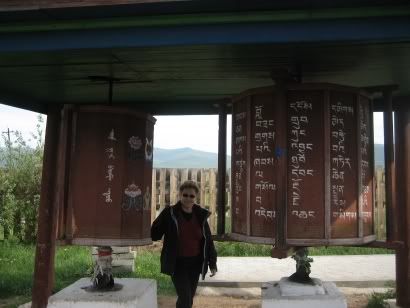
Judy, my co-worker, spinning the prayer wheel. Prayer wheels are used for (what else?) meditative prayer, and it is said that one spin of the wheel relieves you of one sin. I spun many of the wheels at the monastery – small ones lined up in a row, big ones that were so heavy they had iron handles attached for ease of spinning, drab ones and colorful ones. Hopefully I took care of a lot of sins that way. It's common to find kopeck coins left by the prayer wheels as offerings to the gods.
In fact, there were kopecks almost everywhere at the monastery, especially inside the shrines. There were other gifts left, too – most commonly bags of rice and open boxes of milk, and most amusingly a bottle of dish soap (I guess the gods have dirty dishes too).
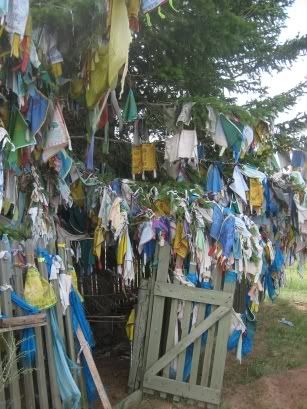
Lots and lots of the trees at the monastery had these prayer cloths tied to them. There are different colored cloths for different prayers (health, happiness, etc.). The trees outside the huts of the monks who were renowned healers had the most cloths on them.
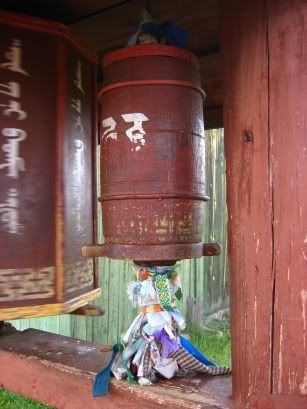
A close-up of a prayer wheel, with prayer cloths tied to it.
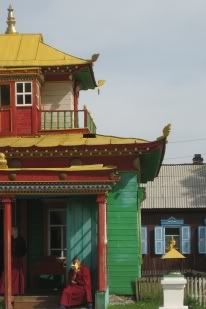
Ok, I'm ready to admit that I have a little monk/nun obsession. I blame it on that nun who yelled at me last August in Novodevichy convent. Anyway, here is a Buddhist monk doing his morning reading.
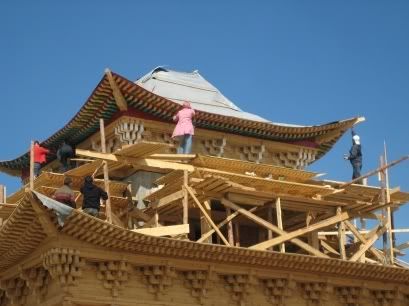
Like most religion in Russia, Buddhism is still in the comeback phase after the Fall – gaining support and money, expanding and rebuilding what was lost. Nowhere was this more evident than at the datsan, where several new buildings were going up, including structures for the new Buddhist university (yes, really). Judy (the co-worker in the first picture), who comes from a family in the construction business and has a civil engineer for a daughter, looked up at these roof painters and said, "I think OSHA would have something to say about that!"
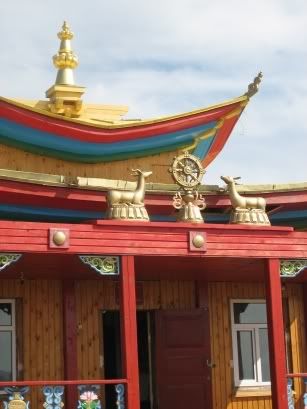
One of the many shrines on the territory of the datsan. I am a fan of Buddhist shrines because unlike Orthodox churches, I don't have to cover my hair to go in. In one of the shrines, you could pay a donation to have your name or the names of your friends read by the monks in prayer. "Everything for a price!" as Grisha, our driver/guide, said. But it seems to me that Christians do practically the same thing.
There are apparently deer on top of this shrine because the deer came flocking to Buddha after he was enlightened. There were also two holy deer in a cage outside the shrine.
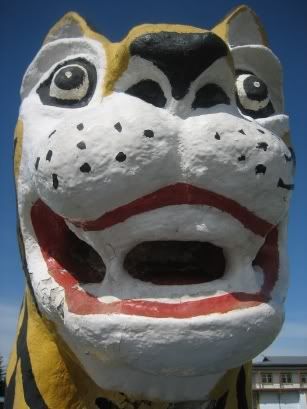
Grr, I'm a tiger! I thought this thing (whatever it is) was very cute.
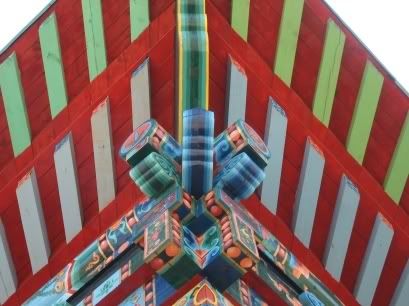
Close-up of the beautiful colors used in Buddhist religious art. Notice especially the frequent use of many different shades of one color close together.
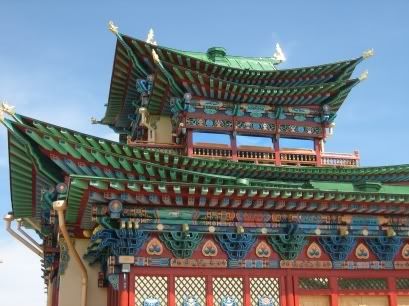
The most impressive shrine. This is where a Buddhist monk who was buried alive in the 1920's is housed. He was buried alive because he felt he had achieved nirvana and was ready to be done living, and he left instructions that he should be dug up again after a certain period of time. They did so, and found that he's still alive. Or at least that's what the Russians told us, though different people had different conceptions of what "still alive" means, from "still warm" to "not completely decayed." You can only see him on special occasions, and I didn't meet anyone who had actually seen him. Needless to say, I'm a mite skeptical.
So! That's the datsan. I highly recommend visiting it if you go to Ulan Ude. More pictures (the city itself, Baikal, maybe Irkutsk) to come later! And don't miss the post below this one, which is also new!
Judy, my co-worker, spinning the prayer wheel. Prayer wheels are used for (what else?) meditative prayer, and it is said that one spin of the wheel relieves you of one sin. I spun many of the wheels at the monastery – small ones lined up in a row, big ones that were so heavy they had iron handles attached for ease of spinning, drab ones and colorful ones. Hopefully I took care of a lot of sins that way. It's common to find kopeck coins left by the prayer wheels as offerings to the gods.
In fact, there were kopecks almost everywhere at the monastery, especially inside the shrines. There were other gifts left, too – most commonly bags of rice and open boxes of milk, and most amusingly a bottle of dish soap (I guess the gods have dirty dishes too).
Lots and lots of the trees at the monastery had these prayer cloths tied to them. There are different colored cloths for different prayers (health, happiness, etc.). The trees outside the huts of the monks who were renowned healers had the most cloths on them.
A close-up of a prayer wheel, with prayer cloths tied to it.
Ok, I'm ready to admit that I have a little monk/nun obsession. I blame it on that nun who yelled at me last August in Novodevichy convent. Anyway, here is a Buddhist monk doing his morning reading.
Like most religion in Russia, Buddhism is still in the comeback phase after the Fall – gaining support and money, expanding and rebuilding what was lost. Nowhere was this more evident than at the datsan, where several new buildings were going up, including structures for the new Buddhist university (yes, really). Judy (the co-worker in the first picture), who comes from a family in the construction business and has a civil engineer for a daughter, looked up at these roof painters and said, "I think OSHA would have something to say about that!"
One of the many shrines on the territory of the datsan. I am a fan of Buddhist shrines because unlike Orthodox churches, I don't have to cover my hair to go in. In one of the shrines, you could pay a donation to have your name or the names of your friends read by the monks in prayer. "Everything for a price!" as Grisha, our driver/guide, said. But it seems to me that Christians do practically the same thing.
There are apparently deer on top of this shrine because the deer came flocking to Buddha after he was enlightened. There were also two holy deer in a cage outside the shrine.
Grr, I'm a tiger! I thought this thing (whatever it is) was very cute.
Close-up of the beautiful colors used in Buddhist religious art. Notice especially the frequent use of many different shades of one color close together.
The most impressive shrine. This is where a Buddhist monk who was buried alive in the 1920's is housed. He was buried alive because he felt he had achieved nirvana and was ready to be done living, and he left instructions that he should be dug up again after a certain period of time. They did so, and found that he's still alive. Or at least that's what the Russians told us, though different people had different conceptions of what "still alive" means, from "still warm" to "not completely decayed." You can only see him on special occasions, and I didn't meet anyone who had actually seen him. Needless to say, I'm a mite skeptical.
So! That's the datsan. I highly recommend visiting it if you go to Ulan Ude. More pictures (the city itself, Baikal, maybe Irkutsk) to come later! And don't miss the post below this one, which is also new!
Bayarte, Ulaan Ude!
Remember how I promised to write a post before leaving Ulan Ude? Well, that didn't work out... I wrote the post, but on our last day in town, I couldn't get Blogger (the site my blog runs on) to load on the dinosaur computers in the language department. Then I really disappeared from Internet-land for a few days as I took a 3-day trip to Irkutsk and then made my long and winding way home. So here, a week late, is the promised Ulan Ude post:
Bayarte, Ulaan Ude!
Although that's probably not spelled right, it means "Goodbye, Ulan Ude!" in Buryat. Yes, I am leaving this lovely city tonight on a night train to Irkutsk, and since I promised I'd deliver an entry before I left, I got up extra early this morning (after one of those conversations that goes until 3:30 a.m. – ugh, seems like a good idea when it's 3:30 a.m., but not so much when it's 8:30 and your alarm goes off) to write one.
Well, what to say? I realize I haven't actually told you much at all about what's going on or why I'm here. So I have a lot to say, which I will cop out on and offer in list form. So, I present to you a few fascinating tidbits about Ulan Ude (Ulaan Ude in Buryat):
1. The name means "Red River." I once speculated that Ulaan might mean "city" in Mongolian languages, since there's also Ulaan Baator, the capital of Mongolia. But no. Turns out Ulaan Baator means "Red Warrior," and Ulan Ude was called Verkhneudinsk (Upper Udinsk) until the Soviets both Communistized and Buryatified the name (don't know if Ulaan Baator is also of Communist origin... seems likely). Ulan Ude is situated at the confluence of the rivers Uda and Selenga, which merge to become one of the 300+ rivers that flow into Lake Baikal. By the way, only one river, the Angara, flows out. She is said to be the daughter of father Baikal (they really call it that, Batyushka Baikal), who ran away from him to the arms of her forbidden lover, the river Yenisei in the north.
2. On the topic of rivers, Ulan Ude is on the southern bank of the Selenga, and once you leave the city, there's no bridge to cross the river to the north bank and venture up into Baikal-land. They've been building one for the last fifteen years or so (my brother mentioned something in an email about the mark of Soviet power in Iraq – numerous unfinished structures – and I have to say yes, it's true. Finishing what they started was not apparently a part of the Soviet plan). We had to cross the river by ferry when we went to Lake Baikal. (Caulking the wagons and floating was not an option.) Larisa Petrovna, our host, mentioned that the village that owns the ferry will be in big trouble when they finish building the bridge, because half of them will find themselves out of work. I suggested that the government has already found a solution: keep the bridge perpetually half-finished, and both the bridge-builders and the ferry workers win!
3. The population is about half Buryat. What's a Buryat, you ask? The Buryats are a Mongol people that have been living in the area around Baikal and northeast of the Gobi for... well, I'm not sure, but a really long time. They cooperated fairly early and peaceably with the Russians, who arrived out here in the 1600's, because the amount of fur tax the Russians demanded for the privilege of the Tsar's protection was less than the Chinese (or Genghis Khan? I forget) were demanding for the Emperor's protection. So they missed out on the mass slaughters that nearly wiped out the Sakha (formerly known as Yakut) to the east and the Chukot (maybe not spelled right) north of Kamchatka. They're traditionally a tribal, nomadic people who live in felt yurts (a round, packable-but-sturdy tent-like structure) and wander the steppe following their cattle and camel herds. They were originally shamanists, but Buddhism came from Mongolia via Tibet at some long-ago time, and now there's a sort of mix of the two religions – predominantly Buddhist, with some shamanist aspects. (Although of course the Soviets did their best to stamp out both religions.) I've seen several offices here that claim to offer "Ritual Services," which I can only assume refers to shamanism. Near the city is the largest datsan (Buddhist monastery) in Russia, of which I have some awesome pictures that I'll show you when I get home.
Anyway, since Ulan Ude is the capital of the republic of Buryatia, it might not seem surprising that the capital is half Buryat. (Brief explanation: Russia is made up of regions, districts, and several "autonomous republics," none of which seem to differ much from one another except that the leaders of the autonomous republics are called presidents instead of governors. They answer to Putin all the same (and are now all appointed by Putin – three cheers for democracy!), so it's mostly just a difference of nomenclature.) But with the exception of Tuva, to the west of Baikal, none of Russia's ostensibly ethnic autonomous republics can claim a majority ethnic population. In Buryatia, I hear the split is about 80-20 in favor of the Russians, but many more Russians than Buryats live in the villages, so the capital is full of Buryat faces. Some of them have lovely Buryat names (Altana, Darima, Arsalan, Zhargal, Oyuna, Radna); fewer of them still actually speak Buryat. For me, it's a nice change to see all these non-Russian faces and feel little to no ethnic tension – it's pretty much the opposite of the situation in Vladivostok, where there's actually more tension than non-white faces (if tension and faces could somehow be measured in the same units). However, the Russian delight in ethnic stereotyping persists, in that I've had both Russians and Buryats here tell me that the Buryats are a very lazy people because of their nomadic lifestyle; Larisa Petrovna (not Buryat) explained to us that if our students stared at us silently and without emotion, we should write it off as a peculiarity of Buryat character; and last night one of the students (Chinese-Russian) mentioned that he wouldn't want the president of Buryatia to be Buryat, because they are dishonest.
4. So what's the city like? Small, cozy, with wide streets and lots of trees. (Unfortunately, it seems that 90% of the trees are cottonwoods, which were perpetually releasing their fluff onto us for the first two weeks of our stay.) It's situated on some hills, but they aren't nearly as steep as the ones in Vladivostok. The famous head of Lenin (called something like "the noggin" in local parlance) that dominates the central square is indeed huge and comical. Just like in Vladivostok, they have a gaudy (though less gaudy) triumphal arch to celebrate Tsarevich Nikolai's visit in the 1890's, torn down in the '30's and rebuilt in the last few years. Unlike Vladivostok, they have a lot of old wooden buildings, plus a great many more of the same two or three-story 19th-century structures I liked so much there. There are no tall buildings to speak of, because the region is prone to earthquakes, and there's a lovely pedestrian street (kind of a fixture of Russian cities) where the young'uns hang out in the evening. There's a surprisingly professional-looking historical museum, which we went to yesterday to see old Buddhist stuff and Old Believer costumes, and in addition to the Buddhist temple, there's an open-air ethnographic museum not far from the city, which is full of authentic old buildings (mostly from the 18th and 19th century) that were relocated there in the '70's. There are also pozy – Buryat steamed meat dumplings – EVERYWHERE. More than a national cuisine, I'd call it a national obsession. They even have cafés called "poznayas" – "pozy joint," I suppose, in English. The first question people ask me is often, "Have you tried pozy yet?!" (Yes, three times.) Very cute.
So all in all, it's a lovely city. I can already feel that it's somehow more civilized, by which I guess I mean more Western (as opposed to Soviet, not as opposed to Eastern) than Vladivostok. Which is funny, because while I was there I tried hard not to buy into all the "edge of the world" talk about the Russian Far East. But it seems that it is actually less developed than the rest of Russia. Hmm.
5. This will be the last thing because I need to get dressed and go to camp, but considering the length of this entry, maybe you're satisfied anyway: last weekend ranks among the best days of my life. I went walking alone in the forest, enjoyed a banya experience that involved jumping into a lake during a gale to cool off, went on a mountain hike that was too steep and had no trail and got lost in the forest on the way down and returned for lunch an hour late, and stayed out until 1 a.m. standing on the dock and looking at the stars. All in all, good Siberian fun. I decided then that if my life somehow goes badly in the U.S. (when I eventually move back to the U.S., that is), I will pack up and move to Buryatia.
Bayarte, Ulaan Ude!
Although that's probably not spelled right, it means "Goodbye, Ulan Ude!" in Buryat. Yes, I am leaving this lovely city tonight on a night train to Irkutsk, and since I promised I'd deliver an entry before I left, I got up extra early this morning (after one of those conversations that goes until 3:30 a.m. – ugh, seems like a good idea when it's 3:30 a.m., but not so much when it's 8:30 and your alarm goes off) to write one.
Well, what to say? I realize I haven't actually told you much at all about what's going on or why I'm here. So I have a lot to say, which I will cop out on and offer in list form. So, I present to you a few fascinating tidbits about Ulan Ude (Ulaan Ude in Buryat):
1. The name means "Red River." I once speculated that Ulaan might mean "city" in Mongolian languages, since there's also Ulaan Baator, the capital of Mongolia. But no. Turns out Ulaan Baator means "Red Warrior," and Ulan Ude was called Verkhneudinsk (Upper Udinsk) until the Soviets both Communistized and Buryatified the name (don't know if Ulaan Baator is also of Communist origin... seems likely). Ulan Ude is situated at the confluence of the rivers Uda and Selenga, which merge to become one of the 300+ rivers that flow into Lake Baikal. By the way, only one river, the Angara, flows out. She is said to be the daughter of father Baikal (they really call it that, Batyushka Baikal), who ran away from him to the arms of her forbidden lover, the river Yenisei in the north.
2. On the topic of rivers, Ulan Ude is on the southern bank of the Selenga, and once you leave the city, there's no bridge to cross the river to the north bank and venture up into Baikal-land. They've been building one for the last fifteen years or so (my brother mentioned something in an email about the mark of Soviet power in Iraq – numerous unfinished structures – and I have to say yes, it's true. Finishing what they started was not apparently a part of the Soviet plan). We had to cross the river by ferry when we went to Lake Baikal. (Caulking the wagons and floating was not an option.) Larisa Petrovna, our host, mentioned that the village that owns the ferry will be in big trouble when they finish building the bridge, because half of them will find themselves out of work. I suggested that the government has already found a solution: keep the bridge perpetually half-finished, and both the bridge-builders and the ferry workers win!
3. The population is about half Buryat. What's a Buryat, you ask? The Buryats are a Mongol people that have been living in the area around Baikal and northeast of the Gobi for... well, I'm not sure, but a really long time. They cooperated fairly early and peaceably with the Russians, who arrived out here in the 1600's, because the amount of fur tax the Russians demanded for the privilege of the Tsar's protection was less than the Chinese (or Genghis Khan? I forget) were demanding for the Emperor's protection. So they missed out on the mass slaughters that nearly wiped out the Sakha (formerly known as Yakut) to the east and the Chukot (maybe not spelled right) north of Kamchatka. They're traditionally a tribal, nomadic people who live in felt yurts (a round, packable-but-sturdy tent-like structure) and wander the steppe following their cattle and camel herds. They were originally shamanists, but Buddhism came from Mongolia via Tibet at some long-ago time, and now there's a sort of mix of the two religions – predominantly Buddhist, with some shamanist aspects. (Although of course the Soviets did their best to stamp out both religions.) I've seen several offices here that claim to offer "Ritual Services," which I can only assume refers to shamanism. Near the city is the largest datsan (Buddhist monastery) in Russia, of which I have some awesome pictures that I'll show you when I get home.
Anyway, since Ulan Ude is the capital of the republic of Buryatia, it might not seem surprising that the capital is half Buryat. (Brief explanation: Russia is made up of regions, districts, and several "autonomous republics," none of which seem to differ much from one another except that the leaders of the autonomous republics are called presidents instead of governors. They answer to Putin all the same (and are now all appointed by Putin – three cheers for democracy!), so it's mostly just a difference of nomenclature.) But with the exception of Tuva, to the west of Baikal, none of Russia's ostensibly ethnic autonomous republics can claim a majority ethnic population. In Buryatia, I hear the split is about 80-20 in favor of the Russians, but many more Russians than Buryats live in the villages, so the capital is full of Buryat faces. Some of them have lovely Buryat names (Altana, Darima, Arsalan, Zhargal, Oyuna, Radna); fewer of them still actually speak Buryat. For me, it's a nice change to see all these non-Russian faces and feel little to no ethnic tension – it's pretty much the opposite of the situation in Vladivostok, where there's actually more tension than non-white faces (if tension and faces could somehow be measured in the same units). However, the Russian delight in ethnic stereotyping persists, in that I've had both Russians and Buryats here tell me that the Buryats are a very lazy people because of their nomadic lifestyle; Larisa Petrovna (not Buryat) explained to us that if our students stared at us silently and without emotion, we should write it off as a peculiarity of Buryat character; and last night one of the students (Chinese-Russian) mentioned that he wouldn't want the president of Buryatia to be Buryat, because they are dishonest.
4. So what's the city like? Small, cozy, with wide streets and lots of trees. (Unfortunately, it seems that 90% of the trees are cottonwoods, which were perpetually releasing their fluff onto us for the first two weeks of our stay.) It's situated on some hills, but they aren't nearly as steep as the ones in Vladivostok. The famous head of Lenin (called something like "the noggin" in local parlance) that dominates the central square is indeed huge and comical. Just like in Vladivostok, they have a gaudy (though less gaudy) triumphal arch to celebrate Tsarevich Nikolai's visit in the 1890's, torn down in the '30's and rebuilt in the last few years. Unlike Vladivostok, they have a lot of old wooden buildings, plus a great many more of the same two or three-story 19th-century structures I liked so much there. There are no tall buildings to speak of, because the region is prone to earthquakes, and there's a lovely pedestrian street (kind of a fixture of Russian cities) where the young'uns hang out in the evening. There's a surprisingly professional-looking historical museum, which we went to yesterday to see old Buddhist stuff and Old Believer costumes, and in addition to the Buddhist temple, there's an open-air ethnographic museum not far from the city, which is full of authentic old buildings (mostly from the 18th and 19th century) that were relocated there in the '70's. There are also pozy – Buryat steamed meat dumplings – EVERYWHERE. More than a national cuisine, I'd call it a national obsession. They even have cafés called "poznayas" – "pozy joint," I suppose, in English. The first question people ask me is often, "Have you tried pozy yet?!" (Yes, three times.) Very cute.
So all in all, it's a lovely city. I can already feel that it's somehow more civilized, by which I guess I mean more Western (as opposed to Soviet, not as opposed to Eastern) than Vladivostok. Which is funny, because while I was there I tried hard not to buy into all the "edge of the world" talk about the Russian Far East. But it seems that it is actually less developed than the rest of Russia. Hmm.
5. This will be the last thing because I need to get dressed and go to camp, but considering the length of this entry, maybe you're satisfied anyway: last weekend ranks among the best days of my life. I went walking alone in the forest, enjoyed a banya experience that involved jumping into a lake during a gale to cool off, went on a mountain hike that was too steep and had no trail and got lost in the forest on the way down and returned for lunch an hour late, and stayed out until 1 a.m. standing on the dock and looking at the stars. All in all, good Siberian fun. I decided then that if my life somehow goes badly in the U.S. (when I eventually move back to the U.S., that is), I will pack up and move to Buryatia.
22 June 2007
A pocket full of mumbles - such are promises
Didn't I promise I would write? And post pictures?
Well... oops! I'm really busy here in Ulan Ude, and since being here only three weeks feels kind of like a vacation, I haven't been inclined to spend much of my free time working at my computer. (In fact, we went to Baikal almost a week ago and I still haven't even managed to upload my pictures from my camera!) I apologize to anyone who feels they've been left hanging (probably only my mom and dad), but I swear that I'll make the effort to update at least once before I leave (in a week). I can't promise pictures, because unless the internet feels like being fast, uploading to photobucket and then from there to blogger is actually a huge pain. But I'll try.
This place is really, really amazing. Baikal was awesome. Ulan Ude is awesome. Our hosts at Buryat State University are awesome. When I write my real update, I'll try to think of more descriptive adjectives than "awesome," but for now at least you can get an idea of how happy I am to be here. :)
Well... oops! I'm really busy here in Ulan Ude, and since being here only three weeks feels kind of like a vacation, I haven't been inclined to spend much of my free time working at my computer. (In fact, we went to Baikal almost a week ago and I still haven't even managed to upload my pictures from my camera!) I apologize to anyone who feels they've been left hanging (probably only my mom and dad), but I swear that I'll make the effort to update at least once before I leave (in a week). I can't promise pictures, because unless the internet feels like being fast, uploading to photobucket and then from there to blogger is actually a huge pain. But I'll try.
This place is really, really amazing. Baikal was awesome. Ulan Ude is awesome. Our hosts at Buryat State University are awesome. When I write my real update, I'll try to think of more descriptive adjectives than "awesome," but for now at least you can get an idea of how happy I am to be here. :)
12 June 2007
Trans-Siberian adventures
Hello all! By the time this is posted, I will have arrived safely in Ulan Ude, but for now I am somewhere in southeastern Siberia between Khabarovsk and Chita. It is Hour #46 of our train ride.
(Note: I am indeed in Ulan Ude now, and having just found a computer with a USB port, I am posting this and am getting excited about showing you pictures sometime in the near future!)
The first 23 hours and 23 minutes of the train ride were spent in very loud, drunk company, as the other two people in Judith's and my four-person compartment were railway workers traveling from Vladivostok to Belogorsk on a work trip. Two guys in the next compartment were doing the same, and the two women they shared the compartment with were apparently not that hospitable to drunk middle-aged men, because they (the men, not the women) spent most of the ride in our compartment. I would like to say it was enjoyable, but it really wasn't, after the first night. The first night was enjoyable because, even though six people is definitely two people too many for a compartment on a Russian train, they had brought a lot of food, vodka, and самогон/samogon (which one of them kept calling "HOME VISKEY," combining – in a very loud, drunk voice – two of the few English words he knew), which they shared with us. We were, naturally, very interesting to them, I more than Judith because her Russian is limited to basic words and phrases, and by 10 o’clock the next morning it was apparent that the only polite way to escape long, slow-moving conversations with them was to sleep. This became even truer throughout the day as they became drunker and drunker. They were nice enough guys, but about the fifth time Gena asked me where we were traveling to and informed me that he has acquaintances in Ulan Ude but they'll be no use to me because they're in prison, I gave up and rudely holed up in my corner of the compartment with my book of Chekhov stories. Which they then teased me about because the volume is called "О любви" – "On Love."
But anyway, enough about that. The burning question I’m sure you all have on your minds is “What's Siberia like?” Well, Judith says it reminds her of Idaho, which makes sense to me because to me it looks like a set from Brokeback Mountain. I had in my head the idea of "vast stretches of trackless taiga," but I found that, while they probably exist somewhere, that somewhere is not here in southern Siberia. There's a lot of forest (not all coniferous, like I thought it would be), but also a lot of plains, and rolling hills and rivers. It's very green and vastly empty, although if you look carefully you can start to see signs of life even in the empty parts – a kettle hanging from a branch, a bunch of empty water bottles piled up by the side of the tracks, a clean-cut tree stump. The roads, when there are roads, are all dirt, and we often ride for hours without seeing any villages.
The villages that we stop in are really interesting. Early in our trip, Judith mournfully intoned (she can be a little dramatic sometimes), "Without the railroad these places wouldn't survive," to which I countered that without the railroad, these places wouldn't exist. They're small, a cluster of fifty or so wooden huts and a few bigger brick or concrete buildings – inhabited mostly with railway workers, one would assume – and in each one, a line of babushki wait for us as we roll in, each manning a card table piled with the fruits of her labor – homemade pickles, boiled eggs from her hens, beet and cabbage salads, dried fish, and homemade pelmeni, vareniki (both types of Russian dumplings), pirozhki (sweet and savory pastries), and pryanniki (spice cookies). I usually can't resist buying something. By the time we roll back out after a half-hour stop, they're already folding up the tables and hauling back whatever they didn't sell. Do they do this every day? How many times? How often do trains come through? Is this their entire livelihood?
(Note: I am indeed in Ulan Ude now, and having just found a computer with a USB port, I am posting this and am getting excited about showing you pictures sometime in the near future!)
The first 23 hours and 23 minutes of the train ride were spent in very loud, drunk company, as the other two people in Judith's and my four-person compartment were railway workers traveling from Vladivostok to Belogorsk on a work trip. Two guys in the next compartment were doing the same, and the two women they shared the compartment with were apparently not that hospitable to drunk middle-aged men, because they (the men, not the women) spent most of the ride in our compartment. I would like to say it was enjoyable, but it really wasn't, after the first night. The first night was enjoyable because, even though six people is definitely two people too many for a compartment on a Russian train, they had brought a lot of food, vodka, and самогон/samogon (which one of them kept calling "HOME VISKEY," combining – in a very loud, drunk voice – two of the few English words he knew), which they shared with us. We were, naturally, very interesting to them, I more than Judith because her Russian is limited to basic words and phrases, and by 10 o’clock the next morning it was apparent that the only polite way to escape long, slow-moving conversations with them was to sleep. This became even truer throughout the day as they became drunker and drunker. They were nice enough guys, but about the fifth time Gena asked me where we were traveling to and informed me that he has acquaintances in Ulan Ude but they'll be no use to me because they're in prison, I gave up and rudely holed up in my corner of the compartment with my book of Chekhov stories. Which they then teased me about because the volume is called "О любви" – "On Love."
But anyway, enough about that. The burning question I’m sure you all have on your minds is “What's Siberia like?” Well, Judith says it reminds her of Idaho, which makes sense to me because to me it looks like a set from Brokeback Mountain. I had in my head the idea of "vast stretches of trackless taiga," but I found that, while they probably exist somewhere, that somewhere is not here in southern Siberia. There's a lot of forest (not all coniferous, like I thought it would be), but also a lot of plains, and rolling hills and rivers. It's very green and vastly empty, although if you look carefully you can start to see signs of life even in the empty parts – a kettle hanging from a branch, a bunch of empty water bottles piled up by the side of the tracks, a clean-cut tree stump. The roads, when there are roads, are all dirt, and we often ride for hours without seeing any villages.
The villages that we stop in are really interesting. Early in our trip, Judith mournfully intoned (she can be a little dramatic sometimes), "Without the railroad these places wouldn't survive," to which I countered that without the railroad, these places wouldn't exist. They're small, a cluster of fifty or so wooden huts and a few bigger brick or concrete buildings – inhabited mostly with railway workers, one would assume – and in each one, a line of babushki wait for us as we roll in, each manning a card table piled with the fruits of her labor – homemade pickles, boiled eggs from her hens, beet and cabbage salads, dried fish, and homemade pelmeni, vareniki (both types of Russian dumplings), pirozhki (sweet and savory pastries), and pryanniki (spice cookies). I usually can't resist buying something. By the time we roll back out after a half-hour stop, they're already folding up the tables and hauling back whatever they didn't sell. Do they do this every day? How many times? How often do trains come through? Is this their entire livelihood?
06 June 2007
Goodbye, but not farewell!
(I've had more than one Russian speaker of English say "Goodbye, but not farewell!" to me, apparently believing that "farewell" is more permanent than "goodbye." Any thoughts?)
So, I'm leaving Vladivostok tomorrow, and I'm probably not coming back for a very long time.
Here I run up against the fundamental problem of blogging from experience, which is that when you're having experiences that are exciting enough to blog about, you're either too busy or too tired to actually blog about them. (I'm sure I'm not the first person to notice this.) Life has been very interesting and blog-worthy lately, but I am both too tired and too swamped with departure preparations to tell you about it in detail.
In not-detail, I've spent the last week having many little parties with different groups of people, including the best weekend ever – I went to three different dachas, slept at two of them, ate enough grilled meat and smoked fish to completely negate my three months of pseudo-vegetarian asceticism, drank enough vodka to... well, never mind, and best of all, went to the banya! (A dacha is a Russian summer cottage. A banya is a Russian sauna; they beat you with birch branches. It is really something wonderful.) Yesterday was the official dean's office party, at which I was presented with (among many other things – apparently the Institute of Foreign Languages was concerned that my suitcases might make it under the 35 kg limit) a framed Letter of Gratitude (capitalized because of course a Letter of Gratitude is an official document in Russia) from Vladimir Kurilov himself, the president of DVGU! I'm told this is a very big deal. Unfortunately, it's also a very big frame, so it's getting left here (just the frame – the letter itself is coming with me). Today is the unofficial going-away party, at which I hopefully won't be given any more presents. Although to be honest, I wouldn't say no to a Letter of Gratitude from Vladimir Putin. Especially if it were unframed.
All this partying and very little work has made me extremely sad to be leaving Vladivostok and not coming back. Many promises have been made on my part about coming to visit, which will hopefully be fulfilled next summer. Much doubt has been expressed on my colleagues' and students' parts that Taganrog could be anywhere near as awesome as Vladivostok, which will hopefully not turn out to be the case. At any rate, it's hard to leave the people and it's hard to leave the city, especially right at the beginning of summer and the four-month mark (four months since returning with the mended leg, that is) – the mythical point at which you're supposed to start feeling like you're actually living in a city and not just visiting it. I don't know how generalizable that is, but it seems true enough for me.
Well, I've written a substantial entry, I guess, although nothing like the eloquent farewell to Vladivostok I meant to write before I realized how much energy it takes to leave a place. Maybe in a few weeks I'll be able to write that, or after I get home. Anyway, start looking for updates from sunny Ulan Ude in the next week or so!
So, I'm leaving Vladivostok tomorrow, and I'm probably not coming back for a very long time.
Here I run up against the fundamental problem of blogging from experience, which is that when you're having experiences that are exciting enough to blog about, you're either too busy or too tired to actually blog about them. (I'm sure I'm not the first person to notice this.) Life has been very interesting and blog-worthy lately, but I am both too tired and too swamped with departure preparations to tell you about it in detail.
In not-detail, I've spent the last week having many little parties with different groups of people, including the best weekend ever – I went to three different dachas, slept at two of them, ate enough grilled meat and smoked fish to completely negate my three months of pseudo-vegetarian asceticism, drank enough vodka to... well, never mind, and best of all, went to the banya! (A dacha is a Russian summer cottage. A banya is a Russian sauna; they beat you with birch branches. It is really something wonderful.) Yesterday was the official dean's office party, at which I was presented with (among many other things – apparently the Institute of Foreign Languages was concerned that my suitcases might make it under the 35 kg limit) a framed Letter of Gratitude (capitalized because of course a Letter of Gratitude is an official document in Russia) from Vladimir Kurilov himself, the president of DVGU! I'm told this is a very big deal. Unfortunately, it's also a very big frame, so it's getting left here (just the frame – the letter itself is coming with me). Today is the unofficial going-away party, at which I hopefully won't be given any more presents. Although to be honest, I wouldn't say no to a Letter of Gratitude from Vladimir Putin. Especially if it were unframed.
All this partying and very little work has made me extremely sad to be leaving Vladivostok and not coming back. Many promises have been made on my part about coming to visit, which will hopefully be fulfilled next summer. Much doubt has been expressed on my colleagues' and students' parts that Taganrog could be anywhere near as awesome as Vladivostok, which will hopefully not turn out to be the case. At any rate, it's hard to leave the people and it's hard to leave the city, especially right at the beginning of summer and the four-month mark (four months since returning with the mended leg, that is) – the mythical point at which you're supposed to start feeling like you're actually living in a city and not just visiting it. I don't know how generalizable that is, but it seems true enough for me.
Well, I've written a substantial entry, I guess, although nothing like the eloquent farewell to Vladivostok I meant to write before I realized how much energy it takes to leave a place. Maybe in a few weeks I'll be able to write that, or after I get home. Anyway, start looking for updates from sunny Ulan Ude in the next week or so!
25 May 2007
Andryusha's papa
Last Sunday I went to an orphanage with Laura, who does social work research and volunteers at orphanages and "rehabilitation centers" (homes for children who the state has seized on a temporary basis from parents deemed unfit to raise them) here. Russian orphanages seem to hold a measure of fascination for Americans; witness the number of U.S. adoptions of Russian orphans, as well as the fact that several Fulbrighters (myself included) either planned to do or ended up doing something orphan-related, if only in their free time. I suppose it has to do with our not having an orphanage system, the seeming backwardness of it, as well as that general Soviet/post-Soviet mystique that attracts Americans to Russia in the first place. Not to mention the fact that everyone (ok, not everyone) loves children, or more specifically loves to feel like they're doing something to help children in need.
So, having initially planned to get involved with orphans but having, up to this point, failed at it (there's a lot of red tape involved - shocking, right?), I jumped at the chance to tag along for what was ostensibly "American Culture Day." (This did not pan out. We didn't even manage to teach them the Hokey-Pokey. But I think deep down, all of us knew that's how it would end up; attempting that degree of organization with a group of thirteen two- to seven-year-olds is futile.)
This orphanage, attached to a hospital of internal medicine, was for children with HIV. After a slow start (or an allegedly slow start) in the '80's and '90's, HIV is now a big problem in Russia, spread to a large degree by needle-sharing among the country's significant population of drug addicts. Consequently, a lot of children are not only HIV-positive, but also "social orphans" – their parents may be living, but as narcotics abusers, they're unfit to care for them and have either abandoned them or had them taken by the state.
You would expect that the double whammy of orphans with HIV – especially in the context of Russia's orphanage system, which by Western accounts (many firsthand) is anywhere from foundering to completely in shambles – would be just about the most depressing thing on earth. But, like many things in life and almost everything in Russia, the truth turned out not to be all that black and white. To comment on how well the system cares for the children after only one visit would be to put myself at risk of ridicule by future historians (hey, if I can't be a number-one bestseller, I can at least hope to someday be a primary source), so I'll just say that the orphanage was not the complete hole that I think many of us probably imagine when we think "Russian orphanage." Except love and attention, which probably no orphanage on earth offers enough of, the kids seemed to have adequate amounts of everything they needed.
Besides, none of the children was obviously sick, at least not in the sense you'd expect. There were no hospital beds or dripping IVs; there was a courtyard with swings and slides, a soft foam jungle gym, books and television. On the other hand, almost all of the kids had obvious developmental issues, such as what Laura called "attachment disorder," a psychological problem that apparently arises from neglect or inadequate human contact in very early childhood, and causes the kids to do everything they can – including kick, bite and push competitors – to remain in physical contact with you at all times. I gave SO many piggyback and shoulder rides that day, most of which involved carrying one child while trying to get another, who insisted it was her turn, to detach from my leg.
Even so, actually interacting with the kids was, as with most children, frustrating, hilarious and heartwarming by turns. They were excited to have new adults around, and the older ones were amused by this "смешная тетка" ("Silly Auntie," "auntie" or "uncle" being the standard Russian child's appellation for any unknown adult) who didn't always understand or communicate adequately. An older boy named Artyom was particularly clever about this, catching onto the fact that I can't pronounce the Russian rolled r and making not-so-subtle fun of me for it:
Artyom: Do you speak Russian?
Me: Of course I speak Russian! Aren't I speaking Russian right now?
Artyom: Well, yes... but if you can really speak Russian, say my name.
Me: Artyom.
Artyom: No, no, no. It's Arrrrrrrtyom.
Me: Argkh... Argpdh... Arr-tyom?
Artyom: Pfft. Not even close. Call me Tyoma.
So, I had a lot of fun; it was only actually thinking about the situation, these children's likely lot in life, that depressed me, and now I haven't been able to keep my mind off them for several days. The most depressing thing is knowing that these children will probably never live in a family again. Adoption isn't encouraged in Russian culture – much less adoption of invalids – and foreign adoption of children with HIV is, I've been told, illegal. Because of this, one particular interaction has stuck in my mind:
Andryusha (the endearing form of Andrei) is a sweet little boy with chubby cheeks that I'd guess is about 3 or 4 years old. He had a toy cell phone that we played with together for a while; it would "ring," and I'd pretend to be getting a call from Ded Moroz (Santa), a crow sitting in the tree overhead, Laura, etc. Later, I was playing with someone else and Andryusha ran up and handed me the phone.
"Who is it this time?" I asked.
His face lit up by a grin, he announced, "It's papa!"
"Your papa?"
"Yes, it's my papa!"
So, having initially planned to get involved with orphans but having, up to this point, failed at it (there's a lot of red tape involved - shocking, right?), I jumped at the chance to tag along for what was ostensibly "American Culture Day." (This did not pan out. We didn't even manage to teach them the Hokey-Pokey. But I think deep down, all of us knew that's how it would end up; attempting that degree of organization with a group of thirteen two- to seven-year-olds is futile.)
This orphanage, attached to a hospital of internal medicine, was for children with HIV. After a slow start (or an allegedly slow start) in the '80's and '90's, HIV is now a big problem in Russia, spread to a large degree by needle-sharing among the country's significant population of drug addicts. Consequently, a lot of children are not only HIV-positive, but also "social orphans" – their parents may be living, but as narcotics abusers, they're unfit to care for them and have either abandoned them or had them taken by the state.
You would expect that the double whammy of orphans with HIV – especially in the context of Russia's orphanage system, which by Western accounts (many firsthand) is anywhere from foundering to completely in shambles – would be just about the most depressing thing on earth. But, like many things in life and almost everything in Russia, the truth turned out not to be all that black and white. To comment on how well the system cares for the children after only one visit would be to put myself at risk of ridicule by future historians (hey, if I can't be a number-one bestseller, I can at least hope to someday be a primary source), so I'll just say that the orphanage was not the complete hole that I think many of us probably imagine when we think "Russian orphanage." Except love and attention, which probably no orphanage on earth offers enough of, the kids seemed to have adequate amounts of everything they needed.
Besides, none of the children was obviously sick, at least not in the sense you'd expect. There were no hospital beds or dripping IVs; there was a courtyard with swings and slides, a soft foam jungle gym, books and television. On the other hand, almost all of the kids had obvious developmental issues, such as what Laura called "attachment disorder," a psychological problem that apparently arises from neglect or inadequate human contact in very early childhood, and causes the kids to do everything they can – including kick, bite and push competitors – to remain in physical contact with you at all times. I gave SO many piggyback and shoulder rides that day, most of which involved carrying one child while trying to get another, who insisted it was her turn, to detach from my leg.
Even so, actually interacting with the kids was, as with most children, frustrating, hilarious and heartwarming by turns. They were excited to have new adults around, and the older ones were amused by this "смешная тетка" ("Silly Auntie," "auntie" or "uncle" being the standard Russian child's appellation for any unknown adult) who didn't always understand or communicate adequately. An older boy named Artyom was particularly clever about this, catching onto the fact that I can't pronounce the Russian rolled r and making not-so-subtle fun of me for it:
Artyom: Do you speak Russian?
Me: Of course I speak Russian! Aren't I speaking Russian right now?
Artyom: Well, yes... but if you can really speak Russian, say my name.
Me: Artyom.
Artyom: No, no, no. It's Arrrrrrrtyom.
Me: Argkh... Argpdh... Arr-tyom?
Artyom: Pfft. Not even close. Call me Tyoma.
So, I had a lot of fun; it was only actually thinking about the situation, these children's likely lot in life, that depressed me, and now I haven't been able to keep my mind off them for several days. The most depressing thing is knowing that these children will probably never live in a family again. Adoption isn't encouraged in Russian culture – much less adoption of invalids – and foreign adoption of children with HIV is, I've been told, illegal. Because of this, one particular interaction has stuck in my mind:
Andryusha (the endearing form of Andrei) is a sweet little boy with chubby cheeks that I'd guess is about 3 or 4 years old. He had a toy cell phone that we played with together for a while; it would "ring," and I'd pretend to be getting a call from Ded Moroz (Santa), a crow sitting in the tree overhead, Laura, etc. Later, I was playing with someone else and Andryusha ran up and handed me the phone.
"Who is it this time?" I asked.
His face lit up by a grin, he announced, "It's papa!"
"Your papa?"
"Yes, it's my papa!"
23 May 2007
Winner is Dad!
Participation in my "Guess Where I'll Be Next!" contest was disappointingly low, but at least we have a winner: my dad, who correctly guessed – after the excellent suggestions of Tiksi and Tuapse, both incorrect – that the seaport beginning with T is Taganrog, on the Sea of Azov (Azov Sea? Why can I never remember what it's called in English?) near the border with Ukraine! The K city was Kostroma, but I think everyone who's talked to me recently already knew that.
I guess I shouldn't be surprised that no one else made the effort to scour maps of Russia's coasts looking for towns beginning with T, but it's still a little lame that my dad won, since the prize is a Vladivostok refrigerator magnet; being my dad, he could pretty much get a Vladivostok refrigerator magnet out of me whenever he wants anyway. But now I guess he can look at the magnet every day and feel smug about the superior map skills that won it for him. And it's good for me, too, because I already know where to mail the prize.
Anyway, now the rest of you know – when I say I'm giving away prizes, I really mean it! I tell you, I almost went with the dried-out, glitter-glued crab with "VLADIVOSTOK" painted on its back, posed holding a faux black pearl (yes, this is an actual souvenir for sale in our fair city), and then you would have been really sorry you missed out.
As for Taganrog and Kostroma, I'll give you more details when I find out for sure which one I'll be in!
And finally, next post with meaningful content: my day at the orphanage for children with HIV. Coming soon to a The Eastern Bell near you!
I guess I shouldn't be surprised that no one else made the effort to scour maps of Russia's coasts looking for towns beginning with T, but it's still a little lame that my dad won, since the prize is a Vladivostok refrigerator magnet; being my dad, he could pretty much get a Vladivostok refrigerator magnet out of me whenever he wants anyway. But now I guess he can look at the magnet every day and feel smug about the superior map skills that won it for him. And it's good for me, too, because I already know where to mail the prize.
Anyway, now the rest of you know – when I say I'm giving away prizes, I really mean it! I tell you, I almost went with the dried-out, glitter-glued crab with "VLADIVOSTOK" painted on its back, posed holding a faux black pearl (yes, this is an actual souvenir for sale in our fair city), and then you would have been really sorry you missed out.
As for Taganrog and Kostroma, I'll give you more details when I find out for sure which one I'll be in!
And finally, next post with meaningful content: my day at the orphanage for children with HIV. Coming soon to a The Eastern Bell near you!
21 May 2007
Wanderlust
To be a sailor of the world bound for all ports,
A ship itself, (see indeed these sails I spread to the sun and air,)
A swift and swelling ship full of rich words, full of joys.
- Walt Whitman, via Dead Poets Society, which I watched five times this semester with various classes and never want to see again.
Now that it’s official, I would like to share that I’ve done something that I spent a significant part of this year thinking I would never do – I’ve accepted an offer to renew my grant and stay in Russia for another year!
This is good news for lovers of my blog, I guess, since I can continue writing about my Russian misadventures, but I’m sad (kind of) to say that there will be no more Far Eastern misadventures to report – I’ll most likely be somewhere west of the Urals, either in a very old city that starts with a K and is located on the Volga, or in (another!) seaside city at the edge of Russia (different edge, though) that starts with a T. Both cities’ names have the stress on the last syllable. If you can guess what cities they are (doesn’t count if I’ve already told you!), you win a prize!
But, one question remains: should I change the name of the blog?
A ship itself, (see indeed these sails I spread to the sun and air,)
A swift and swelling ship full of rich words, full of joys.
- Walt Whitman, via Dead Poets Society, which I watched five times this semester with various classes and never want to see again.
Now that it’s official, I would like to share that I’ve done something that I spent a significant part of this year thinking I would never do – I’ve accepted an offer to renew my grant and stay in Russia for another year!
This is good news for lovers of my blog, I guess, since I can continue writing about my Russian misadventures, but I’m sad (kind of) to say that there will be no more Far Eastern misadventures to report – I’ll most likely be somewhere west of the Urals, either in a very old city that starts with a K and is located on the Volga, or in (another!) seaside city at the edge of Russia (different edge, though) that starts with a T. Both cities’ names have the stress on the last syllable. If you can guess what cities they are (doesn’t count if I’ve already told you!), you win a prize!
But, one question remains: should I change the name of the blog?
17 May 2007
My Life as a Criminal
Here's hoping that the FSB doesn't have English-speaking agents trained on my blog, or I'd better start hiding the evidence. Why? As it turns out, Slavyanka, and in fact all of the surrounding area, Khasanskii region, is in the 'border zone,' officially off-limits to foreigners lacking special permission to visit.
Whoops.
(If you're wondering, the FSB is the Федеральная Служба Безопасности – the Federal Safety Service, the successor agency to the KGB.)
What's this about a 'border zone?' Well, I'm glad you asked. The 'border zone' is a nebulous, shifting entity that consists of any area the FSB deems close enough to important borders of the country and/or important enough for national security to be a restricted area. According to the very interesting person I had dinner with last night, a friend of an acquaintance of my mother's (I'll call her Sofia), last summer a lot of Primorskii Krai (our administrative unit, kind of like a state), including Khasanskii Region and Lake Khanka, both popular tourist destinations, mysteriously became 'closed,' even to citizens. After a lot of complaining from the populace, they opened back up for Russians, but they're still on the restricted list for foreigners.
So, what's the deal with the border zone? An American acquaintance who's doing conservation research here once mentioned that it's a means of keeping nosy people (like scientists) out of places where the state (either directly or as the thinly veiled agent controlling "private" interests) is destroying the environment in the name of economic development. Sofia had this to say about it:
"It's because Putin was FSB. Once you're in, once you're one of those people, it's for life. You're like a zombie. He's given them too much power. Before, their position wasn't really respected, they didn't have that much power, but now... they do anything they can just to show their importance."
For the record, Sofia reassured me that getting caught there probably would have resulted in detainment, document-checking, and the payment of fines or bribes, but not imprisonment. (The scariest thing that could happen, I think, is that I could end up with a FSB file that would make getting visas to Russia difficult for the rest of my life.) But that's if the police had both a) noticed us and b) cared that we were there. The enforcement of these restrictions is, like the enforcement of many laws in Russia, spotty at best, and it was actually only because of her job that Sofia even knew about the regulation. The woman who sold us our boat tickets appeared to either not know or not care.
Sofia also gave me the lowdown on many places in Primorskii Krai, thus feeding my new minor obsession with local history, politics and economics (unfortunately, not a good obsession to develop three weeks before departure). When I asked about the socioeconomic situation in Slavyanka, I found out that people there, as well as in nearby Artyom, Spassk, Partizansk and most of the other small towns in Primorye "just survive. They have dachas, they grow vegetables, go to China and buy things to bring back and sell at markets, petty trading, things like that. They do anything they can to make a little money and survive." Slavyanka has a shipyard and a port that fell into separate hands during perestroika, thus (somehow – I didn't really understand this part) greatly diminishing production. If I've remembered everything correctly, Spassk and Partizansk had coal mines and Artyom had a well-known furniture factory, all of which were similarly ravaged by sloppy privatization. Vladivostok, Nakhodka, and Ussuriysk are all prosperous exceptions, as is Bol'shoi Kamen' (Big Stone), which is closed – even Russians need a special invitation from the town to visit – because they build nuclear submarines there, and have some kind of nuclear waste treatment plant.
Ok, I think this post has enough alarms to attract the authorities by now, so maybe I should stop writing.
Whoops.
(If you're wondering, the FSB is the Федеральная Служба Безопасности – the Federal Safety Service, the successor agency to the KGB.)
What's this about a 'border zone?' Well, I'm glad you asked. The 'border zone' is a nebulous, shifting entity that consists of any area the FSB deems close enough to important borders of the country and/or important enough for national security to be a restricted area. According to the very interesting person I had dinner with last night, a friend of an acquaintance of my mother's (I'll call her Sofia), last summer a lot of Primorskii Krai (our administrative unit, kind of like a state), including Khasanskii Region and Lake Khanka, both popular tourist destinations, mysteriously became 'closed,' even to citizens. After a lot of complaining from the populace, they opened back up for Russians, but they're still on the restricted list for foreigners.
So, what's the deal with the border zone? An American acquaintance who's doing conservation research here once mentioned that it's a means of keeping nosy people (like scientists) out of places where the state (either directly or as the thinly veiled agent controlling "private" interests) is destroying the environment in the name of economic development. Sofia had this to say about it:
"It's because Putin was FSB. Once you're in, once you're one of those people, it's for life. You're like a zombie. He's given them too much power. Before, their position wasn't really respected, they didn't have that much power, but now... they do anything they can just to show their importance."
For the record, Sofia reassured me that getting caught there probably would have resulted in detainment, document-checking, and the payment of fines or bribes, but not imprisonment. (The scariest thing that could happen, I think, is that I could end up with a FSB file that would make getting visas to Russia difficult for the rest of my life.) But that's if the police had both a) noticed us and b) cared that we were there. The enforcement of these restrictions is, like the enforcement of many laws in Russia, spotty at best, and it was actually only because of her job that Sofia even knew about the regulation. The woman who sold us our boat tickets appeared to either not know or not care.
Sofia also gave me the lowdown on many places in Primorskii Krai, thus feeding my new minor obsession with local history, politics and economics (unfortunately, not a good obsession to develop three weeks before departure). When I asked about the socioeconomic situation in Slavyanka, I found out that people there, as well as in nearby Artyom, Spassk, Partizansk and most of the other small towns in Primorye "just survive. They have dachas, they grow vegetables, go to China and buy things to bring back and sell at markets, petty trading, things like that. They do anything they can to make a little money and survive." Slavyanka has a shipyard and a port that fell into separate hands during perestroika, thus (somehow – I didn't really understand this part) greatly diminishing production. If I've remembered everything correctly, Spassk and Partizansk had coal mines and Artyom had a well-known furniture factory, all of which were similarly ravaged by sloppy privatization. Vladivostok, Nakhodka, and Ussuriysk are all prosperous exceptions, as is Bol'shoi Kamen' (Big Stone), which is closed – even Russians need a special invitation from the town to visit – because they build nuclear submarines there, and have some kind of nuclear waste treatment plant.
Ok, I think this post has enough alarms to attract the authorities by now, so maybe I should stop writing.
14 May 2007
Slavyanka!
I haven't had time lately to write a nice long post about our aforementioned trip to Slavyanka, but here are a few pictures:
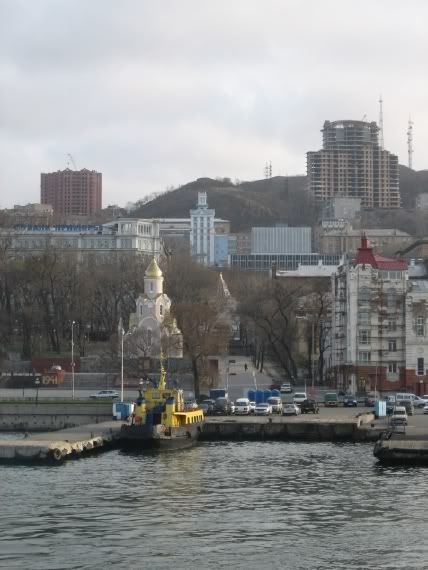
Leaving Vladivostok's harbor
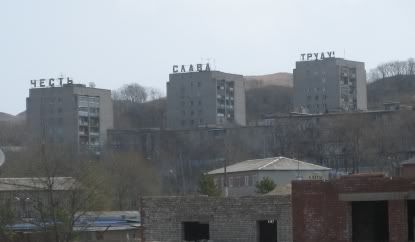
I thought these apartment buildings were awesome. They say "Honor and Glory to Work!" Actually, several of the buildings in Slavyanka (which is not a teeming metropolis, but isn't what I'd call a "village," either) were decorated with various manifestations of Soviet mythology/ideology (Lenin's head, the date of the Revolution, urgings to new acheivements in heavy industry, etc.).
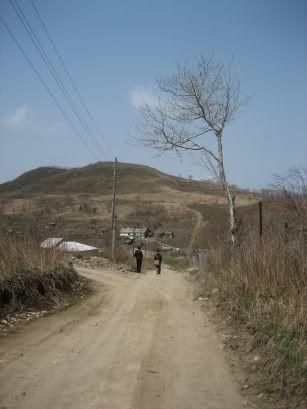
We wandered out of Slavyanka and down some country roads...
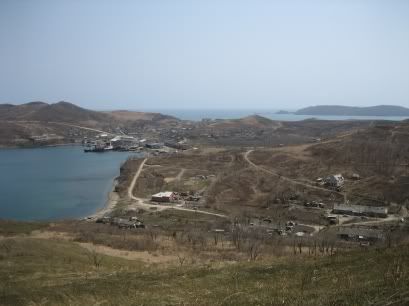
...and up some big hills. Here's a view of some of the landscape we traversed.
All in all, I wish I had found out about Slavyanka sooner, both because I really don't understand how Russian small towns work, and because it's closer to nature (and cleaner, at least air-wise) than Vladivostok, and because it would have been cool to volunteer at a school there a couple of times or something.
Leaving Vladivostok's harbor
I thought these apartment buildings were awesome. They say "Honor and Glory to Work!" Actually, several of the buildings in Slavyanka (which is not a teeming metropolis, but isn't what I'd call a "village," either) were decorated with various manifestations of Soviet mythology/ideology (Lenin's head, the date of the Revolution, urgings to new acheivements in heavy industry, etc.).
We wandered out of Slavyanka and down some country roads...
...and up some big hills. Here's a view of some of the landscape we traversed.
All in all, I wish I had found out about Slavyanka sooner, both because I really don't understand how Russian small towns work, and because it's closer to nature (and cleaner, at least air-wise) than Vladivostok, and because it would have been cool to volunteer at a school there a couple of times or something.
12 May 2007
A rather belated Victory Day post.
(This is the post I wrote on Victory Day and failed to post before.)
So. Victory Day. This holiday is a very big deal here; as I quoted once before, compared to Russians, Americans have completely forgotten about World War II. There are big parades, all the veterans wear their medals (not just on Victory Day, but for a couple of days before it, too), there are outdoor concerts, the city gets very decorated with white, blue and red balloons and posters of the "In Honor of our Great Victory!"/"Today is Victory Day!"/"Glory to Those Who Fell for the Motherland!" variety, and everyone wears black-and-orange striped ribbons (I'm not clear on the symbolism of this).
Today when I was leaving Laura's apartment, an old man on the bench outside her building greeted me (здравствуйте!). I greeted him back, and he responded with "С праздником!" (literally "With the holiday!"). I replied in kind and continued walking, when from behind me I heard him say: "You know, for many people it's a holiday, but for others it's a tragedy."
I turned back to see that he had tears in his eyes. I didn't really know what to do, but I couldn't just walk away, so I just stopped walking without saying anything. He went on to explain that his father died in 1941, then said a lot of stuff that I didn't entirely catch, but which seemed to boil down to this: in 1941, his father put his pregnant mother on an evacuation train bound for Vladivostok and enlisted in the army, eventually falling at the front somewhere around Kiev. His mother gave birth to him here in Vladivostok in August of that year. Then he showed me a picture of his father in his military uniform and one of his parents together, tucked carefully into his wallet.
I kept silent through all of this, offering only the occasional "ага" ("uh-huh") or exclamation of horror or sympathy at appropriate moments, both because I'd rather not display my non-native control of Russian if I don't have to, and because he seemed to want a listener more than a conversation partner. When I did speak, I ended up lying – in the course of his war story, he cursed the Nazis, the Polish (not sure why), and the Estonians (for being ungrateful), and then said something somewhat ambiguous about Americans, so I decided I didn't want to tell him I wasn't Russian. So I told him that my name is Олесия/Olesia and that I'm a student at DVGU and my parents live in Nakhodka.
So he figured out that he had a good listener in me, and proceeded to spend the next hour telling me all sorts of stories about his life: the time a snake fell asleep on his sleeping mother's stomach, the time he (as a taxi driver) picked up a woman who was leaving her husband and convinced her not to do it, how his wife died of cancer fifteen years ago even though they sold the dacha and the car to pay her medical bills, the time his old pre-army girlfriend reappeared and tried to get him to leave his wife (he didn't, because they both had children and he is a порядочный человек, an orderly/upstanding person), and the time mafiosi beat him up and stole his taxi and he lay in the hospital for days and two entire busfuls of taxi drivers came to donate blood, to name a few of the ones I understood. At the end he told me I was a good girl, said I shouldn't let it bother me that I'm still single, kissed my hand, and told me that if anyone ever bothers me, come find him on the 3rd floor in apartment 9, because he has two big, strong sons who can take care of business for me.
Anyway, that's my Victory Day story. Or rather, his Victory Day story, and the Victory Day story of an entire generation of Russian children who lost their fathers (and mothers, but mostly fathers) to the war.
So. Victory Day. This holiday is a very big deal here; as I quoted once before, compared to Russians, Americans have completely forgotten about World War II. There are big parades, all the veterans wear their medals (not just on Victory Day, but for a couple of days before it, too), there are outdoor concerts, the city gets very decorated with white, blue and red balloons and posters of the "In Honor of our Great Victory!"/"Today is Victory Day!"/"Glory to Those Who Fell for the Motherland!" variety, and everyone wears black-and-orange striped ribbons (I'm not clear on the symbolism of this).
Today when I was leaving Laura's apartment, an old man on the bench outside her building greeted me (здравствуйте!). I greeted him back, and he responded with "С праздником!" (literally "With the holiday!"). I replied in kind and continued walking, when from behind me I heard him say: "You know, for many people it's a holiday, but for others it's a tragedy."
I turned back to see that he had tears in his eyes. I didn't really know what to do, but I couldn't just walk away, so I just stopped walking without saying anything. He went on to explain that his father died in 1941, then said a lot of stuff that I didn't entirely catch, but which seemed to boil down to this: in 1941, his father put his pregnant mother on an evacuation train bound for Vladivostok and enlisted in the army, eventually falling at the front somewhere around Kiev. His mother gave birth to him here in Vladivostok in August of that year. Then he showed me a picture of his father in his military uniform and one of his parents together, tucked carefully into his wallet.
I kept silent through all of this, offering only the occasional "ага" ("uh-huh") or exclamation of horror or sympathy at appropriate moments, both because I'd rather not display my non-native control of Russian if I don't have to, and because he seemed to want a listener more than a conversation partner. When I did speak, I ended up lying – in the course of his war story, he cursed the Nazis, the Polish (not sure why), and the Estonians (for being ungrateful), and then said something somewhat ambiguous about Americans, so I decided I didn't want to tell him I wasn't Russian. So I told him that my name is Олесия/Olesia and that I'm a student at DVGU and my parents live in Nakhodka.
So he figured out that he had a good listener in me, and proceeded to spend the next hour telling me all sorts of stories about his life: the time a snake fell asleep on his sleeping mother's stomach, the time he (as a taxi driver) picked up a woman who was leaving her husband and convinced her not to do it, how his wife died of cancer fifteen years ago even though they sold the dacha and the car to pay her medical bills, the time his old pre-army girlfriend reappeared and tried to get him to leave his wife (he didn't, because they both had children and he is a порядочный человек, an orderly/upstanding person), and the time mafiosi beat him up and stole his taxi and he lay in the hospital for days and two entire busfuls of taxi drivers came to donate blood, to name a few of the ones I understood. At the end he told me I was a good girl, said I shouldn't let it bother me that I'm still single, kissed my hand, and told me that if anyone ever bothers me, come find him on the 3rd floor in apartment 9, because he has two big, strong sons who can take care of business for me.
Anyway, that's my Victory Day story. Or rather, his Victory Day story, and the Victory Day story of an entire generation of Russian children who lost their fathers (and mothers, but mostly fathers) to the war.
10 May 2007
С днем победы! / Happy Victory Day!
I wrote a whole long post about Victory Day (probably longer than it should have been, actually) and then forgot to put it on my flash key, so here is one picture from Victory Day, or rather, from Moscow a few days before Victory Day. Red Square was amazingly decked-out.
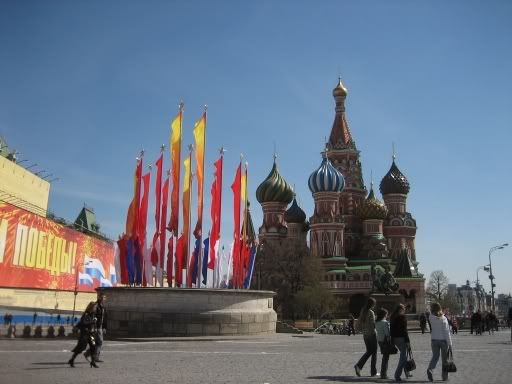
01 May 2007
Slavyanka!
This is a contentless post, but I wanted to write quickly to say that the trip to Slavyanka was a total success! I had a great time, and it was so interesting to see something other than a big city! I'll post pictures (there are many) after I get back from my Moscow/Kostroma trip!
26 April 2007
They're everywhere!
Just popping in from the internet center where I do my printing (of lessons etc.) to deliver, as promised, the update on the situation with the mail-order bride for whom I was translating letters. She left today for Great Britain to meet up with (I hope) the man of her dreams! I’m happy for her, but unfortunately I’m also a little worried, because I failed miserably at teaching her English (to be fair, it would have helped a lot if she had come to more than 25% of our lessons). Hopefully what’s-his-name worked a little harder at Russian, or love will break the language barrier, or something like that. She’ll be there for two weeks.
When I got to the internet center, all the computers were taken, so I had to stand and wait for a few minutes. I glanced at the lady at the nearest computer and noticed that she was writing in English. Always interested to discover other Americans in Vlad, I decided it wouldn’t hurt to take a tiny peek at her computer screen to see whether I could tell by her writing whether she was a native speaker. I freely admit that this makes me a very bad person. However, that didn’t stop me from doing it, and I soon discovered that no, she’s not a native speaker, and furthermore, the email she was writing was definitely a love letter! I’d like to pretend that it didn’t take my inching a bit closer and squinting a little to see that she was writing to a guy named Bjorn. Scandinavian, I guess? (Eek, I can’t believe I did that! What kind of person am I?) Now that must be tough – a long-distance relationship where neither party is communicating in his native language.
Anyway, that’s all for today, but watch for more pictures soon, because on Monday my roommate, two other French teachers (“French teachers” as in “from France,” and also as in “teachers of French”... oh, the imprecisions of the English language!) and anyone else who wants to come are going to Slavyanka, a nearby fishing village. I forget what the guidebook said about it, but it's two hours away by boat, and I believe it’s pretty close to the border with North Korea. And then it’s May Day and there’ll be a parade, and then I’m off to Moscow again for a conference!
When I got to the internet center, all the computers were taken, so I had to stand and wait for a few minutes. I glanced at the lady at the nearest computer and noticed that she was writing in English. Always interested to discover other Americans in Vlad, I decided it wouldn’t hurt to take a tiny peek at her computer screen to see whether I could tell by her writing whether she was a native speaker. I freely admit that this makes me a very bad person. However, that didn’t stop me from doing it, and I soon discovered that no, she’s not a native speaker, and furthermore, the email she was writing was definitely a love letter! I’d like to pretend that it didn’t take my inching a bit closer and squinting a little to see that she was writing to a guy named Bjorn. Scandinavian, I guess? (Eek, I can’t believe I did that! What kind of person am I?) Now that must be tough – a long-distance relationship where neither party is communicating in his native language.
Anyway, that’s all for today, but watch for more pictures soon, because on Monday my roommate, two other French teachers (“French teachers” as in “from France,” and also as in “teachers of French”... oh, the imprecisions of the English language!) and anyone else who wants to come are going to Slavyanka, a nearby fishing village. I forget what the guidebook said about it, but it's two hours away by boat, and I believe it’s pretty close to the border with North Korea. And then it’s May Day and there’ll be a parade, and then I’m off to Moscow again for a conference!
18 April 2007
On honesty in academics, although not in the usual sense.
Maybe I've been lulled into a false sense of security about the relatively low profile of my blog, because this is exactly the kind of thing we probably aren't supposed to post, but what's the worst that could happen? (Famous last words?)
Today we had a student conference at the university. All students have to write big research papers (курсовые работы) once a year, and this conference was an opportunity for those who wanted to present their papers to do so. I went to the session where several of my students and former students were presenting. At this session 11 students spoke, including one girl who is both a senior and a teacher at the institute. (That doesn't happen often, but it happens – better to hire the good ones early than lose them to higher-paying jobs.) I don't have a problem with that, but the weird thing was that she acted as the director of this session (in her capacity as a teacher) even though she was participating in it. This is weird because, as the Russians dearly love a competition, the session was also a contest that offered prizes to the first, second and third best presenters. This would be meaningless if a) Russians weren't obsessed with грамоты – that is, certificates; and b) the first prize didn't include publication in the institute's scientific journal. But they are, and it did. So this student was essentially running a contest that she was competing in, and, although this may be a bit harsh, she had her eyes on the prize.
So. All the presentations are finished, the audience has voted for their favorite speakers, and the teachers are tallying up the votes. I happened to be trapped in the corner (literally – one of the teachers and I were sharing a desk) where they were tallying, so I got an interesting view of things. Here's how it went down:
By the votes, Natasha won first place, Lena won second, and this teacher/student, who I'll call Anya, won third (she made a little squeaky aw-golly-gee-how-bout-that noise, by the way, every time she got a vote, which was SUPER annoying). That should settle it, right? Wrong:
Other teacher: But Anya, you're applying to grad school, right?
Anya: Yes.
Third teacher: Then you need to get published.
Anya: (Catching the drift) Well, yes, of course it would help, but that wouldn't be fair.
Other teacher: Why not? Of course it's fair. You need that certificate.
(See the love of certificates? I believe no one in America would give a fig for a stupid certificate that says "First Prize, Conference blah blah blah." But in Russia, that sucker is going in your portfolio for your grad school application.)
Third teacher: Right.
Anya: But the students voted.
Fourth teacher: Oh, they don't know anything. Your research is way more interesting than Natasha's.
Anya: No, I couldn't. It wouldn't be fair.
(I should note, although this may be a bit harsh, that Anya's protests did not ring true.)
This conversation went on for a few minutes, and ultimately they decided to give Anya and Natasha both first prize and Lena third prize, but Anya would get first dibs on publication if the journal wouldn't accept both of them. Anya oh-so-graciously ceded the rest of her first-prize award (besides the coveted грамота, of course) – a folder, pen and notebook – to Ilya, who might have gotten fourth place in the voting but might just as well have simply been the person she felt like giving it to. Again, this may be a bit harsh, but I hope he threw it away.
So, overall, I wasn't shocked by the lack of regard for honesty and – what's the word? – oh, yes, glasnost, but I was a bit shocked by the sheer blatancy of the favoritism. And the general sense that there was absolutely nothing wrong with this.
Today we had a student conference at the university. All students have to write big research papers (курсовые работы) once a year, and this conference was an opportunity for those who wanted to present their papers to do so. I went to the session where several of my students and former students were presenting. At this session 11 students spoke, including one girl who is both a senior and a teacher at the institute. (That doesn't happen often, but it happens – better to hire the good ones early than lose them to higher-paying jobs.) I don't have a problem with that, but the weird thing was that she acted as the director of this session (in her capacity as a teacher) even though she was participating in it. This is weird because, as the Russians dearly love a competition, the session was also a contest that offered prizes to the first, second and third best presenters. This would be meaningless if a) Russians weren't obsessed with грамоты – that is, certificates; and b) the first prize didn't include publication in the institute's scientific journal. But they are, and it did. So this student was essentially running a contest that she was competing in, and, although this may be a bit harsh, she had her eyes on the prize.
So. All the presentations are finished, the audience has voted for their favorite speakers, and the teachers are tallying up the votes. I happened to be trapped in the corner (literally – one of the teachers and I were sharing a desk) where they were tallying, so I got an interesting view of things. Here's how it went down:
By the votes, Natasha won first place, Lena won second, and this teacher/student, who I'll call Anya, won third (she made a little squeaky aw-golly-gee-how-bout-that noise, by the way, every time she got a vote, which was SUPER annoying). That should settle it, right? Wrong:
Other teacher: But Anya, you're applying to grad school, right?
Anya: Yes.
Third teacher: Then you need to get published.
Anya: (Catching the drift) Well, yes, of course it would help, but that wouldn't be fair.
Other teacher: Why not? Of course it's fair. You need that certificate.
(See the love of certificates? I believe no one in America would give a fig for a stupid certificate that says "First Prize, Conference blah blah blah." But in Russia, that sucker is going in your portfolio for your grad school application.)
Third teacher: Right.
Anya: But the students voted.
Fourth teacher: Oh, they don't know anything. Your research is way more interesting than Natasha's.
Anya: No, I couldn't. It wouldn't be fair.
(I should note, although this may be a bit harsh, that Anya's protests did not ring true.)
This conversation went on for a few minutes, and ultimately they decided to give Anya and Natasha both first prize and Lena third prize, but Anya would get first dibs on publication if the journal wouldn't accept both of them. Anya oh-so-graciously ceded the rest of her first-prize award (besides the coveted грамота, of course) – a folder, pen and notebook – to Ilya, who might have gotten fourth place in the voting but might just as well have simply been the person she felt like giving it to. Again, this may be a bit harsh, but I hope he threw it away.
So, overall, I wasn't shocked by the lack of regard for honesty and – what's the word? – oh, yes, glasnost, but I was a bit shocked by the sheer blatancy of the favoritism. And the general sense that there was absolutely nothing wrong with this.
12 April 2007
Svetlanskaya
Now that the weather is nice, I walk either to the university or back home at least once a day instead of taking the bus. It's pretty far away – about 45 minutes on foot if I'm walking briskly – but it's a pleasant walk down (and up, and down, and up again) two of Vladivostok's main streets, Svetlanskaya Street and Okeanskii Prospekt. The latter we've already seen in one of my other picture posts, so today I'll tell you about Svetlanskaya.
Svetlanskaya runs the length of the Golden Horn Bay, where most of Vlad's port activity is, about two blocks uphill from the shoreline. In the course of my walking down it every day, I've become fascinated with the street – particularly the side of the street nearer the bay, which is dotted with a series of old two- and three-story houses that appear to belong almost exclusively to the Pacific Fleet of the Russian Navy. Even those among these houses that haven't been renovated and are kind of junky are sort of charming – looking at them always makes me imagine Ye Olde Vladivostok, with horse-drawn carriages rolling sedately down quiet, dusty streets. Incidentally, this is one thing that I have unexpectedly come to really like about the city – unlike Western Russia with its ancient kremlins and onion domes (which obviously have their own value), Vladivostok has a short history as a frontier outpost, and the concept of the past here is connected mostly with the latter half of the 19th century. In that way it's similar in feel to many American cities, since that was (if I'm not mistaken) a period of urbanization when a lot of our urban landscape was built.
Contrary to what you'd expect for what's practically the center of town, the bay side of Svetlanskaya isn't entirely taken up with a solid block of buildings. The buildings that are there have yards, and parts of the slope are clear enough that you can actually see down to the bay. I haven't exactly figured out why that is, but my hypothesis is that it has to do with all the property on that side of the street that doesn't belong to the Navy belonging to the shipyards. In fact, the big shipyard, Dal'zavod, is only about a block away from my apartment. There are also several naval monuments along Svetlanskaya, one of which I'm almost sure appeared sometime between November and February while I wasn't here. Anyway, I humbly present to you my pictures: Svetlanskaya (the not-quite-downtown edition).
Starting near the center of the city: this is a little park where Pushkinskaya (the street I technically live on, and also a very old one for Vladivostok) breaks off from Svetlanskaya and climbs up the hill.
1.This monument is too worn for me to read, but it says something about 1905.
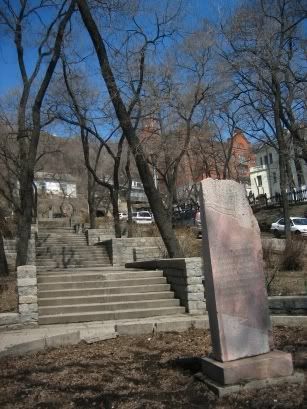
2.What's a Russian city without a bust of Pushkin, even if you’re 5000 miles away from anywhere Pushkin ever lived?
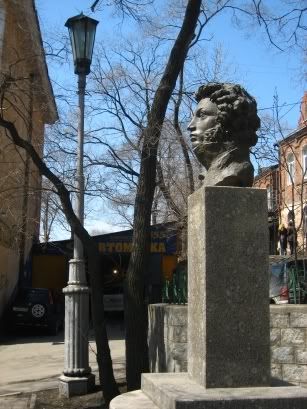
3.Looking down the slope at Svetlanskaya, the Navy memorial, and the bay beyond.
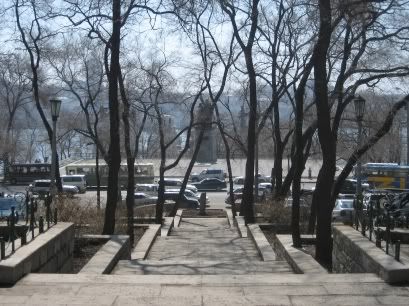
4.Next to the park is this fabulous old mansion that I'm completely in love with. According to the sign by the door, it houses Vladivostok's School for the Arts.
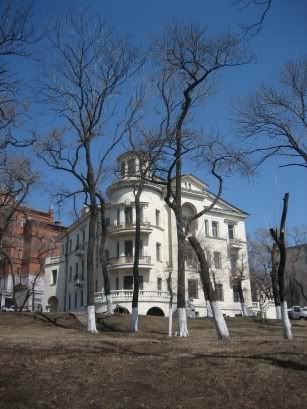
5.This is not technically Svetlanskaya, but this little house strikes me as very quaint.
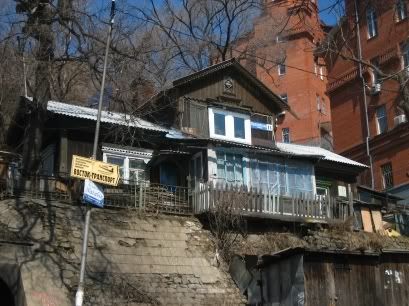
6.And next to the mansion that's next to the park, we have a little Orthodox church that's being renovated. Notice the bells, which make me very happy when they're being rung by priests (monks?) in long black robes. And the banner: Christ is Risen!
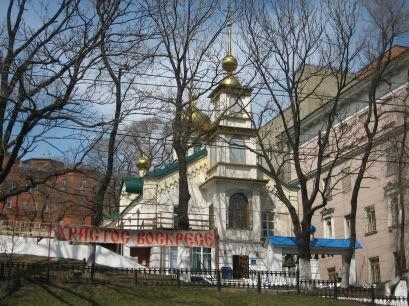
7.The first of the naval monuments. This one is to the ships of the merchant fleet that were damaged/sunk/engaged in battle in WWII.
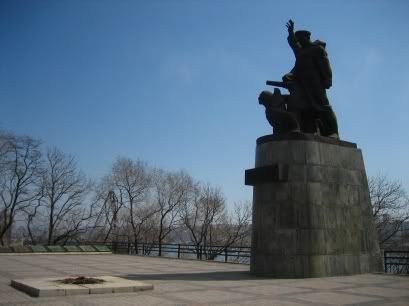
8.Not far down the street from the park is the Sailor's Club. The club itself is an ugly little Soviet building (contrast with the Officers' Club, which is an ugly big Soviet building), but it's set back and downhill from the street, and in its courtyard are all sorts of interesting things, like this colorful closed-down bar:
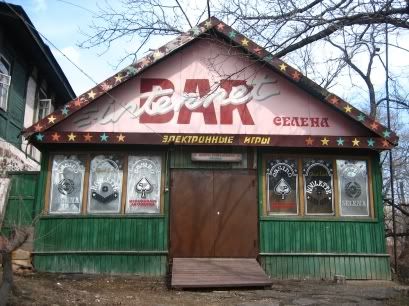
9.And this very melancholy monument to the crew of the ship Kreiserok, all of whom perished in 1889 (under what circumstances I don't know):
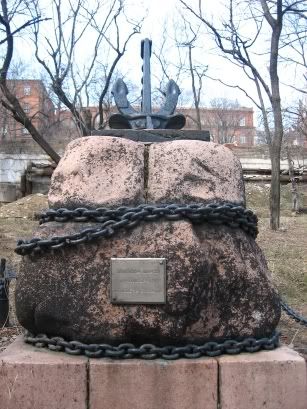
10.And a blacksmith shop. I tried to take a picture of the yard of the shop itself, which was quite interesting, but the blacksmiths were gawking at me and I chickened out.
11.Next to the Sailor's Club is the monument that I'm pretty sure is new. It's dedicated to the memory of the sailors who fought in the Russo-Japanese War.
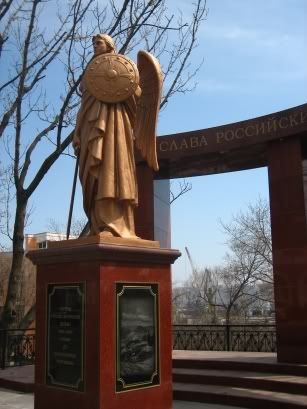
12.Down the street from that is one of the lovely old buildings I was mentioning. I didn't get many good photos of these, but hopefully you can get an idea.
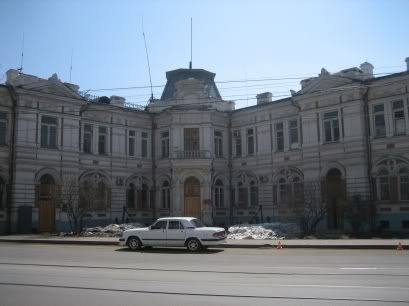
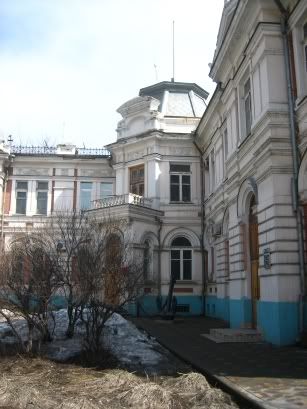
13.Across the street is Vladivostok's circus building, just called "Цирк/Cirque" as far as I know. It's a triumph of Soviet hideousness.
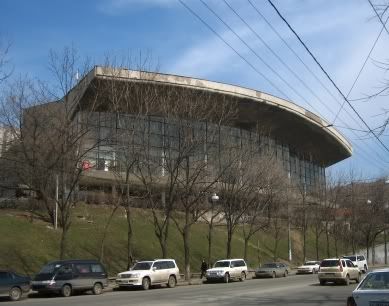
14.One of the other old Navy buildings apparently belongs to the Hydrographic Service, or at least has a monument to them.
15.It also has a cool star on it.
16.And here are several views of the Navy building nearest my apartment, which actually houses a Navy-run kindergarten. If you look at the third one and can make out the Cyrillic, you can see what Svetlanskaya was called during the Soviet years. And you'll get a gold star from me for the effort.
17.Finally, Dal'zavod and Dal'zavodskaya street! This is a short street that breaks off of Svetlanskaya. First, the factory façade, which is so many kinds of retro it boggles my mind:
18.A memorial (also retro-looking, although it was built in 2005) commemorating Dal'zavod workers (I assume) who served/worked/showed heroism in WWII.
19.A view down the street, which is one of the only quiet, tree-lined ones I've found here. It's also permanently waterlogged, and I'm not sure why.
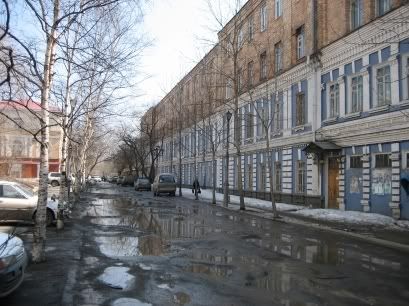
Ok, that's all for now! Hope everyone's having a good day!
Svetlanskaya runs the length of the Golden Horn Bay, where most of Vlad's port activity is, about two blocks uphill from the shoreline. In the course of my walking down it every day, I've become fascinated with the street – particularly the side of the street nearer the bay, which is dotted with a series of old two- and three-story houses that appear to belong almost exclusively to the Pacific Fleet of the Russian Navy. Even those among these houses that haven't been renovated and are kind of junky are sort of charming – looking at them always makes me imagine Ye Olde Vladivostok, with horse-drawn carriages rolling sedately down quiet, dusty streets. Incidentally, this is one thing that I have unexpectedly come to really like about the city – unlike Western Russia with its ancient kremlins and onion domes (which obviously have their own value), Vladivostok has a short history as a frontier outpost, and the concept of the past here is connected mostly with the latter half of the 19th century. In that way it's similar in feel to many American cities, since that was (if I'm not mistaken) a period of urbanization when a lot of our urban landscape was built.
Contrary to what you'd expect for what's practically the center of town, the bay side of Svetlanskaya isn't entirely taken up with a solid block of buildings. The buildings that are there have yards, and parts of the slope are clear enough that you can actually see down to the bay. I haven't exactly figured out why that is, but my hypothesis is that it has to do with all the property on that side of the street that doesn't belong to the Navy belonging to the shipyards. In fact, the big shipyard, Dal'zavod, is only about a block away from my apartment. There are also several naval monuments along Svetlanskaya, one of which I'm almost sure appeared sometime between November and February while I wasn't here. Anyway, I humbly present to you my pictures: Svetlanskaya (the not-quite-downtown edition).
Starting near the center of the city: this is a little park where Pushkinskaya (the street I technically live on, and also a very old one for Vladivostok) breaks off from Svetlanskaya and climbs up the hill.
1.This monument is too worn for me to read, but it says something about 1905.
2.What's a Russian city without a bust of Pushkin, even if you’re 5000 miles away from anywhere Pushkin ever lived?
3.Looking down the slope at Svetlanskaya, the Navy memorial, and the bay beyond.
4.Next to the park is this fabulous old mansion that I'm completely in love with. According to the sign by the door, it houses Vladivostok's School for the Arts.
5.This is not technically Svetlanskaya, but this little house strikes me as very quaint.
6.And next to the mansion that's next to the park, we have a little Orthodox church that's being renovated. Notice the bells, which make me very happy when they're being rung by priests (monks?) in long black robes. And the banner: Christ is Risen!
7.The first of the naval monuments. This one is to the ships of the merchant fleet that were damaged/sunk/engaged in battle in WWII.
8.Not far down the street from the park is the Sailor's Club. The club itself is an ugly little Soviet building (contrast with the Officers' Club, which is an ugly big Soviet building), but it's set back and downhill from the street, and in its courtyard are all sorts of interesting things, like this colorful closed-down bar:
9.And this very melancholy monument to the crew of the ship Kreiserok, all of whom perished in 1889 (under what circumstances I don't know):
10.And a blacksmith shop. I tried to take a picture of the yard of the shop itself, which was quite interesting, but the blacksmiths were gawking at me and I chickened out.
11.Next to the Sailor's Club is the monument that I'm pretty sure is new. It's dedicated to the memory of the sailors who fought in the Russo-Japanese War.
12.Down the street from that is one of the lovely old buildings I was mentioning. I didn't get many good photos of these, but hopefully you can get an idea.
13.Across the street is Vladivostok's circus building, just called "Цирк/Cirque" as far as I know. It's a triumph of Soviet hideousness.
14.One of the other old Navy buildings apparently belongs to the Hydrographic Service, or at least has a monument to them.
15.It also has a cool star on it.
16.And here are several views of the Navy building nearest my apartment, which actually houses a Navy-run kindergarten. If you look at the third one and can make out the Cyrillic, you can see what Svetlanskaya was called during the Soviet years. And you'll get a gold star from me for the effort.
17.Finally, Dal'zavod and Dal'zavodskaya street! This is a short street that breaks off of Svetlanskaya. First, the factory façade, which is so many kinds of retro it boggles my mind:
18.A memorial (also retro-looking, although it was built in 2005) commemorating Dal'zavod workers (I assume) who served/worked/showed heroism in WWII.
19.A view down the street, which is one of the only quiet, tree-lined ones I've found here. It's also permanently waterlogged, and I'm not sure why.
Ok, that's all for now! Hope everyone's having a good day!
08 April 2007
Aha!
Today Yse and I got the traditional Russian Easter greeting again, from a babushka on the street as we walked home from the market, who walked up to us and said, "Girls, Christ is risen!" (Девушки, Христос воскрес!) with genuine joy, as if she were actually delivering the news to us, which was delightful. Having forgotten how to say the proper reply, "He is risen, indeed!," (Воистину воскрес!) we looked it up when we got home. At which point I made the discovery that Passover really is called "Jewish Easter" in Russian (see post below). Oy. So it wasn't Nijole who was confused; it was the silly American. Duly noted.
P.S. – I'm at a loss to explain where Russian Jews get their matzoh. Without the appearance of matzoh in grocery stores, I didn't even know it was Passover until someone told me. Any ideas? Can you make matzoh yourself?
P.S. – I'm at a loss to explain where Russian Jews get their matzoh. Without the appearance of matzoh in grocery stores, I didn't even know it was Passover until someone told me. Any ideas? Can you make matzoh yourself?
Happy Easter! / Random update
I can now add "participation in a scientific conference" to my CV! I gave my talk on Friday about Icelandic-English language contact and syntactic change (a product of data collected in Iceland two summers ago for the senior thesis-that-never-was) at the conference "Russia East-West: Problems in Cross-Cultural Communication," and it went really well. Obviously, Iceland has nothing to do with "Russia East-West," and theoretical syntax only has to do with cross cultural communication if you do some stretching of the terms, but that's ok. The professor organizing the conference really wanted me to participate, and I was not the only one with an off-topic paper.
So, like I said, the presentation went well. However, the funny thing is that my audience was most interested in the parts that had nothing to do with my research. The (mostly female – Russian academia, especially the liberal arts, is generally female) crowd got really excited when I mentioned that Icelandic single mothers give their children matronymics instead of patronymics. Seriously. Some of the women wanted to start clapping (matronymics are not legal in Russia). Then when I explained that Icelanders don't have last names, just first names and patronymics, the Russianness in them really came out – their first question was, "How do they fill out their passport documents if they don't have last names?!?" Ah, the Russian love of paper and bureaucracy.
That reminds me of a similar story – I recently took the state Russian exam for foreigners (like the TOEFL, but Russian), and when I filled out my registration, the proctor was very, very concerned about the fact that I had only put down my first and last names, leaving off my middle names. Middle names confuse Russians a little bit, because they don't have them, and the fact that I have two of them seems to really mess with them sometimes (thanks, Mom!). He warned me that if I wanted to use the certificate saying I passed the test (I passed, by the way!) in Russia, I might have trouble if it didn't have my full legal name on it. But I don't plan to use it in Russia, and I'm sure that if I want to use it in the U.S., my first and last name will be sufficient.
And speaking of things Russians are a little confused about, here are two conversations about Easter that I've had with Russians recently:
At the Catholic center where I teach English, although this conversation was in Russian:
Me: So is Sunday Catholic Easter or Orthodox Easter?
Valentina: It's both. But you're right, they're usually on different days. This year they just happen to coincide.
Me: Oh, I see. That doesn't happen very often, does it?
Valentina: No. It's very strange that the Catholic and Orthodox ones are at the same time this year.
Nijole: And what's more, the Jewish!
Me: The Jewish?
Nijole: Yes, the Jewish!
In Russian it made more sense that Nijole (it's a Lithuanian name, btw) didn't have to say "Easter" after the word "Jewish." Obviously she was talking about Passover, but the conversation still amused me. So, happy "Jewish Easter" to my Jewish readers!
And at the university:
Alla Ivanovna: What? Leslie, you've never had homemade pelmeni? We should have a party with Russian food for you! We could have borsch and everything... although, by the way, borsch isn't Russian, it's Ukrainian. What's the next holiday? Easter, right?
Anna Vladimirovna: Yes, Easter.
AI: We could have a party for Easter! Anya, do you know when it is?
AV: April 8th.
AI: April 8th... (looks at a calendar) Oh, that's no good, it's a Sunday.
I guess Alla Ivanovna, who is about 70, spent too much of her life in the atheist Soviet era to have quite grasped that Easter always falls on a Sunday.
P.S. - Today at 12:45 in the morning, I was awakened by a text message from someone I don't know (or possibly someone I know whose phone number I don't have) with the traditional Russian Easter greeting, "Иисус воскрес!" ("Christ is risen!" or actually, "Jesus is risen!" which I think is slightly less traditional). While I appreciate the news, I didn't really appreciate being awakened by it. Also I feel like they kind of jumped the gun.
So, like I said, the presentation went well. However, the funny thing is that my audience was most interested in the parts that had nothing to do with my research. The (mostly female – Russian academia, especially the liberal arts, is generally female) crowd got really excited when I mentioned that Icelandic single mothers give their children matronymics instead of patronymics. Seriously. Some of the women wanted to start clapping (matronymics are not legal in Russia). Then when I explained that Icelanders don't have last names, just first names and patronymics, the Russianness in them really came out – their first question was, "How do they fill out their passport documents if they don't have last names?!?" Ah, the Russian love of paper and bureaucracy.
That reminds me of a similar story – I recently took the state Russian exam for foreigners (like the TOEFL, but Russian), and when I filled out my registration, the proctor was very, very concerned about the fact that I had only put down my first and last names, leaving off my middle names. Middle names confuse Russians a little bit, because they don't have them, and the fact that I have two of them seems to really mess with them sometimes (thanks, Mom!). He warned me that if I wanted to use the certificate saying I passed the test (I passed, by the way!) in Russia, I might have trouble if it didn't have my full legal name on it. But I don't plan to use it in Russia, and I'm sure that if I want to use it in the U.S., my first and last name will be sufficient.
And speaking of things Russians are a little confused about, here are two conversations about Easter that I've had with Russians recently:
At the Catholic center where I teach English, although this conversation was in Russian:
Me: So is Sunday Catholic Easter or Orthodox Easter?
Valentina: It's both. But you're right, they're usually on different days. This year they just happen to coincide.
Me: Oh, I see. That doesn't happen very often, does it?
Valentina: No. It's very strange that the Catholic and Orthodox ones are at the same time this year.
Nijole: And what's more, the Jewish!
Me: The Jewish?
Nijole: Yes, the Jewish!
In Russian it made more sense that Nijole (it's a Lithuanian name, btw) didn't have to say "Easter" after the word "Jewish." Obviously she was talking about Passover, but the conversation still amused me. So, happy "Jewish Easter" to my Jewish readers!
And at the university:
Alla Ivanovna: What? Leslie, you've never had homemade pelmeni? We should have a party with Russian food for you! We could have borsch and everything... although, by the way, borsch isn't Russian, it's Ukrainian. What's the next holiday? Easter, right?
Anna Vladimirovna: Yes, Easter.
AI: We could have a party for Easter! Anya, do you know when it is?
AV: April 8th.
AI: April 8th... (looks at a calendar) Oh, that's no good, it's a Sunday.
I guess Alla Ivanovna, who is about 70, spent too much of her life in the atheist Soviet era to have quite grasped that Easter always falls on a Sunday.
P.S. - Today at 12:45 in the morning, I was awakened by a text message from someone I don't know (or possibly someone I know whose phone number I don't have) with the traditional Russian Easter greeting, "Иисус воскрес!" ("Christ is risen!" or actually, "Jesus is risen!" which I think is slightly less traditional). While I appreciate the news, I didn't really appreciate being awakened by it. Also I feel like they kind of jumped the gun.
30 March 2007
The View from Vlad 4: Sportivnaya
I've realized that the idea of my blog as a reference for travelers to Vladivostok isn't the most realistic, but I think there's a lot in this city that's worth writing about, even if none of my readers will ever see it up close. So I've decided to continue the "View from Vlad" entries. Here's the latest.
Where you go to buy your groceries in Russia seems to vary from city to city, and even among neighborhoods within a city. The choices include Western-style supermarkets; продукты/produkty, which are similar to American convenience stores in size; kiosks on the street that specialize in one type of item; and the рынок/rynok, or market. The rynok can be open-air or indoors, but as a rule it'll be comprised of a selection of kiosks ranging from simple counters to various sizes of tent to veritable grocery stores in a big box that folds open into a sort of concession stand-like apparatus. Besides groceries, you can find housewares, appliances, dishes, vinyl flooring, silk flowers, clothes, shoes, makeup, books, CDs and DVDs, and almost anything else you can imagine at a rynok.
In expensive Vladivostok, the rynok is your best bet in terms of price for groceries, and once you learn how the rynok is laid out, you can get almost everything there you could get at a grocery store with only slightly more effort. There are several rynki to choose from – see the list at the end of this entry – but the best is Спортивная/Sportivnaya.
Sportivnaya is big enough that I'm pretty sure I still haven't seen the whole thing, though I've been there several times, and it's a microcosm of everything a market can and should be. You can find Russian babushki selling homemade pickles and berry preserves, young Central Asian men with dried fruit or Uzbek bread, and whole Chinese families running miniature emporia of imported vegetables and Asian prepackaged foods (and, quite literally, 5-pound bags of MSG). Long roofed-in rows of kiosks feature cheap clothing – they're a haven for knockoffs of every designer and brand you can imagine, from Vivienne Westwood to Gap, and all of last season's best styles. Another section of the market includes not only the aforementioned Chinese groceries (the place to buy vegetables in the dead of winter), but cheap, delicious and popular Chinese cafes with owners who lean out the front door as you walk by to invite you in. If you don't feel like eating in the cafes, you can buy shawerma, corn on the cob or sugared fruit on a stick from vendors clustered among the housewares and clothing kiosks. Almost any seller will be friendly to you if you're polite to them and offer an unexpected спасибо, до свидания! ("Thank you, goodbye!") as you leave, but you can also be as pushy as you want: haggling is the expected norm in the non-grocery sections.
As for ambiance, it doesn't get any more "authentic" than Sportivnaya (where "authentic" = "crappy"). Sportivnaya is so named because it's built around the walls of an old athletic stadium. The stadium is located in one of the ugliest, most industrial parts of Vladivostok, and it's crumbling – take a peek inside when you're on one of the endzone sides to get a good look at the disintegrating concrete, rotting wooden bleachers and pothole-scarred field absolutely packed with junky-looking market stalls, dumpsters, and wads of filthy tarpaulin. This setting, added to the general dirt and disorder inherent to markets, makes a trip to Sportivnaya on a cold, rainy day worth your while just for the deep sense of gloom it'll induce. (Don't try to pretend that you weren't hoping for a little deep gloominess on your trip to Russia. If you weren't looking for melancholy, you'd be in the Mediterranean.)
Slogging through the mud of the market, dodging cascades of water as vendors poke broom handles at the tarps hanging over the walkways, fingers and toes numb with cold – I wouldn't call it the post-Soviet equivalent of standing in the bread line, but it's a misery of the same kind, the kind that makes it seem like the best thing that's ever happened to you when you finally make your purchase and the middle-aged bread lady starts up a friendly conversation about the weather, or the guy selling dried fruit tells you to forget about the extra four rubles as you dig in vain for pocket change. It makes coming home to your little Soviet apartment with your purchases and starting up dinner with your roommate seem like its own reward for your sufferings. Therein, I think, lies the reason I love the market so much – at its best, it's bright and exciting and bustling and commercial, and at its worst, it makes you feel glad to turn toward the rest of humanity to find relief from the miseries it inflicts, and provides you with a ready-made throng of humanity to turn to.
Right, so I might be getting a little too pseudo-philosophical with that (it was rainy when we went to the market this weekend, can you tell?), but at any rate, the market in bad weather is just what the doctor ordered on days when you want to taste a little bit of dark, Dostoevskian Russian existence. For those less intrepid, Sportivnaya on a sunny day is considerably more enjoyable (in the traditional sense of the word). And it's really the best place to take care of all of your shopping needs, whether you suddenly feel a hankering for fried silkworms (I think that's what they are?) or realize that you'll never make it through the winter without a hat handknitted out of dog-hair yarn (I know for sure, because I asked).
The promised list of rynki, for the wayward traveler:
1. Спортивная/Sportivnaya, at the bus stop of the same name, one stop beyond the bus station Луговая.
2. Центральный Рынок/Central'ny Rynok at the bus stop Комарова/Komarova, intersection of улица Комарова and Океанский проспект. Features a small row of booths "for pensioners," which allows you to support a worthy cause (if you don't know about the plight of pensioners in Russia, just ask) while buying delicious dacha-grown vegetables and herbs.
3. Центральная площадь/Central'naya ploshchad' (Central Square), at the bus stop Центр. Right in the center of town, but the market is only there on Thursdays and Fridays, and it disappears during the colder months.
4. Первая Речка/Pervaya Rechka, at the bus stop of the same name on Океанский Проспект. A combination rynok/torgovy kompleks.
5. Вторая Речка/Vtoraya Rechka. I don't know what the bus stop is called, but get on a bus bound for the north reaches of town and get off after you've gone over the big bridge and you see signs out the left window of the bus that say "Рынок." It's almost as big as Sportivnaya.
6. Некрасовская/Nekrasovskaya. That might not actually be the name of the market, but it's at the bus stop of that name, two stops beyond Первая Речка (#4). Smallish and indoors.
7. For wimps or those who need 24-hour service, there's a 24-hour grocery store right in the center of town, about 25 yards up Океанский Проспект/Okeanskii Prospekt from the central square.
8. For the really, really wimpy – e.g. those who can't live without Swedish ice cream, cheesecake from Texas, French sugars infused with lavender and rose petals, balsamic vinegar, pesto or real Heinz ketchup – check out the гипермаркет/hypermarket on Okeanskii at the bus stop Дальпресс/Dal'press. You won't be disappointed, although you might go broke feeding yourself.
Where you go to buy your groceries in Russia seems to vary from city to city, and even among neighborhoods within a city. The choices include Western-style supermarkets; продукты/produkty, which are similar to American convenience stores in size; kiosks on the street that specialize in one type of item; and the рынок/rynok, or market. The rynok can be open-air or indoors, but as a rule it'll be comprised of a selection of kiosks ranging from simple counters to various sizes of tent to veritable grocery stores in a big box that folds open into a sort of concession stand-like apparatus. Besides groceries, you can find housewares, appliances, dishes, vinyl flooring, silk flowers, clothes, shoes, makeup, books, CDs and DVDs, and almost anything else you can imagine at a rynok.
In expensive Vladivostok, the rynok is your best bet in terms of price for groceries, and once you learn how the rynok is laid out, you can get almost everything there you could get at a grocery store with only slightly more effort. There are several rynki to choose from – see the list at the end of this entry – but the best is Спортивная/Sportivnaya.
Sportivnaya is big enough that I'm pretty sure I still haven't seen the whole thing, though I've been there several times, and it's a microcosm of everything a market can and should be. You can find Russian babushki selling homemade pickles and berry preserves, young Central Asian men with dried fruit or Uzbek bread, and whole Chinese families running miniature emporia of imported vegetables and Asian prepackaged foods (and, quite literally, 5-pound bags of MSG). Long roofed-in rows of kiosks feature cheap clothing – they're a haven for knockoffs of every designer and brand you can imagine, from Vivienne Westwood to Gap, and all of last season's best styles. Another section of the market includes not only the aforementioned Chinese groceries (the place to buy vegetables in the dead of winter), but cheap, delicious and popular Chinese cafes with owners who lean out the front door as you walk by to invite you in. If you don't feel like eating in the cafes, you can buy shawerma, corn on the cob or sugared fruit on a stick from vendors clustered among the housewares and clothing kiosks. Almost any seller will be friendly to you if you're polite to them and offer an unexpected спасибо, до свидания! ("Thank you, goodbye!") as you leave, but you can also be as pushy as you want: haggling is the expected norm in the non-grocery sections.
As for ambiance, it doesn't get any more "authentic" than Sportivnaya (where "authentic" = "crappy"). Sportivnaya is so named because it's built around the walls of an old athletic stadium. The stadium is located in one of the ugliest, most industrial parts of Vladivostok, and it's crumbling – take a peek inside when you're on one of the endzone sides to get a good look at the disintegrating concrete, rotting wooden bleachers and pothole-scarred field absolutely packed with junky-looking market stalls, dumpsters, and wads of filthy tarpaulin. This setting, added to the general dirt and disorder inherent to markets, makes a trip to Sportivnaya on a cold, rainy day worth your while just for the deep sense of gloom it'll induce. (Don't try to pretend that you weren't hoping for a little deep gloominess on your trip to Russia. If you weren't looking for melancholy, you'd be in the Mediterranean.)
Slogging through the mud of the market, dodging cascades of water as vendors poke broom handles at the tarps hanging over the walkways, fingers and toes numb with cold – I wouldn't call it the post-Soviet equivalent of standing in the bread line, but it's a misery of the same kind, the kind that makes it seem like the best thing that's ever happened to you when you finally make your purchase and the middle-aged bread lady starts up a friendly conversation about the weather, or the guy selling dried fruit tells you to forget about the extra four rubles as you dig in vain for pocket change. It makes coming home to your little Soviet apartment with your purchases and starting up dinner with your roommate seem like its own reward for your sufferings. Therein, I think, lies the reason I love the market so much – at its best, it's bright and exciting and bustling and commercial, and at its worst, it makes you feel glad to turn toward the rest of humanity to find relief from the miseries it inflicts, and provides you with a ready-made throng of humanity to turn to.
Right, so I might be getting a little too pseudo-philosophical with that (it was rainy when we went to the market this weekend, can you tell?), but at any rate, the market in bad weather is just what the doctor ordered on days when you want to taste a little bit of dark, Dostoevskian Russian existence. For those less intrepid, Sportivnaya on a sunny day is considerably more enjoyable (in the traditional sense of the word). And it's really the best place to take care of all of your shopping needs, whether you suddenly feel a hankering for fried silkworms (I think that's what they are?) or realize that you'll never make it through the winter without a hat handknitted out of dog-hair yarn (I know for sure, because I asked).
The promised list of rynki, for the wayward traveler:
1. Спортивная/Sportivnaya, at the bus stop of the same name, one stop beyond the bus station Луговая.
2. Центральный Рынок/Central'ny Rynok at the bus stop Комарова/Komarova, intersection of улица Комарова and Океанский проспект. Features a small row of booths "for pensioners," which allows you to support a worthy cause (if you don't know about the plight of pensioners in Russia, just ask) while buying delicious dacha-grown vegetables and herbs.
3. Центральная площадь/Central'naya ploshchad' (Central Square), at the bus stop Центр. Right in the center of town, but the market is only there on Thursdays and Fridays, and it disappears during the colder months.
4. Первая Речка/Pervaya Rechka, at the bus stop of the same name on Океанский Проспект. A combination rynok/torgovy kompleks.
5. Вторая Речка/Vtoraya Rechka. I don't know what the bus stop is called, but get on a bus bound for the north reaches of town and get off after you've gone over the big bridge and you see signs out the left window of the bus that say "Рынок." It's almost as big as Sportivnaya.
6. Некрасовская/Nekrasovskaya. That might not actually be the name of the market, but it's at the bus stop of that name, two stops beyond Первая Речка (#4). Smallish and indoors.
7. For wimps or those who need 24-hour service, there's a 24-hour grocery store right in the center of town, about 25 yards up Океанский Проспект/Okeanskii Prospekt from the central square.
8. For the really, really wimpy – e.g. those who can't live without Swedish ice cream, cheesecake from Texas, French sugars infused with lavender and rose petals, balsamic vinegar, pesto or real Heinz ketchup – check out the гипермаркет/hypermarket on Okeanskii at the bus stop Дальпресс/Dal'press. You won't be disappointed, although you might go broke feeding yourself.
23 March 2007
A glut of posts
The reason for the current glut of posts is that I'm preparing to take the State Test of Russian as a Foreign Language, Level 2 (a passing score allows you to enter grad school in Russia - not that I'm planning on doing that) on Tuesday, and, just like when I had to study for things in college, I'm procrastinating like crazy. In case you wanted to know. Anyway, this is the last one for now.
It's that time of year again (for me, anyway) – the time to figure out what I'm doing next academic year. In the midst of my angst about re-applying to stay here teaching for another year (as in, angst about whether I should do so or not), I've discovered that just as it's easy to say that you want to stay another year in Russia when you're sitting at home in America, it's easy to say that you want to come home to America when you feel like you have all the time in the world left in Russia. And in both cases, a change in perspective can change your opinion quite fast.
This was precipitated by being waitlisted for grant renewal, as well as by receiving an email today about the Russian summer camps we're all supposed to work at, which informed me that I've been assigned (pending agreement on my part) to spend most of June in Ulan-Ude. Being waitlisted is kind of crappy, obviously, but it was the other email that really made me realize how little time I have left here. Don't get me wrong, I am over the moon about getting to go to Ulan-Ude (don't know where it is? look it up, and it will become clear why I'm over the moon about it), but looking at the dates of the camp and the date I want to be home by and the current date just really underlined the fact that I only have a little more than two months left in Vlad.
Can you believe it? I sure can't.
It's that time of year again (for me, anyway) – the time to figure out what I'm doing next academic year. In the midst of my angst about re-applying to stay here teaching for another year (as in, angst about whether I should do so or not), I've discovered that just as it's easy to say that you want to stay another year in Russia when you're sitting at home in America, it's easy to say that you want to come home to America when you feel like you have all the time in the world left in Russia. And in both cases, a change in perspective can change your opinion quite fast.
This was precipitated by being waitlisted for grant renewal, as well as by receiving an email today about the Russian summer camps we're all supposed to work at, which informed me that I've been assigned (pending agreement on my part) to spend most of June in Ulan-Ude. Being waitlisted is kind of crappy, obviously, but it was the other email that really made me realize how little time I have left here. Don't get me wrong, I am over the moon about getting to go to Ulan-Ude (don't know where it is? look it up, and it will become clear why I'm over the moon about it), but looking at the dates of the camp and the date I want to be home by and the current date just really underlined the fact that I only have a little more than two months left in Vlad.
Can you believe it? I sure can't.
Spring!
I'm not going to make any grand pronouncements about spring being here, because I know it could change its mind at any time (and indeed, they're promising snow for tomorrow), but let's say that spring has at least popped its head in to say hello. This week the snow from our blizzard finally melted enough for Vlad traffic to return to normal (that is, there are at least a few minutes every day without traffic jams). And yesterday it was so warm that there were people on the street other than me not wearing hats (Russians, for a cold-dwelling people, are surprisingly neurotic about keeping warm, especially keeping one's head warm). Today, for the first time in a very long time, I ditched my fur-lined (completely fur-lined, not just around the tops) Russian knee-high boots for tennis shoes and rediscovered how much faster I can walk without high heels, which was glorious. And it's sunny and breezy and bright out, and the melting snow makes steam rise from the sidewalks and the moisture in the air makes mists gather at the tops of the higher hills, and it just feels like spring! So in honor of the coming of spring, I've posted the third View from Vlad entry below, which I may have actually written a few weeks ago and forgotten to post (sorry).
The View from Vlad 3: Приморский Кондитер/Primorskii Konditer/The Primorskii Candy Company
If my Women's Day experience was any indication, Russian women must all either be resigned to gaining a couple of kilos every March, or they must be doing something with their chocolates other than eating them. As I sat pondering this and steadily consuming bonbons, it occurred to me that I hadn't written about the candy factory. It occurred to me at that particular moment because one of the boxes was of a candy called Птичье молоко/ptich'ye moloko/Bird's Milk. It's not a local invention – you can get it all over Russia – but it's apparently a local favorite. I've had several Vladivostokians (?) insist that it's the best and that I absolutely have to try it.
Although it's clearly supposed to sound dainty and magical, the name "bird's milk" weirds me out a little bit, especially since the box features a big, scary green hummingbird. The candy itself consists of rectangular blocks of this sort of gelatin/marshmallow hybrid (made with agar-agar) in almond, rum and lemon flavors, coated in the waxy chocolate glaze they use on all Russian candy. To be honest, though I suspect this is heresy, I don't think it's that great. But when I got the Women's Day box, I hid it in the freezer with the rest of the Women's Day candy (to prevent overconsumption – it didn't work), which caused the accidental discovery that the weird, slightly slimy texture is greatly improved by freezing.
Right, so that's ptich'ye moloko. Which brings us, in its roundabout way, to View from Vlad #3 – the candy factory!! It surprised me that Vladivostok has its own candy factory. Or at least that the candy factory is right in the center of town. In fact, when the wind is right and the factory's really cranking 'em out, a wonderful smell reminiscent of chocolate chip cookies fills the air downtown, overpowering even the diesel fumes from the buses. Mmm.
I suppose this isn't much of a "View from Vlad" entry, because I don't even know whether you can get tours of the factory, but you can walk by and enjoy the smell at any rate, and I do know that there's a retail store attached to it ("Престиж/Prestige," at 56 Aleutskaya, right before it curves around to meet Okeanskii). It seems to be quite a popular store, and more important, the women who work there are polite even when you speak Russian badly. Visitors to Vlad should definitely get some authentic Vlad-made, Vlad-themed candies to take back home with them (since our nesting dolls are imported from Nizhny Novgorod and I strongly suspect that the seashells with "Vladivostok" pasted on them secretly come from China). There's the "Capital of Primorye" box, the "Nighttime Vladivostok" box with an appropriate nighttime panoramic view of the city, the "Primorye" box with seaside scenes ("Primorye" means "maritime"), and the "Lord of the Taiga" box, which features a cheesy painting of a Siberian tiger.
As for the quality of the candy, this is Russian candy for everyday consumption, which Americans seem to have divided opinions about. I like it, though. At any rate, most of the standards of the Russian candy repertoire – Красная шапочка (Little Red Riding Hood), Мишка на севере (Bear Cub of the North), Белочка (Squirrel) – are made there, as well as some others that I haven't seen elsewhere, all variations on the ubiquitous theme of either firm cocoa nougat or waffle cookies covered in the aforementioned glaze. My favorite is Сладкоёжка, unremarkable save for the fact that its name is a goofy play on the word for "sweet tooth" (it turns into "sweet-hedgehog"), and the wrapper features a hedgehog, my favorite animal, playing a balalaika, my favorite Russian folk instrument.
Although it's clearly supposed to sound dainty and magical, the name "bird's milk" weirds me out a little bit, especially since the box features a big, scary green hummingbird. The candy itself consists of rectangular blocks of this sort of gelatin/marshmallow hybrid (made with agar-agar) in almond, rum and lemon flavors, coated in the waxy chocolate glaze they use on all Russian candy. To be honest, though I suspect this is heresy, I don't think it's that great. But when I got the Women's Day box, I hid it in the freezer with the rest of the Women's Day candy (to prevent overconsumption – it didn't work), which caused the accidental discovery that the weird, slightly slimy texture is greatly improved by freezing.
Right, so that's ptich'ye moloko. Which brings us, in its roundabout way, to View from Vlad #3 – the candy factory!! It surprised me that Vladivostok has its own candy factory. Or at least that the candy factory is right in the center of town. In fact, when the wind is right and the factory's really cranking 'em out, a wonderful smell reminiscent of chocolate chip cookies fills the air downtown, overpowering even the diesel fumes from the buses. Mmm.
I suppose this isn't much of a "View from Vlad" entry, because I don't even know whether you can get tours of the factory, but you can walk by and enjoy the smell at any rate, and I do know that there's a retail store attached to it ("Престиж/Prestige," at 56 Aleutskaya, right before it curves around to meet Okeanskii). It seems to be quite a popular store, and more important, the women who work there are polite even when you speak Russian badly. Visitors to Vlad should definitely get some authentic Vlad-made, Vlad-themed candies to take back home with them (since our nesting dolls are imported from Nizhny Novgorod and I strongly suspect that the seashells with "Vladivostok" pasted on them secretly come from China). There's the "Capital of Primorye" box, the "Nighttime Vladivostok" box with an appropriate nighttime panoramic view of the city, the "Primorye" box with seaside scenes ("Primorye" means "maritime"), and the "Lord of the Taiga" box, which features a cheesy painting of a Siberian tiger.
As for the quality of the candy, this is Russian candy for everyday consumption, which Americans seem to have divided opinions about. I like it, though. At any rate, most of the standards of the Russian candy repertoire – Красная шапочка (Little Red Riding Hood), Мишка на севере (Bear Cub of the North), Белочка (Squirrel) – are made there, as well as some others that I haven't seen elsewhere, all variations on the ubiquitous theme of either firm cocoa nougat or waffle cookies covered in the aforementioned glaze. My favorite is Сладкоёжка, unremarkable save for the fact that its name is a goofy play on the word for "sweet tooth" (it turns into "sweet-hedgehog"), and the wrapper features a hedgehog, my favorite animal, playing a balalaika, my favorite Russian folk instrument.
15 March 2007
My first-ever translation gig
One of the most interesting things I'm doing right now is translating letters from Russian into English for one of my evening students.
Pause for a second and think about that. What are some of the reasons a Russian woman who's taking free evening English classes might need letters translated into English?
If you guessed, "because she's a mail-order bride," you would be correct! Or rather, she's going to be a mail-order bride, if it all works out.
So in addition to my duties as an English teacher, I'm now serving as the one tenuous link between two souls forced apart by a language barrier (and a cultural barrier, and several thousand miles), since she doesn't speak English and he doesn't speak Russian. Yes, there's already a 'he,' one 'he,' in this situation. Apparently they've been communicating for some time through the mail-order bride agency, which presumably offers translation services, but she recently had a falling out with this agency, by which I mean she got tired of having to pay a lot of bribes. That's where I enter the scene. From what I've gleaned from the letters, they're now at the stage of planning to actually meet.
Needless to say, this is an interesting vantage point. Translating people's personal letters is, quite frankly, kind of awkward work. On the one hand, I have plenty of cultural bias against mail-order brides (or rather, against the guys who order them), like most of you probably do, which makes me constantly question the character and/or intentions of this guy "I'm" writing to – is he a sleaze-ball? A misogynist? A psycho? Abusive, alcoholic, egomaniacal? On the other hand, I know enough about the subject (we watched a touching-but-sad documentary about a couple in upstate New York in third-year Russian) that I can imagine this man as simply lonely and awkward, or interested in Russian culture, or really hoping for a chance at true love, or just a regular guy in hundreds of other ways. Besides, it's hard not to root for the love you're helping to foster.
So, wanting this to work out (at least half the time), I want Valeria's letters to be successful. Therein lies the problem of the translator, or at least this translator: do I stick to the task and go word-for-word, or do I embellish where I think more explanation is needed, leave out the parts I think might be off-putting – in short, make it more like the kind of love letter I would write?
Obviously, omitting large chunks or adding my own thoughts isn't fair to Valeria, who has no clue what I'm writing, or to the man, who presumably takes my letters to be accurate representations of what Valeria wrote. And it's not like I'm a certified expert in affaires du coeur anyway. But where does one draw the line between translating what's actually on the page and translating what one perceives to be the spirit of the letter? I've already decided to stay out of the romantic parts – if Valeria wants to sign her letter "hugs and kisses," it's certainly not up to me to decide whether Mark'll go for that or not, even though it's much less smarmy-sounding in Russian than in English – but it becomes an especially sticky problem when there are bigger cultural differences involved. Is it my prerogative to explain situations that Valeria writes about familiarly, if I can guess that Mark won't be familiar with them?
More specifically, can I vouch for Valeria's character, for the difficulties she claims she's having with her passport and visa, for the bribes she says she had to pay the agency - which could easily sound like whining or scheming to someone unfamiliar with Russia? Am I the referee here? Or is a translator just a vessel for transmitting ideas from one code into another? I haven't quite figured that out yet.
(I'll keep you updated in non-privacy violating ways if anything happens. And of course, their names have been changed.)
Pause for a second and think about that. What are some of the reasons a Russian woman who's taking free evening English classes might need letters translated into English?
If you guessed, "because she's a mail-order bride," you would be correct! Or rather, she's going to be a mail-order bride, if it all works out.
So in addition to my duties as an English teacher, I'm now serving as the one tenuous link between two souls forced apart by a language barrier (and a cultural barrier, and several thousand miles), since she doesn't speak English and he doesn't speak Russian. Yes, there's already a 'he,' one 'he,' in this situation. Apparently they've been communicating for some time through the mail-order bride agency, which presumably offers translation services, but she recently had a falling out with this agency, by which I mean she got tired of having to pay a lot of bribes. That's where I enter the scene. From what I've gleaned from the letters, they're now at the stage of planning to actually meet.
Needless to say, this is an interesting vantage point. Translating people's personal letters is, quite frankly, kind of awkward work. On the one hand, I have plenty of cultural bias against mail-order brides (or rather, against the guys who order them), like most of you probably do, which makes me constantly question the character and/or intentions of this guy "I'm" writing to – is he a sleaze-ball? A misogynist? A psycho? Abusive, alcoholic, egomaniacal? On the other hand, I know enough about the subject (we watched a touching-but-sad documentary about a couple in upstate New York in third-year Russian) that I can imagine this man as simply lonely and awkward, or interested in Russian culture, or really hoping for a chance at true love, or just a regular guy in hundreds of other ways. Besides, it's hard not to root for the love you're helping to foster.
So, wanting this to work out (at least half the time), I want Valeria's letters to be successful. Therein lies the problem of the translator, or at least this translator: do I stick to the task and go word-for-word, or do I embellish where I think more explanation is needed, leave out the parts I think might be off-putting – in short, make it more like the kind of love letter I would write?
Obviously, omitting large chunks or adding my own thoughts isn't fair to Valeria, who has no clue what I'm writing, or to the man, who presumably takes my letters to be accurate representations of what Valeria wrote. And it's not like I'm a certified expert in affaires du coeur anyway. But where does one draw the line between translating what's actually on the page and translating what one perceives to be the spirit of the letter? I've already decided to stay out of the romantic parts – if Valeria wants to sign her letter "hugs and kisses," it's certainly not up to me to decide whether Mark'll go for that or not, even though it's much less smarmy-sounding in Russian than in English – but it becomes an especially sticky problem when there are bigger cultural differences involved. Is it my prerogative to explain situations that Valeria writes about familiarly, if I can guess that Mark won't be familiar with them?
More specifically, can I vouch for Valeria's character, for the difficulties she claims she's having with her passport and visa, for the bribes she says she had to pay the agency - which could easily sound like whining or scheming to someone unfamiliar with Russia? Am I the referee here? Or is a translator just a vessel for transmitting ideas from one code into another? I haven't quite figured that out yet.
(I'll keep you updated in non-privacy violating ways if anything happens. And of course, their names have been changed.)
12 March 2007
Moving adventures, or Katy and the Big Snow
Ok, here is the promised post about my new apartment and our big snowstorm etc. And just so you know, I've already regained my sense of humor about many of the things mentioned in this post (which I wrote on Friday night).
Let me give you some advice. Maybe this advice will seem obvious to you, but for some reason, it wasn't obvious to me, and on the off chance that some poor soul can learn from my mistake, I'm passing it on. Ok, are you ready? Here it is:
Never, ever make the decision to move into an apartment under the following conditions:
1) you don't have access to a car to move your things;
2) they're forecasting the blizzard of the century to hit the day after you sign the lease; and
3) you live in the Bad Traffic Capital of the World, a title which, if it exists, must surely be held by Vladivostok. If such a title doesn't exist, it does now, and I hereby confer it on Vladivostok.
I think that's all I'm going to say about the general mayhem that ensues when you try to find an apartment in Vladivostok (mostly because the wounds are still too fresh for me to write about it with any sense of humor), and just offer this brief recap before returning to the issues of traffic and the blizzard: I decided in January that I wanted to move out of the convenient-but-exorbitantly-expensive dormitory, and after much strife, I found someone I'd be willing to share an apartment with, and we found a relatively centrally-located apartment we could actually afford, no small feat in Vlad's real estate market. We did this, incidentally, by promising to teach our landlady English and French (my roommate is French) in exchange for reduced rent. Now that the lease is signed, I'm hoping the landlady will forget all about this agreement. Pictures and stories about the apartment will come later, when I regain my sense of humor about, among other things, the fact that we only have one bed and the fact that I now live a 40-minute walk away from work (as compared to my one-point-five minute walk when I lived in the dormitory).
So on Sunday/Monday we were hit with the blizzard of the century. Or so they say, anyway. I'd guess it's accurate, because I've never seen so much snow in a city before. I'm a poor judge of snow depth, and it drifted a lot, but I'm sure we got a foot and a half minimum. Probably two feet. If that doesn't sound like much, then it was more than two feet. Because when I say "blizzard of the century," I don't mean the century that's only seven years old. I mean Vladivostok hasn't seen this much snow in a hundred years.
Imagine this scene: The sidewalks of Svetlanskaya, one of Vlad's main thoroughfares, are covered in two feet of uncleared snow. The street itself vaguely resembles a really nice ski slope – several inches of packed powder – thanks to all the cars that are driving on it. Or sitting on it, more accurately. Incidentally, Vlad has more cars per capita than any other city in Russia, thanks to our proximity to Japan and status as a commercial port. And I think Vlad residents have some kind of Pavlovian response to snow that causes them to all get into their cars and drive around aimlessly, because that's the only explanation for the sheer volume of vehicles on the road. Anyway, these vehicles are at a standstill, because even under the best conditions Vlad's streets are laid out in such a way that the city is one giant traffic jam for about 8 hours of every 24. They're being passed by hordes and hordes of pedestrians walking in the street.
On Monday morning, I was one of those pedestrians. (Why, I don't know, since we obviously didn't have any classes at the university. I guess the Pavlovian response to snow got me as well.) I found this mass exodus amusing enough that it allowed me to have a sense of humor about the fact that if I hadn't signed that lease, I wouldn't be walking two miles to work. Briefly, anyway; that was another thing I quickly lost my sense of humor about, because pedestrians walking in the street and cars sitting in traffic jams became the theme of the week. I'm tempted to applaud the city administration for at least bringing plows out to clear some of the snow off the roads, because they didn't do that for our last blizzard, but on the other hand, shouldn't we expect a bit more than that? Maybe not, since we currently don't have a mayor – he was arrested on embezzlement charges, or maybe misuse of funds. Something to do with money. At any rate, the city is a disaster. Residents claim that this happens every time it snows, because of a combination of poor planning, unfamiliarity with snow (Vlad's usually pretty dry in the winter, I'm told), and the city's innumerable steep hills. But they also claim it's never been this bad.
So as of today, there's still snow everywhere, although it's increasingly in eight-foot piles instead of a two-foot blanket. (Funny scene: an entire phys ed class at the Pacific State University of Economics forced outside with snow shovels, halfheartedly clearing the sidewalk in front of their main academic building.) There's still a constant citywide traffic jam – in fact, I think traffic has gotten progressively worse throughout the week, maybe because the roads are clearer and more people think it's safe to drive. Despite the number of cars on the road, no one seems to be actually getting anywhere – our Wednesday night volunteer English class was canceled, and even on Friday I had a total of six out of eighteen students. The buses, overcrowded even on normal days, are so stuffed with people that I decided early in the week that the physical stress of walking to work and back, even on snowy, slushy sidewalks, is far preferable to the emotional stress of wedging myself into a sardine can, traveling at a pace of three blocks an hour, and fighting my way toward the doors in the hope that I can situate myself properly to be forcefully expelled from the bus with minimal bodily injury when the doors open at my stop. So far my knee agrees with me, as it's hardly put up a complaint against all the walking. Thank you, knee. You are being good to me.
Needless to say, all this has put a damper on my moving plans – since the taxis that are running at all are price-gouging, and there's no room on the bus for boxes or bags, my stuff has been making its way very, very slowly from the dorm to the apartment. But I'm almost done, except for a problematic suitcase full of books and a pair of no-longer-necessary crutches. They might have to wait another week or two.
So, in conclusion, here's a slightly more useful list of advice for travelers to Vladivostok:
1) If it snows, don't leave your hotel or apartment. For, like, a week. It doesn't matter if you have somewhere to be – no one else is going to be there, either.
2) If you must leave your dwelling, wear waterproof boots and avoid buses at all costs. Or if you need to take the bus and it's between 8 am and 8 pm, allow two and a half hours for the ride, if the ride is more than half a mile. If the ride is less than half a mile, what's wrong with you? You should be walking.
3) If you need a taxi, call at least two hours in advance.
Ok, I think that's all. In closing (for real this time), happy belated International Women's Day to all you women out there! It's quite a big deal in the former Soviet Union, and in addition to giving us a day off of work yesterday (inasmuch as anyone was working this week anyway), it's supplied me with several boxes of chocolate (apparently the traditional Women's Day gift for platonic or professional relationships). So as a holiday, I approve.
Let me give you some advice. Maybe this advice will seem obvious to you, but for some reason, it wasn't obvious to me, and on the off chance that some poor soul can learn from my mistake, I'm passing it on. Ok, are you ready? Here it is:
Never, ever make the decision to move into an apartment under the following conditions:
1) you don't have access to a car to move your things;
2) they're forecasting the blizzard of the century to hit the day after you sign the lease; and
3) you live in the Bad Traffic Capital of the World, a title which, if it exists, must surely be held by Vladivostok. If such a title doesn't exist, it does now, and I hereby confer it on Vladivostok.
I think that's all I'm going to say about the general mayhem that ensues when you try to find an apartment in Vladivostok (mostly because the wounds are still too fresh for me to write about it with any sense of humor), and just offer this brief recap before returning to the issues of traffic and the blizzard: I decided in January that I wanted to move out of the convenient-but-exorbitantly-expensive dormitory, and after much strife, I found someone I'd be willing to share an apartment with, and we found a relatively centrally-located apartment we could actually afford, no small feat in Vlad's real estate market. We did this, incidentally, by promising to teach our landlady English and French (my roommate is French) in exchange for reduced rent. Now that the lease is signed, I'm hoping the landlady will forget all about this agreement. Pictures and stories about the apartment will come later, when I regain my sense of humor about, among other things, the fact that we only have one bed and the fact that I now live a 40-minute walk away from work (as compared to my one-point-five minute walk when I lived in the dormitory).
So on Sunday/Monday we were hit with the blizzard of the century. Or so they say, anyway. I'd guess it's accurate, because I've never seen so much snow in a city before. I'm a poor judge of snow depth, and it drifted a lot, but I'm sure we got a foot and a half minimum. Probably two feet. If that doesn't sound like much, then it was more than two feet. Because when I say "blizzard of the century," I don't mean the century that's only seven years old. I mean Vladivostok hasn't seen this much snow in a hundred years.
Imagine this scene: The sidewalks of Svetlanskaya, one of Vlad's main thoroughfares, are covered in two feet of uncleared snow. The street itself vaguely resembles a really nice ski slope – several inches of packed powder – thanks to all the cars that are driving on it. Or sitting on it, more accurately. Incidentally, Vlad has more cars per capita than any other city in Russia, thanks to our proximity to Japan and status as a commercial port. And I think Vlad residents have some kind of Pavlovian response to snow that causes them to all get into their cars and drive around aimlessly, because that's the only explanation for the sheer volume of vehicles on the road. Anyway, these vehicles are at a standstill, because even under the best conditions Vlad's streets are laid out in such a way that the city is one giant traffic jam for about 8 hours of every 24. They're being passed by hordes and hordes of pedestrians walking in the street.
On Monday morning, I was one of those pedestrians. (Why, I don't know, since we obviously didn't have any classes at the university. I guess the Pavlovian response to snow got me as well.) I found this mass exodus amusing enough that it allowed me to have a sense of humor about the fact that if I hadn't signed that lease, I wouldn't be walking two miles to work. Briefly, anyway; that was another thing I quickly lost my sense of humor about, because pedestrians walking in the street and cars sitting in traffic jams became the theme of the week. I'm tempted to applaud the city administration for at least bringing plows out to clear some of the snow off the roads, because they didn't do that for our last blizzard, but on the other hand, shouldn't we expect a bit more than that? Maybe not, since we currently don't have a mayor – he was arrested on embezzlement charges, or maybe misuse of funds. Something to do with money. At any rate, the city is a disaster. Residents claim that this happens every time it snows, because of a combination of poor planning, unfamiliarity with snow (Vlad's usually pretty dry in the winter, I'm told), and the city's innumerable steep hills. But they also claim it's never been this bad.
So as of today, there's still snow everywhere, although it's increasingly in eight-foot piles instead of a two-foot blanket. (Funny scene: an entire phys ed class at the Pacific State University of Economics forced outside with snow shovels, halfheartedly clearing the sidewalk in front of their main academic building.) There's still a constant citywide traffic jam – in fact, I think traffic has gotten progressively worse throughout the week, maybe because the roads are clearer and more people think it's safe to drive. Despite the number of cars on the road, no one seems to be actually getting anywhere – our Wednesday night volunteer English class was canceled, and even on Friday I had a total of six out of eighteen students. The buses, overcrowded even on normal days, are so stuffed with people that I decided early in the week that the physical stress of walking to work and back, even on snowy, slushy sidewalks, is far preferable to the emotional stress of wedging myself into a sardine can, traveling at a pace of three blocks an hour, and fighting my way toward the doors in the hope that I can situate myself properly to be forcefully expelled from the bus with minimal bodily injury when the doors open at my stop. So far my knee agrees with me, as it's hardly put up a complaint against all the walking. Thank you, knee. You are being good to me.
Needless to say, all this has put a damper on my moving plans – since the taxis that are running at all are price-gouging, and there's no room on the bus for boxes or bags, my stuff has been making its way very, very slowly from the dorm to the apartment. But I'm almost done, except for a problematic suitcase full of books and a pair of no-longer-necessary crutches. They might have to wait another week or two.
So, in conclusion, here's a slightly more useful list of advice for travelers to Vladivostok:
1) If it snows, don't leave your hotel or apartment. For, like, a week. It doesn't matter if you have somewhere to be – no one else is going to be there, either.
2) If you must leave your dwelling, wear waterproof boots and avoid buses at all costs. Or if you need to take the bus and it's between 8 am and 8 pm, allow two and a half hours for the ride, if the ride is more than half a mile. If the ride is less than half a mile, what's wrong with you? You should be walking.
3) If you need a taxi, call at least two hours in advance.
Ok, I think that's all. In closing (for real this time), happy belated International Women's Day to all you women out there! It's quite a big deal in the former Soviet Union, and in addition to giving us a day off of work yesterday (inasmuch as anyone was working this week anyway), it's supplied me with several boxes of chocolate (apparently the traditional Women's Day gift for platonic or professional relationships). So as a holiday, I approve.
11 March 2007
Блин! (and an unintentional phonetics lesson)
I wrote a post (two posts, actually) last weekend, and failed to post them for several reasons, not the least of which was that on Sunday/Monday we were hit with the Blizzard of the Century. Then I wrote another one yesterday, and somehow failed to put it on my flash drive to convey it to the internet center. Blin!* Anyway, maybe I'll post it tomorrow or something. So, just checking in to reassure you that I've dug my way out of the snow and everything's normal here. Or as normal as it can be in a city that's been turned on its head (besides the blizzard, our mayor was just arrested).
By the way, I fixed the pictures from the last post, so they aren't so huge. Now they'll fit on the page and it shouldn't take as long to load.
*Blin (pronounced 'bleen') means 'pancake,' and is my favorite mild oath in Russian. It translates to something like 'shoot' or 'darn.' It's very satisfying to say; this is a little dorky, but I think it has something to do with the way you can really build up oral pressure before a bilabial stop (the 'b') and forcefully expel the sound. Also, it has a soft l, and I love soft l. Soft l is a very hard sound for Americans to make, because we don't have it in American English. Try making an 'l' with your tongue pulled back a bit and really mashed against the roof of your mouth; that's (approximately) soft l. I like it because it's fun to make, and because after taking phonetics, I can make it almost perfectly (although when I'm actually speaking Russian I tend to forget to use it).
By the way, I fixed the pictures from the last post, so they aren't so huge. Now they'll fit on the page and it shouldn't take as long to load.
*Blin (pronounced 'bleen') means 'pancake,' and is my favorite mild oath in Russian. It translates to something like 'shoot' or 'darn.' It's very satisfying to say; this is a little dorky, but I think it has something to do with the way you can really build up oral pressure before a bilabial stop (the 'b') and forcefully expel the sound. Also, it has a soft l, and I love soft l. Soft l is a very hard sound for Americans to make, because we don't have it in American English. Try making an 'l' with your tongue pulled back a bit and really mashed against the roof of your mouth; that's (approximately) soft l. I like it because it's fun to make, and because after taking phonetics, I can make it almost perfectly (although when I'm actually speaking Russian I tend to forget to use it).
Subscribe to:
Posts (Atom)
