Today's post is dedicated to one of the cultural differences between Russia and America that I have real trouble coping with: the Russian attitude toward cold.
Or, more accurately, it's the Russian attitude toward cold combined with the Russian concept of where the line is between one's personal business and everyone's business. If it were just Russians being fanatical about staying warm, I wouldn't mind – it's the fact that they're fanatical about ME staying warm.
One might expect that a northerly country such as our fair Russia would face cold weather with aplomb, much like the alleged Alaskan schoolchildren who go outside to play without jackets on as soon as the mercury inches its way up past 32 degrees Fahrenheit. But one would be wrong. Russians fear cold and its effects on human health much more than any other culture I've encountered (which, granted, isn't all that many). Cold weather is always something to talk about, and occasionally something to brag about, but it's never, ever something to laugh about.
Why? Of course, I don’t know, but considering that the attitude seems outdated rather than completely foreign (that is to say, it belongs to the American past as much as to the Russian present), I suppose it's because people always take a keen interest in whatever aspects of their health they feel like they can control. For example, fad diets will always loop in and out of fashion in any society that believes that controlling your weight is the key to good health. As the harmful effects of chemicals and additives have been getting more and more press in Western society, there's been an upswing in interest in organic foods and homeopathic medicine. And in a society where most people have either limited financial resources or limited medical knowledge, the very simplest means of ensuring one's health – like staying warm – are the ones that get the most attention.
Being a little cold doesn't bother me, so in college I wore flip-flops and skirts without stockings as long as I could get away with it in the fall, and the flip-flops usually came out again sometime in March. I don't think that's especially abnormal for college students. No one ever bothered me about it, except maybe the occasional, "Hey, aren't your toes cold?"; in that sense, at least, Americans stay out of each other's business. But here, just by getting onto a public bus in flip-flops on a chilly day, I've been cowed into shame so deep that I turned around and went home to change instead of going on to my destination. No one said anything – people don't really converse on public transport here – but the looks were so withering I couldn't take it.
A few other examples of how this attitude plays out:
1. Yesterday, I didn't have time to dry my hair before getting to my 9 a.m. yoga class. It was probably about 60 degrees out, so I put a bandana over my head before leaving the apartment That's more than I would do if I were in the States, but again, there would have been the withering looks. Anyway, I got to yoga and a friend who takes the same class exclaimed in horror, "You have wet hair!" I calmly replied, "Yes, that's why I'm wearing the bandana." (Note, dear reader, that my hair is not even chin-length, so the bandana almost completely covers it.) She eyed me with doubt and said, "Well, be careful. The weather this time of year is really dangerous."
What makes 60-degree weather more dangerous than 20-degree weather, I have yet to determine. I think it has something to do with temperature fluctuations, which is another thing Russians fear.
2. A grantee from a few years ago had significant trouble with her hosts. We heard a lot about this at last year's orientation, and I sort of came to believe that her hosts were some kind of ogres. The story I got from the hosts, who I met while working at a summer camp (they weren't ogres), was that one of the things they fought about was that this girl refused to wear a hat in cold weather. To a Russian, that is tantamount to, say, voluntarily infecting yourself with tuberculosis, and after that display of carelessness, the university never could stop doubting the girl's common sense.
3. In August, Amara and I went to the Armory in the Kremlin to check out the coronation gowns and Faberge eggs. Standing in line for tickets, we were behind a funny little group of two young moms and two or three kids. One of the kids, Aslan*, was about a year old, and cute as a bug's ear. But on this hot August day, the poor child was dressed head-to-toe in a fuzzy polar fleece sweatsuit. He didn't make a fuss about it, which I think must be because young Russian children are ALWAYS overdressed. Come September first, I'm sure his mom stuck a hat and knitted stockings on him no matter what the temperature. If she hadn't, both she and her son would have been subject to scolding by whatever babushki were in the vicinity. (Everyone's business is a babushka's business.)
4. Last year, teaching Slava (my balalaika teacher's son) English, we were playing "Memory" on the floor, because there weren’t any tables big enough for all the cards. I should have known better, because halfway through the game his mom walked in. Uh-oh. "WHAT are you DOING?" she cried. "Get up off the floor RIGHT NOW! Do you want to get SICK?" The floor, you see, is cold. Sitting on it will either a) give you the flu or b) render you infertile (only if you're female, though). I'm pretty sure if either of those were true, there'd be no human race by now, but whatever. By now, I've been completely broken of sitting on the floor, because you'll definitely get withering looks for it. Better to stand, or lean against a wall.
But I'll never forget getting into Moscow from Petersburg at 4 a.m. and having to wait in the train station for the Metro to open at 5:30. I still had my crutches, and after three days of walking around Petersburg all day (after not really walking anywhere for two months), my legs were exhausted. But I just couldn't bring myself to sit on the floor with all those people around. After one of the worst half hours of my life, I caved and sat on my luggage.
5. In a similar vein, I was sitting outside the consulate in Vlad on a cold June day, waiting to be let in to say goodbye to the consulate folk before I left. There was a long line because it was a visa interview day. The only thing to sit on was the concrete road blocks that surround the front entrance, so I sat there. After casting me sidelong glances for a minute or two, the consulate guard came up to me and said, "Hey, what are you doing? That block is cold and dirty!" "It's ok," I assured him, demonstrating that I was sitting on a grocery bag. "I brought a plastic bag." This pacified him; apparently a plastic bag is a better barrier between the cold and my internal organs than is the part of my body that was specially designed for sitting.
6. This one's so common it's almost a cliché, but Russians don't put ice in their drinks. Cold drinks are believed to cause sore throats (which are called ангина/"angina" in Russian – another interesting word history). I've heard the same thing about ice cream, but I've also heard that it's good for sore throats. And I recently saw an ice cube tray for sale in a kitchen store, so maybe this attitude is slowly dying.
7. My most positive experience with Russians and cold – after swimming in frigid Lake Baikal (for about thirty seconds) this summer, my host insisted on putting a couple of shots of vodka in me to warm my internal organs back up. Hmm, not a bad tradition...
I could go on. Oh, how I could go on. The endless conversations about apartment temperature, the endless debates about whether my American winter coat will be warm enough. But this is already pretty long, it's noon and I'm still in my pajamas, and writing it has made me cold, so I think I'll go get dressed.
*I don't know where the families were from – maybe one of the –stans, maybe Tatarstan (which doesn't count as of the –stans, because it's inside Russia) – but Aslan is a name from one of those central Asian Muslim cultures. Isn't it ironic?
30 September 2007

29 September 2007
A Clam in High Water
Man at tram stop: Девушка, балалайка опять в моде? Hey, is the balalaika back in style?
Me, smiling brightly: Нет, совсем не в моде. Nope! Not at all in style.
This exchange made me happy – it's the first time, in either Russian or English, that I've had a remotely snappy reply for someone who's made a smart remark about the instrument I was carrying. And that actually happens a lot when your instrument is six feet tall and you're only five foot two, or when your instrument wraps around your body. (I sure know how to pick 'em, eh?)
Yes, the balalaika is about as square as you can get in Russia. Kind of like klezmer in the U.S., or maybe the banjo – awesome, yes, but totally not stylish. I've had to assure a fair number of people that yes, I am aware that playing the balalaika doesn't make me "more Russian," and yes, I realize that most Russians don't know how to play the balalaika, and no, I am not trying to imitate anyone from the American film version of Dr. Zhivago. I realize that comes with the territory when you're a foreigner studying an instrument that Russians assume is a stereotype of their culture, and it doesn't really bother me. But almost every time I walk down the street with the balalaika, either a five-year-old child or a drunk eighteen-year-old dude will point and crow with delight, "BALALAIKA!" Really, I should start carrying "Captain Obvious" stickers to hand out.
So if I'm not trying to make like Lara and I don't like being pointed at, why do I play the balalaika? I actually don't have a good answer for that. When I got to Russia, I missed playing music, and someone suggested taking guitar or accordion lessons, and then I found out that accordions (also a Russian folk instrument) were expensive and balalaikas were cheap, and things sort of went from there. Not to say that I don't love it with all my heart. It's a fascinating instrument. Besides being shaped like a triangle, its main characteristic is the variety of ways in which you can get it to make noise – strumming with the thumb, wagging the wrist up and down and hitting the strings with the index finger, pizzicato and "two-sided" pizzicato, a fancy finger-spreading technique called a drop, a tinkling tremolo, a vibrato made with the right hand instead of the left, a sharp pluck made with the left hand instead of the right.
Anyway, I just got set up with a new balalaika teacher and had my first lesson. The faculty director of the institute's student club, who is herself giving me singing lessons (she's my kind of singing teacher – she prints off the lyrics to a bunch of folk songs, Okudzhava and Vysotsky, and we bash through them together with little to no regard for anything resembling technique), found him for me at the local music college. I'll admit, when I heard that my new teacher was a man, I had brief visions of a dashing young balalayechnik (who doesn't?), but Mikhail Semyonovich is seventy if he's a day. All the same, I'm really excited to have him for a teacher. All of my most effective music teachers and language teachers have had the same M.O.: be very, very kind, as well as honest and serious about your student's performance, and the student will want nothing more than to not disappoint you. This is exactly the kind of guy Mikhail Semyonych seems to be. He's very quiet and calm, takes care to correct every serious mistake I make, criticizes without judging, always checks whether I understand him, and addresses me, at least for now, на вы [using the formal 'you' rather than the familiar, which would be well within his rights considering our age difference]. I walked home from my lesson smiling all the way, despite the drunk eighteen-year-old dude who pointed and crowed, "BALALAIKA!," because I know I'm going to learn a lot from him.
One last thing: I learned today that a scale (as in do-re-mi etc.) is called a гамма/'gamma' in Russian. If anyone (linguists? music theorists? eh?) has any idea why that might be, I'd be interested to hear. (If you think the fact that I got through a whole year without knowing the word for 'scale' says something about my last balalaika teacher, you'd be right.)
Me, smiling brightly: Нет, совсем не в моде. Nope! Not at all in style.
This exchange made me happy – it's the first time, in either Russian or English, that I've had a remotely snappy reply for someone who's made a smart remark about the instrument I was carrying. And that actually happens a lot when your instrument is six feet tall and you're only five foot two, or when your instrument wraps around your body. (I sure know how to pick 'em, eh?)
Yes, the balalaika is about as square as you can get in Russia. Kind of like klezmer in the U.S., or maybe the banjo – awesome, yes, but totally not stylish. I've had to assure a fair number of people that yes, I am aware that playing the balalaika doesn't make me "more Russian," and yes, I realize that most Russians don't know how to play the balalaika, and no, I am not trying to imitate anyone from the American film version of Dr. Zhivago. I realize that comes with the territory when you're a foreigner studying an instrument that Russians assume is a stereotype of their culture, and it doesn't really bother me. But almost every time I walk down the street with the balalaika, either a five-year-old child or a drunk eighteen-year-old dude will point and crow with delight, "BALALAIKA!" Really, I should start carrying "Captain Obvious" stickers to hand out.
So if I'm not trying to make like Lara and I don't like being pointed at, why do I play the balalaika? I actually don't have a good answer for that. When I got to Russia, I missed playing music, and someone suggested taking guitar or accordion lessons, and then I found out that accordions (also a Russian folk instrument) were expensive and balalaikas were cheap, and things sort of went from there. Not to say that I don't love it with all my heart. It's a fascinating instrument. Besides being shaped like a triangle, its main characteristic is the variety of ways in which you can get it to make noise – strumming with the thumb, wagging the wrist up and down and hitting the strings with the index finger, pizzicato and "two-sided" pizzicato, a fancy finger-spreading technique called a drop, a tinkling tremolo, a vibrato made with the right hand instead of the left, a sharp pluck made with the left hand instead of the right.
Anyway, I just got set up with a new balalaika teacher and had my first lesson. The faculty director of the institute's student club, who is herself giving me singing lessons (she's my kind of singing teacher – she prints off the lyrics to a bunch of folk songs, Okudzhava and Vysotsky, and we bash through them together with little to no regard for anything resembling technique), found him for me at the local music college. I'll admit, when I heard that my new teacher was a man, I had brief visions of a dashing young balalayechnik (who doesn't?), but Mikhail Semyonovich is seventy if he's a day. All the same, I'm really excited to have him for a teacher. All of my most effective music teachers and language teachers have had the same M.O.: be very, very kind, as well as honest and serious about your student's performance, and the student will want nothing more than to not disappoint you. This is exactly the kind of guy Mikhail Semyonych seems to be. He's very quiet and calm, takes care to correct every serious mistake I make, criticizes without judging, always checks whether I understand him, and addresses me, at least for now, на вы [using the formal 'you' rather than the familiar, which would be well within his rights considering our age difference]. I walked home from my lesson smiling all the way, despite the drunk eighteen-year-old dude who pointed and crowed, "BALALAIKA!," because I know I'm going to learn a lot from him.
One last thing: I learned today that a scale (as in do-re-mi etc.) is called a гамма/'gamma' in Russian. If anyone (linguists? music theorists? eh?) has any idea why that might be, I'd be interested to hear. (If you think the fact that I got through a whole year without knowing the word for 'scale' says something about my last balalaika teacher, you'd be right.)
21 September 2007
Clarification
I should have made clear in the last post what "political repression" is. It means the Gulag. Or, for the less fortunate (or possibly more fortunate, if you consider what life in the Gulag was like), "ten years without the right to written correspondence," which I've learned in the course of my research actually meant execution by firing squad. But the families of those who were shot often didn't find that out until near the end of the ten years.
Also, a reader named Kostya, who I don't know (but I assume he's Russian), made the following comment:
Well. The American Civil War ended like 150 years ago. The US of A definitely solved all the problems with Confederate symbols, didn't it?
To which I respond:
I wasn't criticizing Taganrog for not changing the street names. I just think it's funny, if you consider the post-Soviet response to Communist ideals and figures, that it was Lenin (who still has a shrine on Red Square and a statue in essentially every city in Russia) and not Dzerzhinskii (who has, what? a vandalized statue with a missing nose somewhere in a sculpture garden in Moscow?) who got his street name taken away. (To be fair, Dzerzhinskii has a little more than that, including, probably, streets in a lot of cities, but I think the statue, which is in the sculpture garden next to the new Tretyakov gallery, reflects his popularity pretty well.)
Besides the fact that people still fly confederate flags, there are roads, monuments, etc. all over the American South dedicated to Confederate leaders. I would argue that it's a slightly different phenomenon than that of retaining Communist names in post-Soviet Russia (slightly more akin to a defeated Chechnya keeping monuments to its failed revolutionaries, if that were to happen sometime in the future). But I see your point.
I decided to post that here instead of leaving it in the comments because I feel bad that sometimes I forget that things I write here can be insulting to Russians. I don't mean to be!
Also, a reader named Kostya, who I don't know (but I assume he's Russian), made the following comment:
Well. The American Civil War ended like 150 years ago. The US of A definitely solved all the problems with Confederate symbols, didn't it?
To which I respond:
I wasn't criticizing Taganrog for not changing the street names. I just think it's funny, if you consider the post-Soviet response to Communist ideals and figures, that it was Lenin (who still has a shrine on Red Square and a statue in essentially every city in Russia) and not Dzerzhinskii (who has, what? a vandalized statue with a missing nose somewhere in a sculpture garden in Moscow?) who got his street name taken away. (To be fair, Dzerzhinskii has a little more than that, including, probably, streets in a lot of cities, but I think the statue, which is in the sculpture garden next to the new Tretyakov gallery, reflects his popularity pretty well.)
Besides the fact that people still fly confederate flags, there are roads, monuments, etc. all over the American South dedicated to Confederate leaders. I would argue that it's a slightly different phenomenon than that of retaining Communist names in post-Soviet Russia (slightly more akin to a defeated Chechnya keeping monuments to its failed revolutionaries, if that were to happen sometime in the future). But I see your point.
I decided to post that here instead of leaving it in the comments because I feel bad that sometimes I forget that things I write here can be insulting to Russians. I don't mean to be!
19 September 2007
Library adventures
The public library is my new favorite place. I'm helping a fellow Fulbrighter with some research, which I volunteered to do in hopes of finding my own interesting research topic while familiarizing myself with the workings of Russian libraries and archives (a plan which is so far going extremely well). This research requires looking at a lot of newspapers from the '90's, which are very interesting in themselves, since it was a pretty tumultuous time in Russia's history.
Anyway, today I came across this advertisement in a Taganrog newspaper from November 1996:
Dear Citizens of Taganrog!
On 5 November 1996 at 5pm at the city House of Culture (17 Lenin Street) a celebratory meeting dedicated to the 79th anniversary of the Great October Socialist Revolution will take place.
We invite to the meeting all members of the Communist Party of the Russian Federation (CPRF), their affiliates, sympathizers, and all interested parties.
- The City Committee of the CPRF.
It's nothing unusual - the Communists still celebrate the October Revolution every year - but it made me stop and wonder what that meeting was like. Who was there? Was it a real celebration? Who was on the Communists' side in 1996? On the one hand, the newly democratized country was still teetering on the brink of disaster, and things were going to get worse before they got better, which made a lot of people long for the good old days. But on the other hand, an article on the same page described the annual Day of Remembrance of the Victims of Political Repression, where, besides laying flowers and speaking solemn words at the local monument to the more than 17 million victims of Stalinist/Soviet political repression, several activists called for destroying all Soviet monuments and renaming Soviet-themed streets in Taganrog. (It sort of happened - Lenin Street is now Petrovskaya once again, but Marx, Engels, and - most disturbingly - creepy Dzerzhinskii, the father of the KGB, still have their streets.)
It's especially interesting to me that this party that committed all these atrocities is now, in Russia's increasingly withered political landscape, one of the most liberal, active and vocally opposed to the country's drift away from democracy. It's only through events like this where they trot out their history that I even remember that today's CPRF is even related to the CPSU.
Anyway, today I came across this advertisement in a Taganrog newspaper from November 1996:
Dear Citizens of Taganrog!
On 5 November 1996 at 5pm at the city House of Culture (17 Lenin Street) a celebratory meeting dedicated to the 79th anniversary of the Great October Socialist Revolution will take place.
We invite to the meeting all members of the Communist Party of the Russian Federation (CPRF), their affiliates, sympathizers, and all interested parties.
- The City Committee of the CPRF.
It's nothing unusual - the Communists still celebrate the October Revolution every year - but it made me stop and wonder what that meeting was like. Who was there? Was it a real celebration? Who was on the Communists' side in 1996? On the one hand, the newly democratized country was still teetering on the brink of disaster, and things were going to get worse before they got better, which made a lot of people long for the good old days. But on the other hand, an article on the same page described the annual Day of Remembrance of the Victims of Political Repression, where, besides laying flowers and speaking solemn words at the local monument to the more than 17 million victims of Stalinist/Soviet political repression, several activists called for destroying all Soviet monuments and renaming Soviet-themed streets in Taganrog. (It sort of happened - Lenin Street is now Petrovskaya once again, but Marx, Engels, and - most disturbingly - creepy Dzerzhinskii, the father of the KGB, still have their streets.)
It's especially interesting to me that this party that committed all these atrocities is now, in Russia's increasingly withered political landscape, one of the most liberal, active and vocally opposed to the country's drift away from democracy. It's only through events like this where they trot out their history that I even remember that today's CPRF is even related to the CPSU.
16 September 2007
Local lore and a little life lupdate
As a PS to the last post (scroll down - it's new, too!), some things I've learned about Taganrog:
Taganrog claims affiliations with three famous czars: Peter I (aka Peter the Great, who founded St. Petersburg and modernized Russia); Katherine the Great (who... well, to be honest, I don't know enough about Russian history to know why she's Great, but she Russianized what's now the south of Russia (where I am now) with the help of her advisor and/or lover Potemkin, who built a bunch of fake villages and then had a battle ship named after him); and Alexander I (who defeated Napoleon).
Peter founded the city (it was supposed to be Russia's seaport capital until he decided he liked the site where Petersburg now is better - who knows why, since it's a buggy marsh with bad weather). Katherine rebuilt it after Peter's attempts to drive out the Turks failed. And Alexander, who had a summer home here because of the healing effects of the sea air on his wife's TB-ridden lungs, died here.
Or so they say. Legend has it that he didn't really die, but faked his own death when a Preobrazhensky guard who conveniently resembled him kicked the bucket. There are a few different explanations for what happened; one is that he was overcome with grief over his wife's death of TB and wanted to mourn in peace, and another is that he himself killed the guard in a fit of rage and felt so guilty about it that he decided he wasn't fit to rule. Either way, he gave up his czardom, and what happened next is debatable - either he exiled himself to Siberia, or he stayed here and became... Pavel Taganrogskii!! Gasp! (Read previous post if you don't know who Pavel Taganrogskii is yet.)
Of course, there's no proof for any of this, and it's unlikely he was really Pavel, since Pavel was allegedly Ukrainian. But it's an interesting bit of local history. Just thought I'd share.
Life update:
The bad: My Rostov counterpart, Seth, invited me to Rostov today to go to a horse race with him. I turned him down because a teacher in our department had invited me out with her and her friends today, and making local friends seemed more important. She didn't call me, so I skipped the horse race (and seeing Seth's allegedly sketchy new apartment) for nothing.
The good: it poured rain (presumably in Rostov, too), so it wouldn't have been the best day for a horse race anyway. And I hung out with a student at the local teacher training college who's learning English. He got my number from the local American Mormons, who I ran into at the market the other day (I'm still a little weirded out that they gave my number to a stranger, but at least it gave me something to do). And I made cookies for our department meeting tomorrow, where we're celebrating everyone's summer birthdays.
The bad again: I ate, like, 2500 calories' worth of cookies/dough. My stomach still isn't sure why I did that.
The good again: Yesterday was Taganrog's birthday! I went to the City Day festivities with my advisor and we watched the fireworks. And earlier in the day I hung out with a new friend from my yoga/Pilates class (I know, yoga and Pilates! - I'm so hip, right?). So things are going well!
Taganrog claims affiliations with three famous czars: Peter I (aka Peter the Great, who founded St. Petersburg and modernized Russia); Katherine the Great (who... well, to be honest, I don't know enough about Russian history to know why she's Great, but she Russianized what's now the south of Russia (where I am now) with the help of her advisor and/or lover Potemkin, who built a bunch of fake villages and then had a battle ship named after him); and Alexander I (who defeated Napoleon).
Peter founded the city (it was supposed to be Russia's seaport capital until he decided he liked the site where Petersburg now is better - who knows why, since it's a buggy marsh with bad weather). Katherine rebuilt it after Peter's attempts to drive out the Turks failed. And Alexander, who had a summer home here because of the healing effects of the sea air on his wife's TB-ridden lungs, died here.
Or so they say. Legend has it that he didn't really die, but faked his own death when a Preobrazhensky guard who conveniently resembled him kicked the bucket. There are a few different explanations for what happened; one is that he was overcome with grief over his wife's death of TB and wanted to mourn in peace, and another is that he himself killed the guard in a fit of rage and felt so guilty about it that he decided he wasn't fit to rule. Either way, he gave up his czardom, and what happened next is debatable - either he exiled himself to Siberia, or he stayed here and became... Pavel Taganrogskii!! Gasp! (Read previous post if you don't know who Pavel Taganrogskii is yet.)
Of course, there's no proof for any of this, and it's unlikely he was really Pavel, since Pavel was allegedly Ukrainian. But it's an interesting bit of local history. Just thought I'd share.
Life update:
The bad: My Rostov counterpart, Seth, invited me to Rostov today to go to a horse race with him. I turned him down because a teacher in our department had invited me out with her and her friends today, and making local friends seemed more important. She didn't call me, so I skipped the horse race (and seeing Seth's allegedly sketchy new apartment) for nothing.
The good: it poured rain (presumably in Rostov, too), so it wouldn't have been the best day for a horse race anyway. And I hung out with a student at the local teacher training college who's learning English. He got my number from the local American Mormons, who I ran into at the market the other day (I'm still a little weirded out that they gave my number to a stranger, but at least it gave me something to do). And I made cookies for our department meeting tomorrow, where we're celebrating everyone's summer birthdays.
The bad again: I ate, like, 2500 calories' worth of cookies/dough. My stomach still isn't sure why I did that.
The good again: Yesterday was Taganrog's birthday! I went to the City Day festivities with my advisor and we watched the fireworks. And earlier in the day I hung out with a new friend from my yoga/Pilates class (I know, yoga and Pilates! - I'm so hip, right?). So things are going well!
Holy Croutons, Batman!
(I wrote this on Friday. It's now Sunday. Happy Sunday, everyone!)
My host institute is having its biennial scientific conference. Besides a lot of free cake and a ten-minute talk in Russian on some research on Icelandic I did a few years ago (went ok... but explaining linguistic theory in Russian may be slightly beyond my skill level), this meant a tour around Taganrog for the visiting conference attendees and me. It was led by a woman whose position I haven't quite figured out, but who seems to be important and who has very big hair. Our Latin teacher, the very sweet Lydia Arkadievna, came along, possibly on assignment to act as my translator. I didn't actually need a translator, but Lydia Arkadievna needed English practice, which the assignment provided.
The tour somehow ended up being a Holy Places tour. See, there's this saint, Paul of Taganrog (Pavel Taganrogskii), an ordinary guy who lived in the first half of the 19th century and did a lot of nice stuff. He was canonized by the Orthodox church in 1996, and he's now interred – or at least some relic of him (a finger-bone, if I understood correctly) is interred – at Taganrog's Church of St. Nicholas. He's something of a celebrity here, so we went to that church, then to his former house, then to the cemetery from which they exhumed him to put him in the church.
Russian Orthodox faith is fairly mystical. By mystical, I mean that to most Orthodox, miracles, the supernatural, and the healing power of faith (usually distilled through various miraculous substances) are a much more significant part of their belief than to, say, the average American Christian (whoever that might be). Actually, as the last post shows, it's not an exclusively Orthodox thing, but religion gives added depth to the "secular" mysticism that pervades Russian culture. At any rate, here's a list of mysticism, amusing and bemusing from the American perspective, that I ran up against today:
1.Hearing about the miracle that occurred when the aforementioned Saint Paul was reinterred: when his body entered the church and they began ringing the bells, 300 seagulls (I restrained myself from asking who counted) appeared out of nowhere and took off from the roof of the church, and the sun did this sort of eclipse-thing that our guide couldn't accurately describe.
2.Drinking holy water (free of charge) from the church.
3.Being given holy bread (not free, but the driver – the same one who's going to find me my Russian husband – bought a package and gave us each a piece), which I am supposed to eat tomorrow morning before eating or drinking anything else, for spiritual and physical health.
4.Considering buying holy croutons (hence the title of the post) from the same stand that sold the holy bread. Yes, holy croutons. What they're for is unclear to me – maybe you're supposed to eat them with holy beer? (Croutons are eaten in Russia kind of like crackers or chips in the U.S.)
5.Observing the Holy Everything for sale at the saint's house: holy herbs, holy bread and water again, holy headscarves...
6.Standing in the cemetery around the grave of a holy fool and placing our hands on it while thinking about things we wanted. Lydia Arkadievna explained that a scientist from Petersburg had measured the positive energy around the grave and found it to be very high. (The only thing better than a miracle is a miracle with scientific backing.)
7.Being offered a cupful of holy dirt from the former grave of St. Paul in the chapel in the cemetery. I declined on the grounds that I don't have an icon to put it in front of.
8.Peeking at a book of prayers for sale in the chapel offering protection against spells. First sentence of the preface: "In this day and age, many people are concerned about protecting themselves against spell-casters and unclean spirits."
9. Being told that saints' bodies don't decompose. I once again showed admirable restraint and refrained from asking why, if the body wasn't decomposed, they only moved Pavel Taganrogskii's fingerbone to the church. (Or maybe it only stopped decomposing after he was canonized? ...Ok, I'm a terrible person.)
Unrelated: today I spotted a very funny bit of random grafitti on the wall of the Radio-Technical University here: LINUS TORVALDS Happy Bursday! I guess the Radio-Technical University is a good place for it, anyway... (MENTHOL FREAK YEAH near Gorky Park in Moscow still wins for sheer randomness, though.)
My host institute is having its biennial scientific conference. Besides a lot of free cake and a ten-minute talk in Russian on some research on Icelandic I did a few years ago (went ok... but explaining linguistic theory in Russian may be slightly beyond my skill level), this meant a tour around Taganrog for the visiting conference attendees and me. It was led by a woman whose position I haven't quite figured out, but who seems to be important and who has very big hair. Our Latin teacher, the very sweet Lydia Arkadievna, came along, possibly on assignment to act as my translator. I didn't actually need a translator, but Lydia Arkadievna needed English practice, which the assignment provided.
The tour somehow ended up being a Holy Places tour. See, there's this saint, Paul of Taganrog (Pavel Taganrogskii), an ordinary guy who lived in the first half of the 19th century and did a lot of nice stuff. He was canonized by the Orthodox church in 1996, and he's now interred – or at least some relic of him (a finger-bone, if I understood correctly) is interred – at Taganrog's Church of St. Nicholas. He's something of a celebrity here, so we went to that church, then to his former house, then to the cemetery from which they exhumed him to put him in the church.
Russian Orthodox faith is fairly mystical. By mystical, I mean that to most Orthodox, miracles, the supernatural, and the healing power of faith (usually distilled through various miraculous substances) are a much more significant part of their belief than to, say, the average American Christian (whoever that might be). Actually, as the last post shows, it's not an exclusively Orthodox thing, but religion gives added depth to the "secular" mysticism that pervades Russian culture. At any rate, here's a list of mysticism, amusing and bemusing from the American perspective, that I ran up against today:
1.Hearing about the miracle that occurred when the aforementioned Saint Paul was reinterred: when his body entered the church and they began ringing the bells, 300 seagulls (I restrained myself from asking who counted) appeared out of nowhere and took off from the roof of the church, and the sun did this sort of eclipse-thing that our guide couldn't accurately describe.
2.Drinking holy water (free of charge) from the church.
3.Being given holy bread (not free, but the driver – the same one who's going to find me my Russian husband – bought a package and gave us each a piece), which I am supposed to eat tomorrow morning before eating or drinking anything else, for spiritual and physical health.
4.Considering buying holy croutons (hence the title of the post) from the same stand that sold the holy bread. Yes, holy croutons. What they're for is unclear to me – maybe you're supposed to eat them with holy beer? (Croutons are eaten in Russia kind of like crackers or chips in the U.S.)
5.Observing the Holy Everything for sale at the saint's house: holy herbs, holy bread and water again, holy headscarves...
6.Standing in the cemetery around the grave of a holy fool and placing our hands on it while thinking about things we wanted. Lydia Arkadievna explained that a scientist from Petersburg had measured the positive energy around the grave and found it to be very high. (The only thing better than a miracle is a miracle with scientific backing.)
7.Being offered a cupful of holy dirt from the former grave of St. Paul in the chapel in the cemetery. I declined on the grounds that I don't have an icon to put it in front of.
8.Peeking at a book of prayers for sale in the chapel offering protection against spells. First sentence of the preface: "In this day and age, many people are concerned about protecting themselves against spell-casters and unclean spirits."
9. Being told that saints' bodies don't decompose. I once again showed admirable restraint and refrained from asking why, if the body wasn't decomposed, they only moved Pavel Taganrogskii's fingerbone to the church. (Or maybe it only stopped decomposing after he was canonized? ...Ok, I'm a terrible person.)
Unrelated: today I spotted a very funny bit of random grafitti on the wall of the Radio-Technical University here: LINUS TORVALDS Happy Bursday! I guess the Radio-Technical University is a good place for it, anyway... (MENTHOL FREAK YEAH near Gorky Park in Moscow still wins for sheer randomness, though.)
12 September 2007
Cultural differences and links!
A cultural difference I enjoy:
Yesterday in the foreign languages department:
One teacher: Girls, today is the twentieth day of the lunar cycle, so be careful! Evil spirits are especially likely to surround your house. Best to bake some bread - or something with flour, maybe some pancakes - to keep them away.
All other teachers (completely without irony): Oh, ok, thanks for the warning! We'll be sure to do that!
I love my department, by the way. The teachers are all really sweet, and since it's all foreign languages and not just English, I get to speak Russian with a lot of them.
Also, a certain Alert Reader sent me the link to this article on an interesting new holiday. I have a few comments about this:
1. Russian society is obsessed with the so-called "demographic crisis," that is, the country's plummeting population and/or influx of immigrants. Besides the fact that I think the country has bigger fish to fry, the government's policy of trying to fix the situation by raising the birthrate isn't the first step that needs to be taken. (For example, trying to raise the standard of living so the average male life expectancy climbs above 55 might be a start; or fixing the social problems that lead to the high divorce rate, and in turn the abysmal birth rate.) Another weird example of this policy: billboards in the Moscow metro with a picture of a woman holding triplets (no dad, which is more accurate than one would expect from the state) that say "The country needs your records!"
2. A Russian-made ATV doesn't seem like much of a prize to me, especially if they're trying to keep people alive.
And a certain Alert Friend (also a reader?) directed me to this article that sheds light on the puzzling phenomenon of Russian copies of American sitcoms. I had wondered about the legality of it for a long time (there are at least four sitcoms here that are exact duplicates of old American shows - Married with Children, Who's the Boss?, The Nanny, and Home Improvement), and now I know. And you can, too.
Yesterday in the foreign languages department:
One teacher: Girls, today is the twentieth day of the lunar cycle, so be careful! Evil spirits are especially likely to surround your house. Best to bake some bread - or something with flour, maybe some pancakes - to keep them away.
All other teachers (completely without irony): Oh, ok, thanks for the warning! We'll be sure to do that!
I love my department, by the way. The teachers are all really sweet, and since it's all foreign languages and not just English, I get to speak Russian with a lot of them.
Also, a certain Alert Reader sent me the link to this article on an interesting new holiday. I have a few comments about this:
1. Russian society is obsessed with the so-called "demographic crisis," that is, the country's plummeting population and/or influx of immigrants. Besides the fact that I think the country has bigger fish to fry, the government's policy of trying to fix the situation by raising the birthrate isn't the first step that needs to be taken. (For example, trying to raise the standard of living so the average male life expectancy climbs above 55 might be a start; or fixing the social problems that lead to the high divorce rate, and in turn the abysmal birth rate.) Another weird example of this policy: billboards in the Moscow metro with a picture of a woman holding triplets (no dad, which is more accurate than one would expect from the state) that say "The country needs your records!"
2. A Russian-made ATV doesn't seem like much of a prize to me, especially if they're trying to keep people alive.
And a certain Alert Friend (also a reader?) directed me to this article that sheds light on the puzzling phenomenon of Russian copies of American sitcoms. I had wondered about the legality of it for a long time (there are at least four sitcoms here that are exact duplicates of old American shows - Married with Children, Who's the Boss?, The Nanny, and Home Improvement), and now I know. And you can, too.
10 September 2007
In Which My Picnic is Ruined, or The Apartment Chronicles Continue
About ten minutes after moving into this apartment, I discovered that I had an insect problem – teeny-tiny ants started appearing in my bathtub, on the tile bathroom walls, in the folds of the shower curtain and, occasionally, on the toilet seat.
"Oh." I thought. "Well, never mind. They'll probably die soon, since there's obviously nothing to eat in the bathroom. And at least they're small and not cockroaches."
Ha. I should have known better. Not only do they not appear to be dying, but their tiny kingdom seems to be flourishing to the point of sending out colonies to the kitchen. What are they eating there in the bathroom? Lord only knows, although I observed last night while I was caulking (it went quite well, thank you) that they actually appear to live behind the tiles. Maybe they eat tile glue. Accordingly, I would like to know: can I re-grout over the crappy/sometimes nonexistent grout on my wall tile? It would seal off what I assume are the main entry points into their fortress.
So my penciled-in "plan lessons" in my daily planner was erased and replaced with "plan ant pogrom." I did as much squishing as I could, but I think I need chemicals to really do the job right. The most annoying thing is that their small size makes these ants very hard to effectively squish. I guess the exoskeleton-to-internal-organ ratio is particularly high. The second most annoying thing is that the market, where I know they sell insect-killing chemicals, is closed on Mondays. On the bright side, it only took about fifteen minutes to figure out where their colony is based (and accordingly, where the chemicals will go): in the disgusting, dust-clotted, apparently useless vent above the cupboards. (How many more disgusting things do I have to discover about this apartment before I'm done? I hope not very many.)
Ants, you've been warned: you have twenty-four hours left to live.
"Oh." I thought. "Well, never mind. They'll probably die soon, since there's obviously nothing to eat in the bathroom. And at least they're small and not cockroaches."
Ha. I should have known better. Not only do they not appear to be dying, but their tiny kingdom seems to be flourishing to the point of sending out colonies to the kitchen. What are they eating there in the bathroom? Lord only knows, although I observed last night while I was caulking (it went quite well, thank you) that they actually appear to live behind the tiles. Maybe they eat tile glue. Accordingly, I would like to know: can I re-grout over the crappy/sometimes nonexistent grout on my wall tile? It would seal off what I assume are the main entry points into their fortress.
So my penciled-in "plan lessons" in my daily planner was erased and replaced with "plan ant pogrom." I did as much squishing as I could, but I think I need chemicals to really do the job right. The most annoying thing is that their small size makes these ants very hard to effectively squish. I guess the exoskeleton-to-internal-organ ratio is particularly high. The second most annoying thing is that the market, where I know they sell insect-killing chemicals, is closed on Mondays. On the bright side, it only took about fifteen minutes to figure out where their colony is based (and accordingly, where the chemicals will go): in the disgusting, dust-clotted, apparently useless vent above the cupboards. (How many more disgusting things do I have to discover about this apartment before I'm done? I hope not very many.)
Ants, you've been warned: you have twenty-four hours left to live.
09 September 2007
Lazy Sunday musings
I was just listening to Beethoven, and I noticed the basses rum-pum-pum-pum-pumming along and suddenly got a big ol' lump in my throat.
The same thing happened a week or so ago when I saw a brass band playing in the local ЦПК и О (Central Park of Culture and Relaxation, a widely-used acronym that took me forever to decipher). They appeared to be volunteer, and I thought about trying to find out who they were and whether I could join (on tuba, I guess?), but from a sign I saw yesterday, it appears their season is spring-summer. Sigh. Maybe next semester?
(Yes, I could continue my balalaika lessons, and probably will once I'm sure of my work schedule, but there's just something about playing in a group...)
On the subject of acronyms, my new institute's acronym is ТИУиЭ, Teh-I-U-i-Eh, which sounds approximately like "Teeooeeyeh." I can't say it right. Especially not without laughing.
Unrelated: where do Russian girls learn to swing their hips when they walk? Practically every single one of them does it. Is it the same place they learn to walk in high heels on pothole-pitted sidewalks? Is it a phys ed elective in Russian high schools? I've tried it (the swinging the hips thing, not the heels... although actually I've tried that, too) and it just seems like a lot of extra work that really slows you down, not to mention making you feel like an idiot. Conclusion: I am not a Russian girl. In case that wasn't obvious.
This reminds me of a tangentially related, classic observation made by a 16-year-old German exchange student who was visiting when I first arrived: "In Germany, we wear more clothes." (We were on the way to a discotheque with some Russian students.) Meanwhile, the trend of wearing all-over-lace tops that show off your bra (or lack of a bra, in one particularly flagrant sighting on Tverskaya in Moscow) continues.
Unrelated 2: I've named the elevator in my apartment building the World's Most Satisfying Elevator. Why? Because it actually *does* come faster if you push the button multiple times.
Unrelated 3: I've never been a southerner before (unless you count Washington, DC when I was really little), and despite my professed love of changing seasons, I have to say I like it. The weather is fabulous, and I've never seen a selection of vegetables like the one at our local market. I hope it's like this all autumn. However, the first thing I'm going to miss about Vladivostok has made itself apparent: a distinct lack of Chinese cabbage, soy sauce, mung bean noodles, tofu, kimchi, fresh ginger...
Unrelated 4: I was totally a movie star at the market today. The vegetable lady was SO excited that I was a real live American. She shouted to all the other vegetable ladies, in effect, "Hey! We have a REAL LIVE AMERICAN buying cucumbers from us!" I've had a few amused smiles (and annoyed eyerolls) at my less-than-perfect Russian, but this was the first time that someone here came out and asked where I was from. I'm glad I made her day.
Unrelated 5: I've bought the caulk and the caulk gun (called a пистолет герметика/caulk pistol, to my amusement), but I'm afraid to use it. But I'd better get down to it, because the downstairs neighbors just dropped by to say that they're doing some very expensive ceiling renovations, so could I please be extra-careful not to flood the bathroom. I guess that's as good an excuse as any to bite the bullet and do it without asking my landlord. (I'm sure if I ask him he'll tell me that he'll fix it himself, seeing as I'm a girl and a non-Russian and would therefore end up doing God knows what, but he'll probably never get around to it.)
Last but not least, here's the view out my window (and the gorgeous weather I was talking about).


The same thing happened a week or so ago when I saw a brass band playing in the local ЦПК и О (Central Park of Culture and Relaxation, a widely-used acronym that took me forever to decipher). They appeared to be volunteer, and I thought about trying to find out who they were and whether I could join (on tuba, I guess?), but from a sign I saw yesterday, it appears their season is spring-summer. Sigh. Maybe next semester?
(Yes, I could continue my balalaika lessons, and probably will once I'm sure of my work schedule, but there's just something about playing in a group...)
On the subject of acronyms, my new institute's acronym is ТИУиЭ, Teh-I-U-i-Eh, which sounds approximately like "Teeooeeyeh." I can't say it right. Especially not without laughing.
Unrelated: where do Russian girls learn to swing their hips when they walk? Practically every single one of them does it. Is it the same place they learn to walk in high heels on pothole-pitted sidewalks? Is it a phys ed elective in Russian high schools? I've tried it (the swinging the hips thing, not the heels... although actually I've tried that, too) and it just seems like a lot of extra work that really slows you down, not to mention making you feel like an idiot. Conclusion: I am not a Russian girl. In case that wasn't obvious.
This reminds me of a tangentially related, classic observation made by a 16-year-old German exchange student who was visiting when I first arrived: "In Germany, we wear more clothes." (We were on the way to a discotheque with some Russian students.) Meanwhile, the trend of wearing all-over-lace tops that show off your bra (or lack of a bra, in one particularly flagrant sighting on Tverskaya in Moscow) continues.
Unrelated 2: I've named the elevator in my apartment building the World's Most Satisfying Elevator. Why? Because it actually *does* come faster if you push the button multiple times.
Unrelated 3: I've never been a southerner before (unless you count Washington, DC when I was really little), and despite my professed love of changing seasons, I have to say I like it. The weather is fabulous, and I've never seen a selection of vegetables like the one at our local market. I hope it's like this all autumn. However, the first thing I'm going to miss about Vladivostok has made itself apparent: a distinct lack of Chinese cabbage, soy sauce, mung bean noodles, tofu, kimchi, fresh ginger...
Unrelated 4: I was totally a movie star at the market today. The vegetable lady was SO excited that I was a real live American. She shouted to all the other vegetable ladies, in effect, "Hey! We have a REAL LIVE AMERICAN buying cucumbers from us!" I've had a few amused smiles (and annoyed eyerolls) at my less-than-perfect Russian, but this was the first time that someone here came out and asked where I was from. I'm glad I made her day.
Unrelated 5: I've bought the caulk and the caulk gun (called a пистолет герметика/caulk pistol, to my amusement), but I'm afraid to use it. But I'd better get down to it, because the downstairs neighbors just dropped by to say that they're doing some very expensive ceiling renovations, so could I please be extra-careful not to flood the bathroom. I guess that's as good an excuse as any to bite the bullet and do it without asking my landlord. (I'm sure if I ask him he'll tell me that he'll fix it himself, seeing as I'm a girl and a non-Russian and would therefore end up doing God knows what, but he'll probably never get around to it.)
Last but not least, here's the view out my window (and the gorgeous weather I was talking about).


06 September 2007
Entryway 1, Floor 9, Apartment 126
I have a new apartment! Or rather, a new old apartment. Like my last one (and probably like most apartments in Russia that you can get for ~300 dollars a month), it's very, very Soviet. The layout is Soviet, the furniture and dishes are Soviet, the wall hangings are Soviet (or they were until I removed them), the washing machine is Soviet, even the pigeons living on the roof are Soviet (ok, you're right, I have no evidence of that – just a grudge against pigeonkind). Unlike my last one, it's also filthy. My mom and a few select others have already gotten to listen to my rant on this subject, so I'll just summarize: the owner rents it out a few days at a time in the summer to vacationers (despite what I said in the first Taganrog post, Taganrog is kind of a tourist destination, since it's sunny, has beaches, and is cheaper than Sochi). As I'm sure you can imagine, these vacationers never, ever clean anything, so after an entire summer of this, the whole place is pretty slum-tastic. The kitchen is especially gross, although by now my steel wool scrubber (my new best friend) and I have declared victory over more gummy residue and baked-on grease than I care to recall, leaving only the very worst parts: the floor, the tiled walls and the Khrushchev-era fridge.
So most of my time and energy at the moment is taken up with cleaning and buying stuff for the apartment, which is good, since I haven't started teaching yet and therefore have little else to do. The combination of having already lived on a shoestring for one year and having gone back to America and been reminded of all the nice stuff they have there has caused me to go a little hog-wild buying things for the apartment that I went without last year. I've stopped short of a flat-screen TV and an espresso machine, but I've already bought all new rugs, extra towels, a non-mildewed shower curtain, a bathroom scale, a printer, new sheets and new dishes (none of which I had last year). I'm considering a new fridge, a new stove, a washing machine (that's going to be a game of which-do-I-want-most, since I can't really afford all three), a new TV, a mixer, and internet. And I'm going to caulk the poorly-installed bathtub as soon as I figure out how, although when I walked into the hardware store today, every one of the twenty or so men in there looked at me like I had two heads. I guess the hardware store isn't girl-domain in Russia.
Speaking of the bathtub, my water seems to occasionally have electricity in it. I had to cut my shower short this morning because my hands were literally buzzing from holding the showerhead. (In Russian showers you almost always have to hold the showerhead. Sometimes it amazes me that this country ever put anyone in space, because they seem terrible at designing and building even simple things such as a doohickey to hold the showerhead on the wall. I bet you Gagarin had to pedal that spacecraft.) A few minutes later I turned the water back on and received a mild shock when I put my hand under it. I'm not sure if this is a problem with wiring in the walls or the fixture itself or the water or what, but I'm more than a little concerned that I'm going to hurt myself. My landlord says, "Hmm. Well, it probably won't get all the way up to 220 volts." Here's hoping.
So most of my time and energy at the moment is taken up with cleaning and buying stuff for the apartment, which is good, since I haven't started teaching yet and therefore have little else to do. The combination of having already lived on a shoestring for one year and having gone back to America and been reminded of all the nice stuff they have there has caused me to go a little hog-wild buying things for the apartment that I went without last year. I've stopped short of a flat-screen TV and an espresso machine, but I've already bought all new rugs, extra towels, a non-mildewed shower curtain, a bathroom scale, a printer, new sheets and new dishes (none of which I had last year). I'm considering a new fridge, a new stove, a washing machine (that's going to be a game of which-do-I-want-most, since I can't really afford all three), a new TV, a mixer, and internet. And I'm going to caulk the poorly-installed bathtub as soon as I figure out how, although when I walked into the hardware store today, every one of the twenty or so men in there looked at me like I had two heads. I guess the hardware store isn't girl-domain in Russia.
Speaking of the bathtub, my water seems to occasionally have electricity in it. I had to cut my shower short this morning because my hands were literally buzzing from holding the showerhead. (In Russian showers you almost always have to hold the showerhead. Sometimes it amazes me that this country ever put anyone in space, because they seem terrible at designing and building even simple things such as a doohickey to hold the showerhead on the wall. I bet you Gagarin had to pedal that spacecraft.) A few minutes later I turned the water back on and received a mild shock when I put my hand under it. I'm not sure if this is a problem with wiring in the walls or the fixture itself or the water or what, but I'm more than a little concerned that I'm going to hurt myself. My landlord says, "Hmm. Well, it probably won't get all the way up to 220 volts." Here's hoping.
03 September 2007
Travelogue number one: Rostov Velikii
Some extra notes at press time: 1) I don't know why some of the pictures here are sideways, but I'll try to fix it.
2) I should know better than to trust my ears - according to my advisor, the fricative I was talking about in the previous entry is voiced, not voiceless. This is, what, the millionth time I've said something on my blog that I turned out to be wrong about?
3) Huge headline in Komsomol'skaya Pravda yesterday: POLITKOVSKAYA'S KILLERS ARRESTED. Being a chump, I didn't buy the newspaper. But looking at the wikipedia update, I don't buy the story, either, so I guess it works out.
Every year during the August orientation session, the Fulbright program takes its ETAs to one or more of the ancient "Golden Ring" towns to the northeast of Moscow. Last year was Yaroslavl/Kostroma/Plyos; this year we went to Rostov the Great (Ростов Великий), also apparently known as Rostov Yaroslavskii (Rostov of the Yaroslavl region), both of which names distinguish it from the important Rostov.
To some extent, once you've seen one of these towns, you've seen them all, since the main attraction in each is the old architecture (kremlin, monasteries, churches). But they do have their own claims to fame as well. For example, Yaroslavl is the home of the famous elaborately-painted lacquer boxes (not to mention Yarpivo); Kostroma has a lot of linen and was the hideout of the first Romanov tsar during some sort of political intrigue; Plyos was Isaac Levitan's inspiration; Rostov Velikii has a big lake and is known for its painted porcelain.
Anyway, the point of the trip is bonding among the ETAs as much as escape from Moscow, which is why it doesn't really matter that all these towns are variations on a theme; accordingly, I have a lot of pictures of iPod karaoke and a boxing match that at least one participant doesn't remember. I won't share those with you – instead, here are the pretty ones.

The kremlin is a bit of an onion-dome-a-palooza. Americans have many misconceptions about Russia – like the idea that nesting dolls are authentic folk art – but onion domes are one stereotype that corresponds to reality. Anyway, as kremlins go, it's a really nice one, with several different exhibits inside (porcelain, old icons, and bells, to name a few). You can walk along the walls and go up in the bell tower, too.

It's pretty rare that you can take pictures inside an Orthodox church – it's often only allowed in ones that aren't being used as places of worship anymore, like this one. The elaborate paintings covering the walls and the tall, narrow windows are standard. Another interesting point: there are no pews. You have to stand the whole time. (Does this affect church attendance? I have to wonder...)
I don't think I've ever been to a monastery or kremlin that wasn't being renovated. Like the construction at the datsan in Ulan Ude, it's a sign of the times – the country is getting interested in preserving and fixing up what escaped destruction during the Soviet period.

Before we went up in the bell tower, the guard warned us, "Girls, no ringing the bells!" We didn't listen.
The morning we left, we got up early to go to a monastery we had missed the day before. It was overcast, so I don't have any really great pictures, but it was an interesting place – neo-Classical mixed in with the requisite onion domes, and really nice gardens. They also had a holy spring, which is what we're posing in front of for this picture. They were quite serious about the dress code, which is why we're all in headscarves and skirts. Our sole male companion got a dressing-down from a monk for wearing shorts, and steered back to the guard station to put on some pajama pant-like things.
The monastery looked even more interesting the night before, when we walked there from our hotel down wide, still, unlit streets to find it looming before us, glowing white in the light of a rising moon. And you can't see the peeling paint that way.
Last thing: if you go to Rostov in the summer, take bug spray. The mosquitoes are ungodly.
2) I should know better than to trust my ears - according to my advisor, the fricative I was talking about in the previous entry is voiced, not voiceless. This is, what, the millionth time I've said something on my blog that I turned out to be wrong about?
3) Huge headline in Komsomol'skaya Pravda yesterday: POLITKOVSKAYA'S KILLERS ARRESTED. Being a chump, I didn't buy the newspaper. But looking at the wikipedia update, I don't buy the story, either, so I guess it works out.
Every year during the August orientation session, the Fulbright program takes its ETAs to one or more of the ancient "Golden Ring" towns to the northeast of Moscow. Last year was Yaroslavl/Kostroma/Plyos; this year we went to Rostov the Great (Ростов Великий), also apparently known as Rostov Yaroslavskii (Rostov of the Yaroslavl region), both of which names distinguish it from the important Rostov.
To some extent, once you've seen one of these towns, you've seen them all, since the main attraction in each is the old architecture (kremlin, monasteries, churches). But they do have their own claims to fame as well. For example, Yaroslavl is the home of the famous elaborately-painted lacquer boxes (not to mention Yarpivo); Kostroma has a lot of linen and was the hideout of the first Romanov tsar during some sort of political intrigue; Plyos was Isaac Levitan's inspiration; Rostov Velikii has a big lake and is known for its painted porcelain.
Anyway, the point of the trip is bonding among the ETAs as much as escape from Moscow, which is why it doesn't really matter that all these towns are variations on a theme; accordingly, I have a lot of pictures of iPod karaoke and a boxing match that at least one participant doesn't remember. I won't share those with you – instead, here are the pretty ones.

The kremlin is a bit of an onion-dome-a-palooza. Americans have many misconceptions about Russia – like the idea that nesting dolls are authentic folk art – but onion domes are one stereotype that corresponds to reality. Anyway, as kremlins go, it's a really nice one, with several different exhibits inside (porcelain, old icons, and bells, to name a few). You can walk along the walls and go up in the bell tower, too.

It's pretty rare that you can take pictures inside an Orthodox church – it's often only allowed in ones that aren't being used as places of worship anymore, like this one. The elaborate paintings covering the walls and the tall, narrow windows are standard. Another interesting point: there are no pews. You have to stand the whole time. (Does this affect church attendance? I have to wonder...)
I don't think I've ever been to a monastery or kremlin that wasn't being renovated. Like the construction at the datsan in Ulan Ude,
 it's a sign of the times – the country is getting interested in preserving and fixing up what escaped destruction during the Soviet period.
Before we went up in the bell tower, the guard warned us, "Girls, no ringing the bells!" We didn't listen.
The morning we left, we got up early to go to a monastery we had missed the day before. It was overcast, so I don't have any really great pictures, but it was an interesting place – neo-Classical mixed in with the requisite onion domes, and really nice gardens. They also had a holy spring, which is what we're posing in front of for this picture. They were quite serious about the dress code, which is why we're all in headscarves and skirts. Our sole male companion got a dressing-down from a monk for wearing shorts, and steered back to the guard station to put on some pajama pant-like things.

The monastery looked even more interesting the night before, when we walked there from our hotel down wide, still, unlit streets to find it looming before us, glowing white in the light of a rising moon. And you can't see the peeling paint that way.
Last thing: if you go to Rostov in the summer, take bug spray. The mosquitoes are ungodly.
01 September 2007
Taganrog!
The extent to which my mood improved when I stumbled into this seedy-looking little internet cafe and saw their beautiful, fast, Windows XP-running computers makes me a little uneasy.
I've had internet for the past few days, but for some reason my connection at the institute, which loads Gmail quickly and without problems, categorically refuses to load Blogger or Facebook (which are the bread and butter of my internet addiction - or would be, if that metaphor made any sense at all).
So, here I am with Blogger and Facebook again! And the world is as it should be. Anyway, here is a post I wrote two days ago, on August 30th.
I’m in Taganrog!
First impressions: small, cute, green, quiet. Doesn’t appear to be much of a tourist destination, if you know what I mean, but since I grew up in one of the most boring towns on the planet (Norwalk represent!), I don’t anticipate that that will be a problem for me.
My institute already seems to be great – it’s tiny (four buildings, three departments) and all the people have been really nice, including my advisor, who has been bending over backwards to make sure I’m comfortable and getting all the first-days stuff done that I need to get done. Right now I’m staying in the university’s guest house, but thanks to her hard work, I should have an apartment pretty soon. Also, the institute’s driver, Vasilii, has promised to find me a Russian husband. Yippee! Sweet of him, though.
And the most exciting thing to my inner dorky linguist (she’s not buried all that deep, to be honest): people here have southern accents! So far the only feature I’ve noticed is the tendency to pronounce what in the standard variety would be a voiced velar stop (that is, hard /g/) as a voiceless velar fricative (that is, /x/, like the consonant in “ach!” - or just kind of like an /h/, if that explanation confuses you). This is not a groundbreaking discovery, but it’s fun to come and find out that it’s actually true.
Teacher, directing a group of small children to watch a documentary about wartime Taganrog in the local history museum:
Смотрите, ребята! Вот это Таханрох!
(Look, it’s Tahanroh!)
Me: У вас есть ключ от гостиницы?
(Do you have the key to the guest house?)
The guard at the university: Хостиница? Анна Петровна в хостинице, у нее ключ.
(Hest house? Anna Petrovna is in the hest house, she has the key.)
I haven’t figured out exactly what environments it occurs in, but I’m sure I’ll be hearing a lot more of it soon. Who knows, maybe I’ll even pick it up while I’m here. Relatedly, I haven’t yet shaken the habit of saying “ага” (aga), the Far Eastern way of saying “uh-huh” (most Russians say “axa” (aha)). It would be really funny if I ended up with a mix of the two – turning my /g/s into /h/s in most words, but turning the /h/ in that particular word into a /g/!
Finally: Happy День освобождения Таганрога (Day of the Freeing of Taganrog)! On this date in 1944 (I believe), the Nazis were kicked out of the city, which they had occupied for nearly a year and a half.
I've had internet for the past few days, but for some reason my connection at the institute, which loads Gmail quickly and without problems, categorically refuses to load Blogger or Facebook (which are the bread and butter of my internet addiction - or would be, if that metaphor made any sense at all).
So, here I am with Blogger and Facebook again! And the world is as it should be. Anyway, here is a post I wrote two days ago, on August 30th.
I’m in Taganrog!
First impressions: small, cute, green, quiet. Doesn’t appear to be much of a tourist destination, if you know what I mean, but since I grew up in one of the most boring towns on the planet (Norwalk represent!), I don’t anticipate that that will be a problem for me.
My institute already seems to be great – it’s tiny (four buildings, three departments) and all the people have been really nice, including my advisor, who has been bending over backwards to make sure I’m comfortable and getting all the first-days stuff done that I need to get done. Right now I’m staying in the university’s guest house, but thanks to her hard work, I should have an apartment pretty soon. Also, the institute’s driver, Vasilii, has promised to find me a Russian husband. Yippee! Sweet of him, though.
And the most exciting thing to my inner dorky linguist (she’s not buried all that deep, to be honest): people here have southern accents! So far the only feature I’ve noticed is the tendency to pronounce what in the standard variety would be a voiced velar stop (that is, hard /g/) as a voiceless velar fricative (that is, /x/, like the consonant in “ach!” - or just kind of like an /h/, if that explanation confuses you). This is not a groundbreaking discovery, but it’s fun to come and find out that it’s actually true.
Teacher, directing a group of small children to watch a documentary about wartime Taganrog in the local history museum:
Смотрите, ребята! Вот это Таханрох!
(Look, it’s Tahanroh!)
Me: У вас есть ключ от гостиницы?
(Do you have the key to the guest house?)
The guard at the university: Хостиница? Анна Петровна в хостинице, у нее ключ.
(Hest house? Anna Petrovna is in the hest house, she has the key.)
I haven’t figured out exactly what environments it occurs in, but I’m sure I’ll be hearing a lot more of it soon. Who knows, maybe I’ll even pick it up while I’m here. Relatedly, I haven’t yet shaken the habit of saying “ага” (aga), the Far Eastern way of saying “uh-huh” (most Russians say “axa” (aha)). It would be really funny if I ended up with a mix of the two – turning my /g/s into /h/s in most words, but turning the /h/ in that particular word into a /g/!
Finally: Happy День освобождения Таганрога (Day of the Freeing of Taganrog)! On this date in 1944 (I believe), the Nazis were kicked out of the city, which they had occupied for nearly a year and a half.
27 August 2007
Not a post, just a link...
I already emailed this to the various pilots in my family (a surprisingly large group, random as that sounds), but I thought it was so funny that I just had to post it here. It probably won't be active for much longer - I think they archive their articles and make you pay for them, so click fast!
Businessman Asks To Buy US Bomber
The best part is what the businessman reportedly said.
(Leaving Moscow tomorrow! Holy Moly! And pictures from our Rostov trip are coming soon!)
Businessman Asks To Buy US Bomber
The best part is what the businessman reportedly said.
(Leaving Moscow tomorrow! Holy Moly! And pictures from our Rostov trip are coming soon!)
23 August 2007
You say it's your birthday - it's my birthday, too!
There's not much to report, but I thought I'd write a post anyway since it's been a few days. The title is, I suppose, pretty self-explanatory - I turn 23 today! It's my brother's birthday, too, which is why I chose that particular quote. (We're not twins, although it feels like it on our birthday!) Happy birthday, TJ! I wish you were here!
This is my second birthday spent in Moscow, and hopefully this evening's "Babylonian" restaurant (supposedly a fusion of Turkish, Israeli, Syrian, Lebanese, and Iraqi food) will be as tasty as last year's Indian restaurant was! Currently I'm delighting in the wireless internet at Moscow's version of Starbucks, Kofe Haus. A girl could get used to this, but I probably shouldn't, because who knows what there'll be in Taganrog. (Not Kofe Haus, I think.)
My history of having strange things happen at Novodevichy Convent (you know, the nun story) continued yesterday - Amara and I tried to go to the cemetery there, where many famous Russians are buried, but it had closed half an hour before we got there. However, the guards were willing to let us in if we bribed them 50 rubles. (Surprisingly, that's the first time I've been asked for a bribe in Russia.) We didn't, although we half-regretted it afterward. They were flirting with us enough that we think maybe if we had tried acting cute for a few more minutes they would have caved. Oh well.
And tomorrow, off to Rostov Velikii, a not-so-velikii (velikii means 'great,' and Rostov is quite small) city to the north of Moscow! Just a few days of rest and relaxation there (because we've been doing sooo much work in Moscow *cough*), then on to Taganrog next Wednesday on the train "Tikhii Don" ("The Quiet Don," translated to English as "And Quiet Flows the Don") with a stop in Ryazan' on Tuesday. I'm so excited to see my new home!!
This is my second birthday spent in Moscow, and hopefully this evening's "Babylonian" restaurant (supposedly a fusion of Turkish, Israeli, Syrian, Lebanese, and Iraqi food) will be as tasty as last year's Indian restaurant was! Currently I'm delighting in the wireless internet at Moscow's version of Starbucks, Kofe Haus. A girl could get used to this, but I probably shouldn't, because who knows what there'll be in Taganrog. (Not Kofe Haus, I think.)
My history of having strange things happen at Novodevichy Convent (you know, the nun story) continued yesterday - Amara and I tried to go to the cemetery there, where many famous Russians are buried, but it had closed half an hour before we got there. However, the guards were willing to let us in if we bribed them 50 rubles. (Surprisingly, that's the first time I've been asked for a bribe in Russia.) We didn't, although we half-regretted it afterward. They were flirting with us enough that we think maybe if we had tried acting cute for a few more minutes they would have caved. Oh well.
And tomorrow, off to Rostov Velikii, a not-so-velikii (velikii means 'great,' and Rostov is quite small) city to the north of Moscow! Just a few days of rest and relaxation there (because we've been doing sooo much work in Moscow *cough*), then on to Taganrog next Wednesday on the train "Tikhii Don" ("The Quiet Don," translated to English as "And Quiet Flows the Don") with a stop in Ryazan' on Tuesday. I'm so excited to see my new home!!
18 August 2007
The Eagle has landed!
Things of note that have happened since my arrival in Moscow:
-An accidental (sort of) two-hour nap in the middle of the afternoon. Jet lag - HO!
-A small plastic bag floating and twirling on the air currents in our Metro car, causing the middle-aged woman sitting across from me to giggle and try to stomp on it.
Things of note that have not happened since my arrival in Moscow:
-Food. I could eat a horse.
It's weird to be back. I feel completely comfortable being in Russia, but at the same time, I still feel separation anxiety about a lot of things I left behind in the U.S. (i.e. my extremely comfortable American life). That'll go away soon, though. Just get some blini with tvorog in me and I'll be a-ok with Russia again.
On top of that, being back in Moscow brings back so many memories of last August's orientation here. I can remember exactly how I felt about myself and Russia and myself in Russia - "abject terror" seems the best way to describe it - and it's so completely unlike the way I feel now. So I'm doing exactly the same thing I did last year, but starting from (and going to) a different place, and it's all very cognitive dissonance-y. I'm not sure that's the right application of that term, not to mention its grammatical sketchiness, but it seems apt.
-An accidental (sort of) two-hour nap in the middle of the afternoon. Jet lag - HO!
-A small plastic bag floating and twirling on the air currents in our Metro car, causing the middle-aged woman sitting across from me to giggle and try to stomp on it.
Things of note that have not happened since my arrival in Moscow:
-Food. I could eat a horse.
It's weird to be back. I feel completely comfortable being in Russia, but at the same time, I still feel separation anxiety about a lot of things I left behind in the U.S. (i.e. my extremely comfortable American life). That'll go away soon, though. Just get some blini with tvorog in me and I'll be a-ok with Russia again.
On top of that, being back in Moscow brings back so many memories of last August's orientation here. I can remember exactly how I felt about myself and Russia and myself in Russia - "abject terror" seems the best way to describe it - and it's so completely unlike the way I feel now. So I'm doing exactly the same thing I did last year, but starting from (and going to) a different place, and it's all very cognitive dissonance-y. I'm not sure that's the right application of that term, not to mention its grammatical sketchiness, but it seems apt.
16 August 2007
Chapter 2, Verse 1
Hello, dear reader! Welcome to the second chapter of my life in Russia. I tried my best to make this look convincingly like a second chapter of the blog (by changing the color scheme and the title), but Blogger was not very accommodating of my desire to separate the chapters by archiving all the old Vladivostok posts and retaining the old formatting for them. Oh well; that's what I get for not being computer savvy.
Right, so I'm going to go finish packing (uuuuuugh). I'll try to post from Russia soon!
Right, so I'm going to go finish packing (uuuuuugh). I'll try to post from Russia soon!
All in the fullness of time...
With Lisa's publicly heckling me (as well she should) coming on the heels of my recent discovery that you can post pictures right in Blogger (I feel so dumb for not realizing that before), I decided I would post some Ulan Ude pictures like I promised.
I wanted to write a "let's wittily, concisely and insightfully wrap up this past year and what it meant to me" post. But since concise is definitely not my style and my wit is hit-or-miss, plus insight requires actual work, I could see how well that was going to work after about the first sentence. So here's a weak effort: I am not the same person I was a year ago, and that is because I went to Russia. I'm not going the same place I thought I was going, either short term or long term, and I don't look at the world the same way I used to. Also, I learned to eat fish. All of this is good.
Right, so here are some pictures!
This is the head of Lenin that is so famous in Ulan Ude.
And now I remember why I stopped writing the last time I started. Because all of these pictures are on Facebook already. But, not all of my readers are Facebook users, so I'll post at least a few more.
 This is a Buryat orchestra! I never did figure out what the story is with the violins being held like cellos. This was on Russia Day, June 11. The best part about Russia Day was when the folk performances were replaced by rappers. Their rap consisted of saying, "Добро пожаловать в Улан Удэ! Добро пожаловать в Улан Удэ!" (Welcome to Ulan Ude! Welcome to Ulan Ude!) over and over with a synthetic drumbeat in the background. They also had a pretty decent female backup dancer. In short, awesome.
 One more picture (because I'm tired) - Ulan Ude's triumphal arch, looking down the lovely ulitsa Lenina (Lenin street), which becomes a pedestrian street as it approaches the river.
Ok, just two more things - first, I leave for Taganrog (well, Moscow) on Friday. I can't believe how soon that is! And second, I entered some of my datsan pictures as a photo collection in the county fair photography contest, and it won Best in Show! Those Buddhist monasteries sure are photogenic, eh?
I wanted to write a "let's wittily, concisely and insightfully wrap up this past year and what it meant to me" post. But since concise is definitely not my style and my wit is hit-or-miss, plus insight requires actual work, I could see how well that was going to work after about the first sentence. So here's a weak effort: I am not the same person I was a year ago, and that is because I went to Russia. I'm not going the same place I thought I was going, either short term or long term, and I don't look at the world the same way I used to. Also, I learned to eat fish. All of this is good.
Right, so here are some pictures!
This is the head of Lenin that is so famous in Ulan Ude.

And now I remember why I stopped writing the last time I started. Because all of these pictures are on Facebook already. But, not all of my readers are Facebook users, so I'll post at least a few more.
 This is a Buryat orchestra! I never did figure out what the story is with the violins being held like cellos. This was on Russia Day, June 11. The best part about Russia Day was when the folk performances were replaced by rappers. Their rap consisted of saying, "Добро пожаловать в Улан Удэ! Добро пожаловать в Улан Удэ!" (Welcome to Ulan Ude! Welcome to Ulan Ude!) over and over with a synthetic drumbeat in the background. They also had a pretty decent female backup dancer. In short, awesome.
 One more picture (because I'm tired) - Ulan Ude's triumphal arch, looking down the lovely ulitsa Lenina (Lenin street), which becomes a pedestrian street as it approaches the river.
Ok, just two more things - first, I leave for Taganrog (well, Moscow) on Friday. I can't believe how soon that is! And second, I entered some of my datsan pictures as a photo collection in the county fair photography contest, and it won Best in Show! Those Buddhist monasteries sure are photogenic, eh?
05 August 2007
A thousand pardons...
Oh no! I just realized how delinquent I've been about finishing up my posts from Vladivostok/Ulan Ude/Irkutsk. I've been home for four weeks already, and I'm leaving again in less than two weeks! I'll do my best to wrap it all up as soon as I can. Please check back for new posts and heckle me if I don't put them up!
I've decided to continue my blog for the next year, and to keep the same web address - partly because it feels like a waste to abandon this address and get a new one (cyber-litter?), and partly because it will be easier that way for anyone who's bookmarked the page. (I am not willing to part with a single reader, can you tell?)
So for the sake of organization, I've decided I'll just divide the blog into sections by year. Hopefully I can figure out a way to archive all the Vladivostok posts and get them off the main page when I start the Taganrog section. Anyway, I guess the way it will go is that I will wrap up The Eastern Bell, Part I: Восточный колокол and begin The Eastern Bell, Part II: Азовская русалка. (Yes, that means the title of year one will translate as "The Eastern Bell, Part I: The Eastern Bell," but I'm trying not to let that bother my perfectionist side.) Азовская русалка/Azovskaya Rusalka, by the way, means "The Azov Mermaid." It's the best name I've come up with so far along the bent of "geographic adjective + fanciful noun," but feel free to tell me if you think it's a lame name. I also thought of "The Azov Birch," but that seems just a little too stereotypical, plus it makes it sound like a birch tree that's growing out of the ocean.
Also coming soon: links to friends' journals! My good friends Nana and Justin are in Korea now, and I'm super-excited about their blog. I join them in wishing wholeheartedly that it will be "as interesting as [mine], but with fewer car accidents."
I've decided to continue my blog for the next year, and to keep the same web address - partly because it feels like a waste to abandon this address and get a new one (cyber-litter?), and partly because it will be easier that way for anyone who's bookmarked the page. (I am not willing to part with a single reader, can you tell?)
So for the sake of organization, I've decided I'll just divide the blog into sections by year. Hopefully I can figure out a way to archive all the Vladivostok posts and get them off the main page when I start the Taganrog section. Anyway, I guess the way it will go is that I will wrap up The Eastern Bell, Part I: Восточный колокол and begin The Eastern Bell, Part II: Азовская русалка. (Yes, that means the title of year one will translate as "The Eastern Bell, Part I: The Eastern Bell," but I'm trying not to let that bother my perfectionist side.) Азовская русалка/Azovskaya Rusalka, by the way, means "The Azov Mermaid." It's the best name I've come up with so far along the bent of "geographic adjective + fanciful noun," but feel free to tell me if you think it's a lame name. I also thought of "The Azov Birch," but that seems just a little too stereotypical, plus it makes it sound like a birch tree that's growing out of the ocean.
Also coming soon: links to friends' journals! My good friends Nana and Justin are in Korea now, and I'm super-excited about their blog. I join them in wishing wholeheartedly that it will be "as interesting as [mine], but with fewer car accidents."
06 July 2007
The Datsan
A datsan (dot-SAHN) is a Buddhist monastery. Since Buddhism has long been the religion of the Buryat people (although it wasn't their first religion – see Ulan Ude post below), Ulan Ude boasts the largest datsan in Russia. Besides being a religious center, it's a rather popular tourist attraction (like many Orthodox monasteries), and our beloved host Larissa Petrovna made sure to arrange a trip there for us, which I greatly enjoyed. A photo diary:
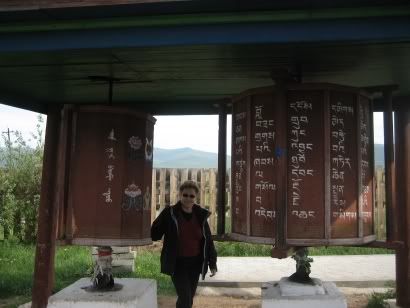
Judy, my co-worker, spinning the prayer wheel. Prayer wheels are used for (what else?) meditative prayer, and it is said that one spin of the wheel relieves you of one sin. I spun many of the wheels at the monastery – small ones lined up in a row, big ones that were so heavy they had iron handles attached for ease of spinning, drab ones and colorful ones. Hopefully I took care of a lot of sins that way. It's common to find kopeck coins left by the prayer wheels as offerings to the gods.
In fact, there were kopecks almost everywhere at the monastery, especially inside the shrines. There were other gifts left, too – most commonly bags of rice and open boxes of milk, and most amusingly a bottle of dish soap (I guess the gods have dirty dishes too).
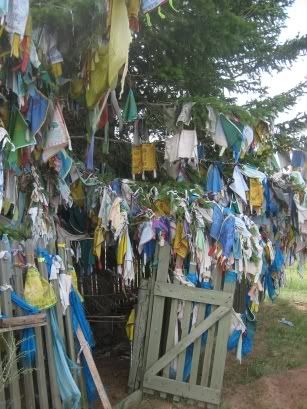
Lots and lots of the trees at the monastery had these prayer cloths tied to them. There are different colored cloths for different prayers (health, happiness, etc.). The trees outside the huts of the monks who were renowned healers had the most cloths on them.
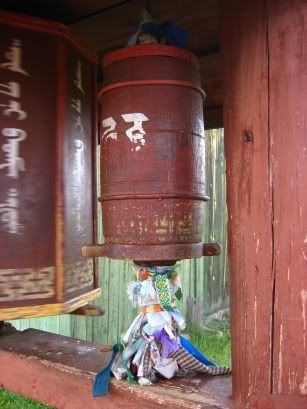
A close-up of a prayer wheel, with prayer cloths tied to it.
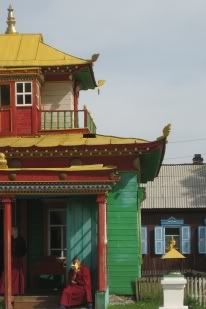
Ok, I'm ready to admit that I have a little monk/nun obsession. I blame it on that nun who yelled at me last August in Novodevichy convent. Anyway, here is a Buddhist monk doing his morning reading.
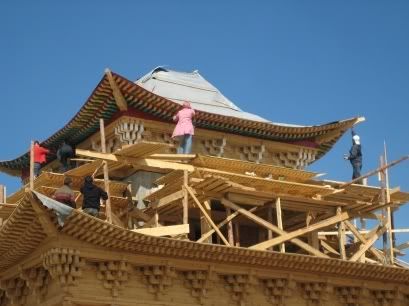
Like most religion in Russia, Buddhism is still in the comeback phase after the Fall – gaining support and money, expanding and rebuilding what was lost. Nowhere was this more evident than at the datsan, where several new buildings were going up, including structures for the new Buddhist university (yes, really). Judy (the co-worker in the first picture), who comes from a family in the construction business and has a civil engineer for a daughter, looked up at these roof painters and said, "I think OSHA would have something to say about that!"
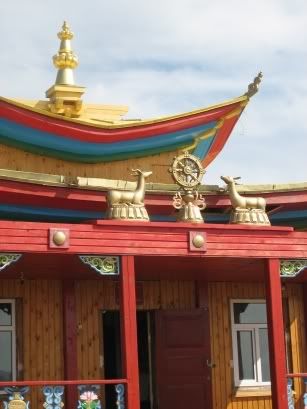
One of the many shrines on the territory of the datsan. I am a fan of Buddhist shrines because unlike Orthodox churches, I don't have to cover my hair to go in. In one of the shrines, you could pay a donation to have your name or the names of your friends read by the monks in prayer. "Everything for a price!" as Grisha, our driver/guide, said. But it seems to me that Christians do practically the same thing.
There are apparently deer on top of this shrine because the deer came flocking to Buddha after he was enlightened. There were also two holy deer in a cage outside the shrine.
Grr, I'm a tiger! I thought this thing (whatever it is) was very cute.
Close-up of the beautiful colors used in Buddhist religious art. Notice especially the frequent use of many different shades of one color close together.
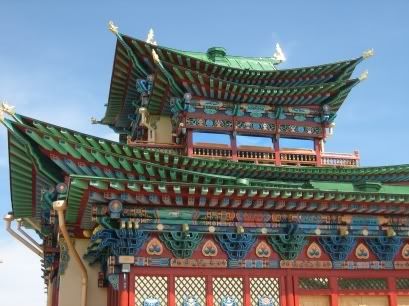
The most impressive shrine. This is where a Buddhist monk who was buried alive in the 1920's is housed. He was buried alive because he felt he had achieved nirvana and was ready to be done living, and he left instructions that he should be dug up again after a certain period of time. They did so, and found that he's still alive. Or at least that's what the Russians told us, though different people had different conceptions of what "still alive" means, from "still warm" to "not completely decayed." You can only see him on special occasions, and I didn't meet anyone who had actually seen him. Needless to say, I'm a mite skeptical.
So! That's the datsan. I highly recommend visiting it if you go to Ulan Ude. More pictures (the city itself, Baikal, maybe Irkutsk) to come later! And don't miss the post below this one, which is also new!
Judy, my co-worker, spinning the prayer wheel. Prayer wheels are used for (what else?) meditative prayer, and it is said that one spin of the wheel relieves you of one sin. I spun many of the wheels at the monastery – small ones lined up in a row, big ones that were so heavy they had iron handles attached for ease of spinning, drab ones and colorful ones. Hopefully I took care of a lot of sins that way. It's common to find kopeck coins left by the prayer wheels as offerings to the gods.
In fact, there were kopecks almost everywhere at the monastery, especially inside the shrines. There were other gifts left, too – most commonly bags of rice and open boxes of milk, and most amusingly a bottle of dish soap (I guess the gods have dirty dishes too).
Lots and lots of the trees at the monastery had these prayer cloths tied to them. There are different colored cloths for different prayers (health, happiness, etc.). The trees outside the huts of the monks who were renowned healers had the most cloths on them.
A close-up of a prayer wheel, with prayer cloths tied to it.
Ok, I'm ready to admit that I have a little monk/nun obsession. I blame it on that nun who yelled at me last August in Novodevichy convent. Anyway, here is a Buddhist monk doing his morning reading.
Like most religion in Russia, Buddhism is still in the comeback phase after the Fall – gaining support and money, expanding and rebuilding what was lost. Nowhere was this more evident than at the datsan, where several new buildings were going up, including structures for the new Buddhist university (yes, really). Judy (the co-worker in the first picture), who comes from a family in the construction business and has a civil engineer for a daughter, looked up at these roof painters and said, "I think OSHA would have something to say about that!"
One of the many shrines on the territory of the datsan. I am a fan of Buddhist shrines because unlike Orthodox churches, I don't have to cover my hair to go in. In one of the shrines, you could pay a donation to have your name or the names of your friends read by the monks in prayer. "Everything for a price!" as Grisha, our driver/guide, said. But it seems to me that Christians do practically the same thing.
There are apparently deer on top of this shrine because the deer came flocking to Buddha after he was enlightened. There were also two holy deer in a cage outside the shrine.
Grr, I'm a tiger! I thought this thing (whatever it is) was very cute.
Close-up of the beautiful colors used in Buddhist religious art. Notice especially the frequent use of many different shades of one color close together.
The most impressive shrine. This is where a Buddhist monk who was buried alive in the 1920's is housed. He was buried alive because he felt he had achieved nirvana and was ready to be done living, and he left instructions that he should be dug up again after a certain period of time. They did so, and found that he's still alive. Or at least that's what the Russians told us, though different people had different conceptions of what "still alive" means, from "still warm" to "not completely decayed." You can only see him on special occasions, and I didn't meet anyone who had actually seen him. Needless to say, I'm a mite skeptical.
So! That's the datsan. I highly recommend visiting it if you go to Ulan Ude. More pictures (the city itself, Baikal, maybe Irkutsk) to come later! And don't miss the post below this one, which is also new!
Bayarte, Ulaan Ude!
Remember how I promised to write a post before leaving Ulan Ude? Well, that didn't work out... I wrote the post, but on our last day in town, I couldn't get Blogger (the site my blog runs on) to load on the dinosaur computers in the language department. Then I really disappeared from Internet-land for a few days as I took a 3-day trip to Irkutsk and then made my long and winding way home. So here, a week late, is the promised Ulan Ude post:
Bayarte, Ulaan Ude!
Although that's probably not spelled right, it means "Goodbye, Ulan Ude!" in Buryat. Yes, I am leaving this lovely city tonight on a night train to Irkutsk, and since I promised I'd deliver an entry before I left, I got up extra early this morning (after one of those conversations that goes until 3:30 a.m. – ugh, seems like a good idea when it's 3:30 a.m., but not so much when it's 8:30 and your alarm goes off) to write one.
Well, what to say? I realize I haven't actually told you much at all about what's going on or why I'm here. So I have a lot to say, which I will cop out on and offer in list form. So, I present to you a few fascinating tidbits about Ulan Ude (Ulaan Ude in Buryat):
1. The name means "Red River." I once speculated that Ulaan might mean "city" in Mongolian languages, since there's also Ulaan Baator, the capital of Mongolia. But no. Turns out Ulaan Baator means "Red Warrior," and Ulan Ude was called Verkhneudinsk (Upper Udinsk) until the Soviets both Communistized and Buryatified the name (don't know if Ulaan Baator is also of Communist origin... seems likely). Ulan Ude is situated at the confluence of the rivers Uda and Selenga, which merge to become one of the 300+ rivers that flow into Lake Baikal. By the way, only one river, the Angara, flows out. She is said to be the daughter of father Baikal (they really call it that, Batyushka Baikal), who ran away from him to the arms of her forbidden lover, the river Yenisei in the north.
2. On the topic of rivers, Ulan Ude is on the southern bank of the Selenga, and once you leave the city, there's no bridge to cross the river to the north bank and venture up into Baikal-land. They've been building one for the last fifteen years or so (my brother mentioned something in an email about the mark of Soviet power in Iraq – numerous unfinished structures – and I have to say yes, it's true. Finishing what they started was not apparently a part of the Soviet plan). We had to cross the river by ferry when we went to Lake Baikal. (Caulking the wagons and floating was not an option.) Larisa Petrovna, our host, mentioned that the village that owns the ferry will be in big trouble when they finish building the bridge, because half of them will find themselves out of work. I suggested that the government has already found a solution: keep the bridge perpetually half-finished, and both the bridge-builders and the ferry workers win!
3. The population is about half Buryat. What's a Buryat, you ask? The Buryats are a Mongol people that have been living in the area around Baikal and northeast of the Gobi for... well, I'm not sure, but a really long time. They cooperated fairly early and peaceably with the Russians, who arrived out here in the 1600's, because the amount of fur tax the Russians demanded for the privilege of the Tsar's protection was less than the Chinese (or Genghis Khan? I forget) were demanding for the Emperor's protection. So they missed out on the mass slaughters that nearly wiped out the Sakha (formerly known as Yakut) to the east and the Chukot (maybe not spelled right) north of Kamchatka. They're traditionally a tribal, nomadic people who live in felt yurts (a round, packable-but-sturdy tent-like structure) and wander the steppe following their cattle and camel herds. They were originally shamanists, but Buddhism came from Mongolia via Tibet at some long-ago time, and now there's a sort of mix of the two religions – predominantly Buddhist, with some shamanist aspects. (Although of course the Soviets did their best to stamp out both religions.) I've seen several offices here that claim to offer "Ritual Services," which I can only assume refers to shamanism. Near the city is the largest datsan (Buddhist monastery) in Russia, of which I have some awesome pictures that I'll show you when I get home.
Anyway, since Ulan Ude is the capital of the republic of Buryatia, it might not seem surprising that the capital is half Buryat. (Brief explanation: Russia is made up of regions, districts, and several "autonomous republics," none of which seem to differ much from one another except that the leaders of the autonomous republics are called presidents instead of governors. They answer to Putin all the same (and are now all appointed by Putin – three cheers for democracy!), so it's mostly just a difference of nomenclature.) But with the exception of Tuva, to the west of Baikal, none of Russia's ostensibly ethnic autonomous republics can claim a majority ethnic population. In Buryatia, I hear the split is about 80-20 in favor of the Russians, but many more Russians than Buryats live in the villages, so the capital is full of Buryat faces. Some of them have lovely Buryat names (Altana, Darima, Arsalan, Zhargal, Oyuna, Radna); fewer of them still actually speak Buryat. For me, it's a nice change to see all these non-Russian faces and feel little to no ethnic tension – it's pretty much the opposite of the situation in Vladivostok, where there's actually more tension than non-white faces (if tension and faces could somehow be measured in the same units). However, the Russian delight in ethnic stereotyping persists, in that I've had both Russians and Buryats here tell me that the Buryats are a very lazy people because of their nomadic lifestyle; Larisa Petrovna (not Buryat) explained to us that if our students stared at us silently and without emotion, we should write it off as a peculiarity of Buryat character; and last night one of the students (Chinese-Russian) mentioned that he wouldn't want the president of Buryatia to be Buryat, because they are dishonest.
4. So what's the city like? Small, cozy, with wide streets and lots of trees. (Unfortunately, it seems that 90% of the trees are cottonwoods, which were perpetually releasing their fluff onto us for the first two weeks of our stay.) It's situated on some hills, but they aren't nearly as steep as the ones in Vladivostok. The famous head of Lenin (called something like "the noggin" in local parlance) that dominates the central square is indeed huge and comical. Just like in Vladivostok, they have a gaudy (though less gaudy) triumphal arch to celebrate Tsarevich Nikolai's visit in the 1890's, torn down in the '30's and rebuilt in the last few years. Unlike Vladivostok, they have a lot of old wooden buildings, plus a great many more of the same two or three-story 19th-century structures I liked so much there. There are no tall buildings to speak of, because the region is prone to earthquakes, and there's a lovely pedestrian street (kind of a fixture of Russian cities) where the young'uns hang out in the evening. There's a surprisingly professional-looking historical museum, which we went to yesterday to see old Buddhist stuff and Old Believer costumes, and in addition to the Buddhist temple, there's an open-air ethnographic museum not far from the city, which is full of authentic old buildings (mostly from the 18th and 19th century) that were relocated there in the '70's. There are also pozy – Buryat steamed meat dumplings – EVERYWHERE. More than a national cuisine, I'd call it a national obsession. They even have cafés called "poznayas" – "pozy joint," I suppose, in English. The first question people ask me is often, "Have you tried pozy yet?!" (Yes, three times.) Very cute.
So all in all, it's a lovely city. I can already feel that it's somehow more civilized, by which I guess I mean more Western (as opposed to Soviet, not as opposed to Eastern) than Vladivostok. Which is funny, because while I was there I tried hard not to buy into all the "edge of the world" talk about the Russian Far East. But it seems that it is actually less developed than the rest of Russia. Hmm.
5. This will be the last thing because I need to get dressed and go to camp, but considering the length of this entry, maybe you're satisfied anyway: last weekend ranks among the best days of my life. I went walking alone in the forest, enjoyed a banya experience that involved jumping into a lake during a gale to cool off, went on a mountain hike that was too steep and had no trail and got lost in the forest on the way down and returned for lunch an hour late, and stayed out until 1 a.m. standing on the dock and looking at the stars. All in all, good Siberian fun. I decided then that if my life somehow goes badly in the U.S. (when I eventually move back to the U.S., that is), I will pack up and move to Buryatia.
Bayarte, Ulaan Ude!
Although that's probably not spelled right, it means "Goodbye, Ulan Ude!" in Buryat. Yes, I am leaving this lovely city tonight on a night train to Irkutsk, and since I promised I'd deliver an entry before I left, I got up extra early this morning (after one of those conversations that goes until 3:30 a.m. – ugh, seems like a good idea when it's 3:30 a.m., but not so much when it's 8:30 and your alarm goes off) to write one.
Well, what to say? I realize I haven't actually told you much at all about what's going on or why I'm here. So I have a lot to say, which I will cop out on and offer in list form. So, I present to you a few fascinating tidbits about Ulan Ude (Ulaan Ude in Buryat):
1. The name means "Red River." I once speculated that Ulaan might mean "city" in Mongolian languages, since there's also Ulaan Baator, the capital of Mongolia. But no. Turns out Ulaan Baator means "Red Warrior," and Ulan Ude was called Verkhneudinsk (Upper Udinsk) until the Soviets both Communistized and Buryatified the name (don't know if Ulaan Baator is also of Communist origin... seems likely). Ulan Ude is situated at the confluence of the rivers Uda and Selenga, which merge to become one of the 300+ rivers that flow into Lake Baikal. By the way, only one river, the Angara, flows out. She is said to be the daughter of father Baikal (they really call it that, Batyushka Baikal), who ran away from him to the arms of her forbidden lover, the river Yenisei in the north.
2. On the topic of rivers, Ulan Ude is on the southern bank of the Selenga, and once you leave the city, there's no bridge to cross the river to the north bank and venture up into Baikal-land. They've been building one for the last fifteen years or so (my brother mentioned something in an email about the mark of Soviet power in Iraq – numerous unfinished structures – and I have to say yes, it's true. Finishing what they started was not apparently a part of the Soviet plan). We had to cross the river by ferry when we went to Lake Baikal. (Caulking the wagons and floating was not an option.) Larisa Petrovna, our host, mentioned that the village that owns the ferry will be in big trouble when they finish building the bridge, because half of them will find themselves out of work. I suggested that the government has already found a solution: keep the bridge perpetually half-finished, and both the bridge-builders and the ferry workers win!
3. The population is about half Buryat. What's a Buryat, you ask? The Buryats are a Mongol people that have been living in the area around Baikal and northeast of the Gobi for... well, I'm not sure, but a really long time. They cooperated fairly early and peaceably with the Russians, who arrived out here in the 1600's, because the amount of fur tax the Russians demanded for the privilege of the Tsar's protection was less than the Chinese (or Genghis Khan? I forget) were demanding for the Emperor's protection. So they missed out on the mass slaughters that nearly wiped out the Sakha (formerly known as Yakut) to the east and the Chukot (maybe not spelled right) north of Kamchatka. They're traditionally a tribal, nomadic people who live in felt yurts (a round, packable-but-sturdy tent-like structure) and wander the steppe following their cattle and camel herds. They were originally shamanists, but Buddhism came from Mongolia via Tibet at some long-ago time, and now there's a sort of mix of the two religions – predominantly Buddhist, with some shamanist aspects. (Although of course the Soviets did their best to stamp out both religions.) I've seen several offices here that claim to offer "Ritual Services," which I can only assume refers to shamanism. Near the city is the largest datsan (Buddhist monastery) in Russia, of which I have some awesome pictures that I'll show you when I get home.
Anyway, since Ulan Ude is the capital of the republic of Buryatia, it might not seem surprising that the capital is half Buryat. (Brief explanation: Russia is made up of regions, districts, and several "autonomous republics," none of which seem to differ much from one another except that the leaders of the autonomous republics are called presidents instead of governors. They answer to Putin all the same (and are now all appointed by Putin – three cheers for democracy!), so it's mostly just a difference of nomenclature.) But with the exception of Tuva, to the west of Baikal, none of Russia's ostensibly ethnic autonomous republics can claim a majority ethnic population. In Buryatia, I hear the split is about 80-20 in favor of the Russians, but many more Russians than Buryats live in the villages, so the capital is full of Buryat faces. Some of them have lovely Buryat names (Altana, Darima, Arsalan, Zhargal, Oyuna, Radna); fewer of them still actually speak Buryat. For me, it's a nice change to see all these non-Russian faces and feel little to no ethnic tension – it's pretty much the opposite of the situation in Vladivostok, where there's actually more tension than non-white faces (if tension and faces could somehow be measured in the same units). However, the Russian delight in ethnic stereotyping persists, in that I've had both Russians and Buryats here tell me that the Buryats are a very lazy people because of their nomadic lifestyle; Larisa Petrovna (not Buryat) explained to us that if our students stared at us silently and without emotion, we should write it off as a peculiarity of Buryat character; and last night one of the students (Chinese-Russian) mentioned that he wouldn't want the president of Buryatia to be Buryat, because they are dishonest.
4. So what's the city like? Small, cozy, with wide streets and lots of trees. (Unfortunately, it seems that 90% of the trees are cottonwoods, which were perpetually releasing their fluff onto us for the first two weeks of our stay.) It's situated on some hills, but they aren't nearly as steep as the ones in Vladivostok. The famous head of Lenin (called something like "the noggin" in local parlance) that dominates the central square is indeed huge and comical. Just like in Vladivostok, they have a gaudy (though less gaudy) triumphal arch to celebrate Tsarevich Nikolai's visit in the 1890's, torn down in the '30's and rebuilt in the last few years. Unlike Vladivostok, they have a lot of old wooden buildings, plus a great many more of the same two or three-story 19th-century structures I liked so much there. There are no tall buildings to speak of, because the region is prone to earthquakes, and there's a lovely pedestrian street (kind of a fixture of Russian cities) where the young'uns hang out in the evening. There's a surprisingly professional-looking historical museum, which we went to yesterday to see old Buddhist stuff and Old Believer costumes, and in addition to the Buddhist temple, there's an open-air ethnographic museum not far from the city, which is full of authentic old buildings (mostly from the 18th and 19th century) that were relocated there in the '70's. There are also pozy – Buryat steamed meat dumplings – EVERYWHERE. More than a national cuisine, I'd call it a national obsession. They even have cafés called "poznayas" – "pozy joint," I suppose, in English. The first question people ask me is often, "Have you tried pozy yet?!" (Yes, three times.) Very cute.
So all in all, it's a lovely city. I can already feel that it's somehow more civilized, by which I guess I mean more Western (as opposed to Soviet, not as opposed to Eastern) than Vladivostok. Which is funny, because while I was there I tried hard not to buy into all the "edge of the world" talk about the Russian Far East. But it seems that it is actually less developed than the rest of Russia. Hmm.
5. This will be the last thing because I need to get dressed and go to camp, but considering the length of this entry, maybe you're satisfied anyway: last weekend ranks among the best days of my life. I went walking alone in the forest, enjoyed a banya experience that involved jumping into a lake during a gale to cool off, went on a mountain hike that was too steep and had no trail and got lost in the forest on the way down and returned for lunch an hour late, and stayed out until 1 a.m. standing on the dock and looking at the stars. All in all, good Siberian fun. I decided then that if my life somehow goes badly in the U.S. (when I eventually move back to the U.S., that is), I will pack up and move to Buryatia.
Subscribe to:
Posts (Atom)
